
Water Damage Under Slab Frisco TX: 10 Warning Signs, Hidden Risks & How Professionals Fix It
Updated: June 2026 | 10-min read | 24/7 Emergency: (945) 297-3238
Water damage under a slab foundation is the kind of problem that starts silently and ends expensively. There is no flooding to step in, no ceiling stain to notice, no obvious sign that hundreds of gallons of water have been escaping from a broken pipe beneath your Frisco TX home’s concrete foundation, possibly for weeks. By the time most homeowners realize something is wrong, the flooring is saturated, mold has taken hold in the wall base plates, and what could have been a $3,000 cleanup has grown into a $15,000 restoration.
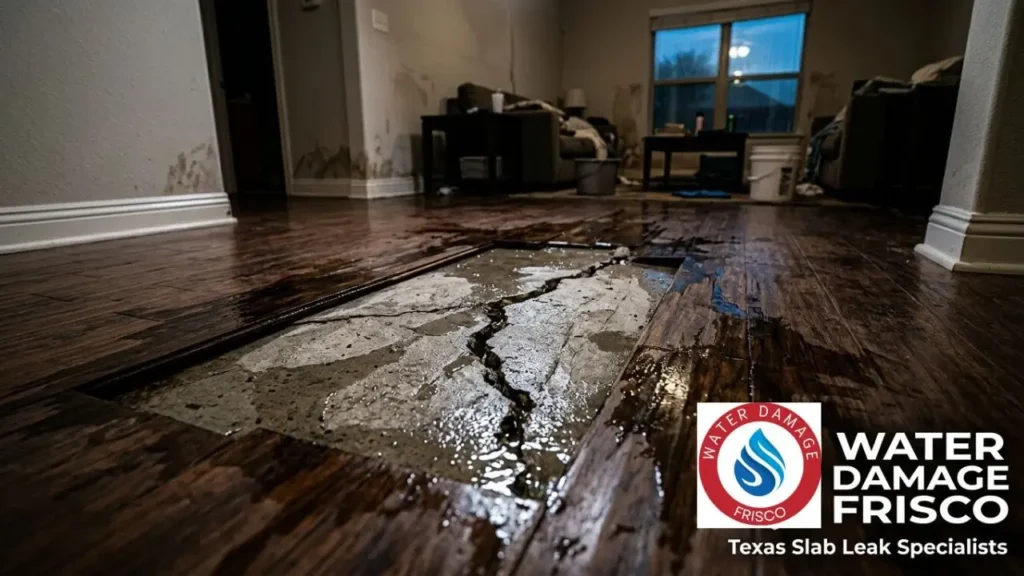
This guide is written for Frisco TX homeowners who want to catch under-slab water damage early, understand exactly what professional restoration involves, and know what their insurance should cover. If you already suspect an active slab leak, call (945) 297-3238 now, Water Damage Frisco dispatches 24/7 and targets a 60-minute arrival anywhere in Collin County.
In This Guide
- Why Frisco TX has more slab leaks than most U.S. cities
- 10 warning signs of water damage under your slab
- The 5-minute DIY leak test
- 4 hidden dangers that worsen every hour
- How professionals detect under-slab leaks without breaking your floor
- The complete restoration process — step by step
- What it costs and what insurance covers
- Frequently asked questions
Why Frisco TX Has More Under-Slab Water Damage Than Most U.S. Cities
Ask any water damage restoration professional who has worked across multiple states and they will tell you the same thing: North Texas, and Frisco specifically, is one of the most slab-leak-prone regions in the country. It is not bad luck. It is geology, climate, and construction history all working against residential plumbing at the same time.
Need help right now? See our full guide to water damage restoration in Frisco, TX for emergency response, services, and coverage across the city.
Blackland Prairie Clay Soil: The Root Cause
Frisco TX sits on Blackland Prairie clay, one of the most expansive soil types in North America. This clay absorbs water during wet periods and swells dramatically, then dries and shrinks during Frisco’s long hot summers. The U.S. Geological Survey Texas Water Science Center identifies North Texas clay soils as experiencing volume changes of up to 30% between wet and dry cycles. Every cycle of that movement flexes the concrete slab above it, and the pipes running through or beneath that slab flex with it.
Over five, ten, or fifteen years, that constant micro-movement creates fatigue cracks in pipe material and joint connections. The failure does not happen suddenly, it accumulates until a threshold is crossed and the pipe gives way.
An Aging Pipe Material Crisis
A large portion of Frisco’s residential housing was built between 1988 and 2008, a period when polybutylene and copper piping were standard. Both materials are now at or past their expected service life under Frisco’s soil conditions.
Polybutylene reacts with chlorine in Frisco’s municipal water and becomes increasingly brittle over time. The U.S. Department of Housing and Urban Development (HUD) documented widespread polybutylene failures in homes built during this era, many of which are still in service in Frisco neighborhoods today. When polybutylene pipe beneath a slab finally fails, water has only one direction to travel: upward through the concrete and into your home.
High Water Pressure and Temperature Extremes
Frisco’s municipal water system delivers pressure that can exceed 80 PSI in some neighborhoods, above the recommended maximum of 60–80 PSI for residential systems. High pressure accelerates wear on pipe joints, particularly joints already weakened by soil movement.
Compound that with temperature extremes, summer heat regularly above 105°F that dries and contracts the soil aggressively, and periodic winter freezes that thermally shock pipes, and you have a system that is under constant, multi-directional stress.
10 Warning Signs of Water Damage Under Your Slab in Frisco TX
Under-slab leaks rarely produce dramatic, unmistakable evidence. They leave clues,and the homeowners who catch slab leaks early are the ones who know what those clues look like. Here are the ten signs our teams encounter most often in Frisco TX homes:
1. A Sudden, Unexplained Spike in Your Water Bill
This is almost always the first sign, and the most commonly overlooked. A slab leak losing just one gallon per minute wastes 1,440 gallons per day, roughly 43,000 gallons per month. Your water bill will reflect this sharply. If your bill has jumped by $40 or more with no change in household usage or season, treat it as an active leak until proven otherwise. According to the U.S. Environmental Protection Agency (EPA), 10% of U.S. homes have leaks wasting 90 or more gallons daily, and slab leaks are among the most significant contributors.
2. Warm or Hot Patches on Your Floor
Walk your floors barefoot, especially tile and hardwood, which conduct temperature well. A localized warm patch, particularly in a kitchen or bathroom where hot water lines run under the slab, is one of the most specific and reliable indicators of a hot water line failure below. The warm water heats the concrete from below, and you feel it through the floor surface above. This sign alone warrants an immediate professional assessment.
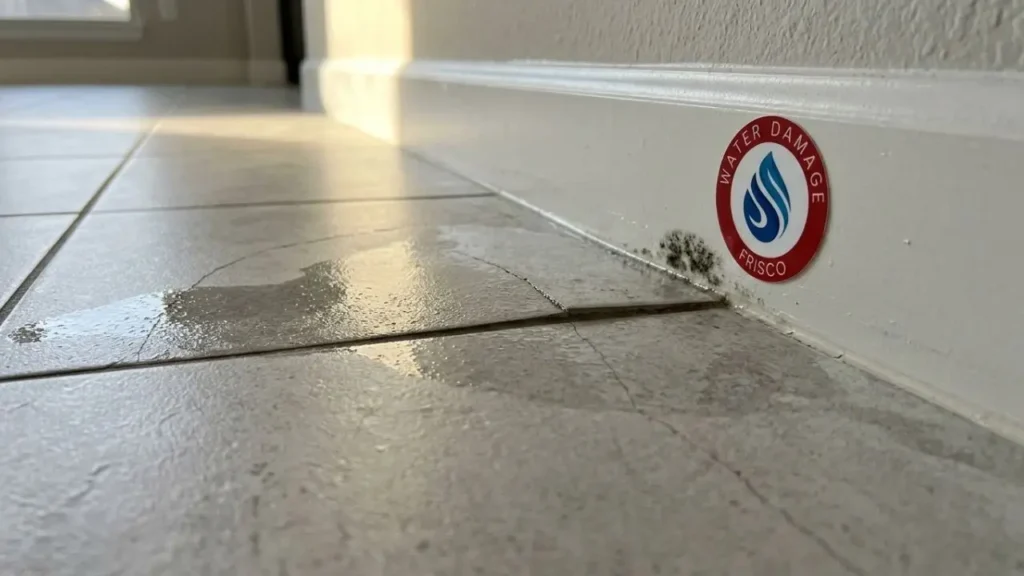
3. Damp, Soft, or Buckled Flooring
Moisture migrating upward through the concrete slab saturates flooring materials from below, the opposite direction from what most water damage produces. Carpet that is damp with no overhead source, hardwood planks that have cupped or developed gaps between boards, tile that sounds hollow or has cracked grout lines, and laminate that has begun to swell at the seams are all classic presentations of prolonged under-slab moisture. Read our guide on water damage categories to understand how moisture quality degrades over time and why acting quickly matters.
4. Sound of Running Water With All Fixtures Off
Turn off every faucet, appliance, and fixture, including the ice maker and irrigation. Stand in the center of the home and listen. A hissing, trickling, or rushing sound with nothing running is water escaping from a pressurized pipe somewhere in the system. Under the slab is one of the most common locations for this type of active leak. The sound may be louder in rooms directly above the pipe route, often bathrooms and kitchens.
5. New Cracks in Walls, Flooring, or Tile Grout
Water escaping under the slab erodes and displaces the supporting soil. As soil migrates away from beneath the foundation, the concrete slab loses support in localized areas and begins to deflect. This deflection produces characteristic cracks, diagonal lines at door and window corners, stepped cracks in brick veneer on exterior walls, tile grout lines that crack and open, and doors or windows that suddenly stick or no longer close squarely. These structural symptoms set under-slab damage apart from other water damage types and make early detection critically important.
6. Mold or Mildew Odor at Floor Level
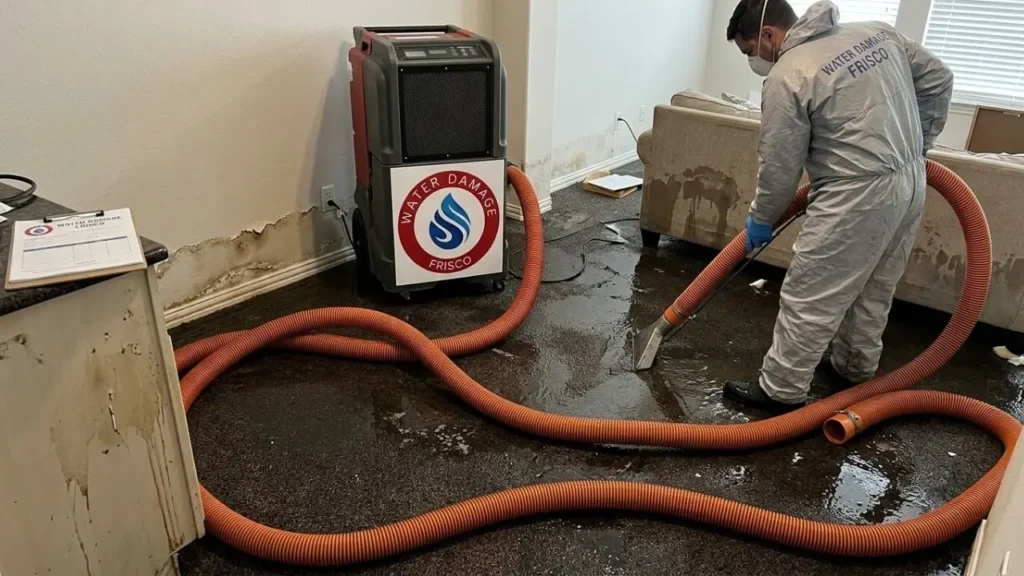
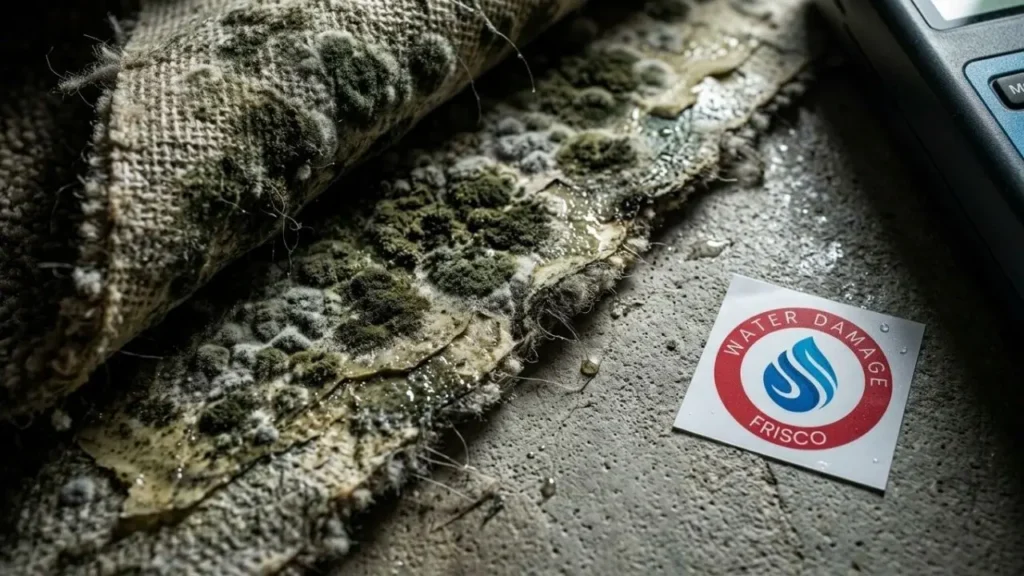
A persistent musty or earthy smell that seems to rise from the floor, especially in rooms without visible moisture, means mold is already growing in materials you cannot see: flooring adhesive, carpet backing, the bottom plate of wall framing, or baseboard wood. By the time a mold odor is detectable, the colony has been established for at least 48 to 72 hours. See our full article on mold growth after water damage in Frisco TX for what each stage looks like and what remediation involves.
7. Visibly Wet Baseboards or Discoloration at the Floor-Wall Junction
Water wicking upward through the slab travels into wall assemblies from the bottom up. Dark discoloration, paint bubbling, baseboard separation from the wall, or drywall that feels soft at floor level, all appearing without any overhead water source, are strong visual indicators of under-slab moisture intrusion reaching wall materials.
8. Low Water Pressure Throughout the Home
A significant under-slab leak bleeds pressure from the supply system continuously. If water pressure has dropped noticeably at multiple fixtures simultaneously, and the reduction is not explained by municipal service issues, a supply line failure below the slab is a likely cause. Pressure loss is most noticeable when multiple fixtures are running at once.
9. Water Pooling Around the Foundation Exterior
Under-slab water that cannot escape upward through the slab may travel laterally and surface at the foundation perimeter. Unexplained wet soil or pooling water along the exterior foundation line during dry weather, particularly on the hot water heater or kitchen side of the home, warrants investigation for an under-slab supply line failure.
10. Your Water Meter Moves With Everything Off
The definitive confirmation. Turn off every water-using device in the home, then observe the water meter for 15 minutes without using anything. Any movement in the meter dial, even slight, confirms an active leak somewhere in the system. This test, combined with any of the signs above, is sufficient justification to call a professional immediately.
The 5-Minute DIY Test: How to Check for a Slab Leak Right Now
You do not need any equipment to perform this test, just 15 minutes and access to your water meter.
- Turn off every water-using fixture and appliance. Faucets, ice maker, dishwasher, washing machine, irrigation, and any running toilets. A single running toilet will invalidate the test.
- Find your water meter. It is typically in a ground-level box near the street or at the property boundary. Lift the cover and locate the sweep dial or digital display.
- Write down the exact reading. Note the position of the sweep dial and the meter numbers.
- Wait 15 minutes without using any water.
- Re-read the meter. If anything has moved, you have an active leak. Call (945) 297-3238 immediately for professional detection.
This test confirms a leak is active but cannot tell you where it is located. Locating an under-slab leak requires professional thermal imaging and acoustic detection equipment.
4 Hidden Dangers of Under-Slab Water Damage That Worsen Every Hour
The concrete slab does not stop the damage, it hides it. Here is what is happening beneath the surface while an undetected slab leak runs:
1. Mold Colonizing Unreachable Spaces
Under-slab moisture saturates flooring adhesive, carpet backing, and the bottom plates of wall framing, organic materials in locations that are difficult to inspect and impossible to dry with consumer equipment. The EPA recommends beginning mold remediation within 24 to 48 hours of water exposure. When the source of moisture is an active leak that has been running for days or weeks, mold establishment in these hidden materials is nearly certain by the time the leak is discovered. Our certified mold remediation service in Frisco TX addresses all affected materials, not just visible surface growth.
2. Foundation Soil Erosion
An active slab leak does not simply wet the soil, it carries fine soil particles away with the flowing water, creating voids beneath the slab in areas that were previously solid bearing ground. The Federal Emergency Management Agency (FEMA) identifies soil erosion beneath foundations as a compounding structural risk. As bearing soil is eroded, the slab loses support in localized areas, begins to deflect, and eventually cracks, taking the flooring, tile, and drywall above with it. This progression from a plumbing problem to a structural one is what makes slab leaks potentially the most expensive type of water damage a homeowner can face.
3. Water Contamination Escalation
A freshly burst supply pipe produces clean Category 1 water. But water that sits in soil, passes through concrete, and contacts organic flooring materials degrades rapidly. Within 24 to 48 hours, Category 1 water becomes Category 2, carrying bacteria, soil contaminants, and chemical compounds from adhesives and flooring materials. Extended exposure produces Category 3 conditions requiring full protective protocols and complete material disposal. Understanding water damage categories in Frisco TX is essential for understanding why speed of response directly affects both health risk and restoration cost. The longer you wait, the more contaminated the water, and the more materials must be discarded rather than dried and saved.
4. Electrical Hazards at Floor Level
Water migrating upward through the slab reaches electrical outlet boxes, kitchen appliance connections, dishwasher and refrigerator lines, and HVAC equipment that sits at floor level. Moisture in these locations creates shock hazards and fire risks that persist long after the surface appears dry. Never assume a floor is electrically safe when under-slab moisture is suspected until a qualified electrician has confirmed the circuits are clear. The U.S. Occupational Safety and Health Administration (OSHA) identifies electrical hazards in water-damaged structures as a leading cause of serious injury during restoration events.
For a complete picture of what prolonged moisture exposure does to your home’s air quality and structural integrity, read our detailed guide on stagnant water dangers and health risks in Frisco TX.
How Water Damage Frisco Detects Under-Slab Leaks Without Destroying Your Floor
The biggest fear most Frisco TX homeowners have about slab leak diagnosis is that finding the leak will require jackhammering through the floor. That was true a generation ago. Today, professional leak detection locates under-slab failures within inches of accuracy using non-invasive technology, before a single tile is touched.
Thermal Imaging Cameras
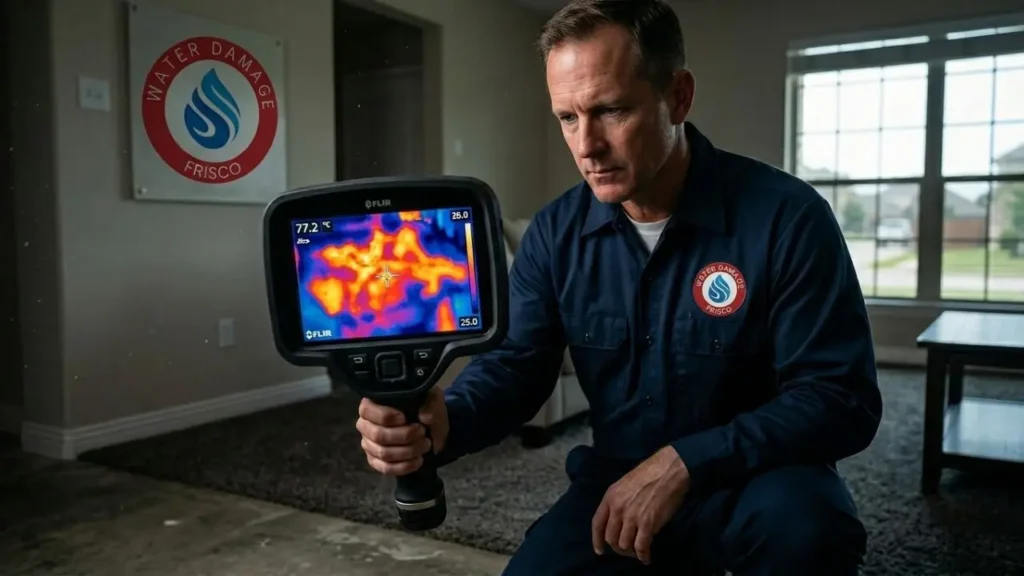
Infrared thermal cameras detect temperature differentials on floor surfaces created by moisture migrating from below. A hot water line failure beneath the slab appears on the thermal image as a warm zone radiating outward from the leak point, visible through tile, carpet, and hardwood. Cold water line failures produce cool zones in the same pattern. Thermal imaging gives us the general leak location in minutes, from above the floor.
Electronic Acoustic Leak Detection
Electronic acoustic sensors placed against the floor surface amplify the sound of water escaping a pressurized pipe. The signal is strongest directly above the leak and diminishes as the sensor moves away. By systematically scanning the floor surface, our technicians triangulate the exact leak location, typically within 2 to 4 inches. This precision means the smallest possible concrete opening for pipe repair access, minimizing reconstruction cost and disruption.
Professional Moisture Mapping
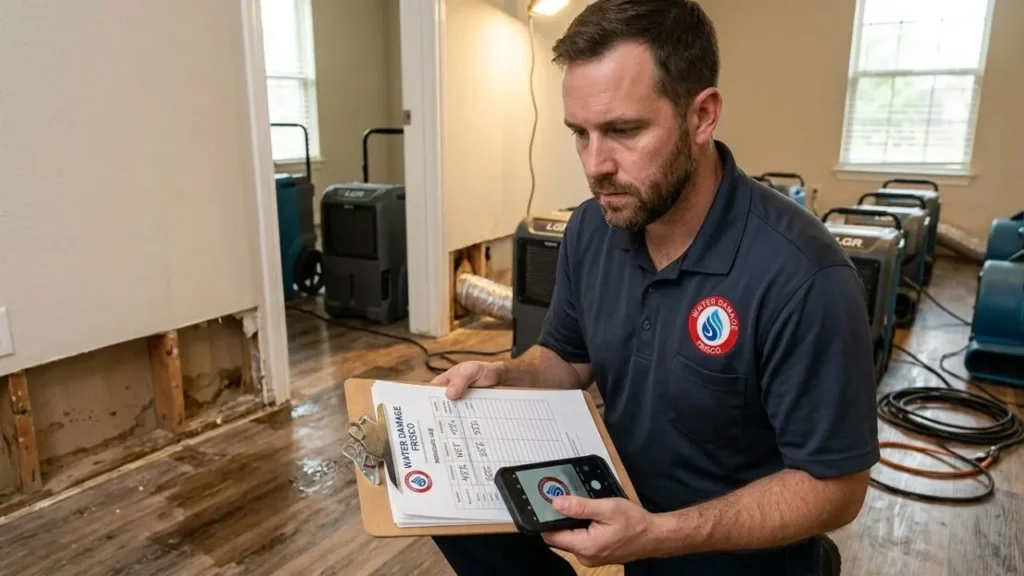
After leak location, calibrated moisture meters are used to map the full extent of moisture migration throughout the property. Under-slab water does not stay directly under the leak, it migrates laterally through soil, wicks upward through concrete in multiple areas, and travels horizontally under flooring materials. Complete moisture mapping identifies every affected zone, ensuring that restoration dries the entire affected area rather than just the visible wet spots. This map also becomes a core component of your insurance documentation.
The Complete Under-Slab Water Damage Restoration Process in Frisco TX
Our water damage restoration process follows IICRC S500 standards, the industry’s governing protocol for professional water damage restoration. Here is what happens from the moment our team arrives at your Frisco TX home:
Stage 1: Emergency Arrival | Safety First, Equipment Ready
Our crew arrives with thermal cameras, acoustic detectors, industrial extraction equipment, commercial drying systems, and moisture meters loaded on the truck. Before touching any water, we assess structural safety and electrical hazards. We document every affected area photographically from arrival, this pre-mitigation record is required for your insurance claim and we create it as standard practice on every job.
Stage 2: Leak Pinpointing and Plumber Coordination
Using thermal imaging and acoustic detection, we locate the leak and coordinate with a licensed Frisco TX plumber for pipe repair. Water Damage Frisco handles the water damage restoration. The plumber addresses the broken pipe. We either work with your preferred plumber or connect you with licensed contractors we partner with regularly across Collin County.
Stage 3: Water Extraction
With the pipe repaired and the water source eliminated, our professional water extraction team removes all standing water and saturated surface moisture using truck-mounted and portable extraction units. Slab leak events commonly saturate carpet and pad, flooring adhesive layers, and the lower sections of drywall, all of which require extraction before structural drying can begin.
Stage 4: Controlled Demolition of Unsalvageable Materials
Flooring materials saturated from below, carpet, pad, laminate, engineered hardwood, and flooring adhesive, cannot be dried in place and must be removed. We perform targeted demolition, taking only what cannot be saved, and document every removed material for the insurance claim with photographs and item descriptions. Concrete repair, if required, is coordinated with a licensed concrete contractor.
Stage 5: Structural Drying | The Critical Phase
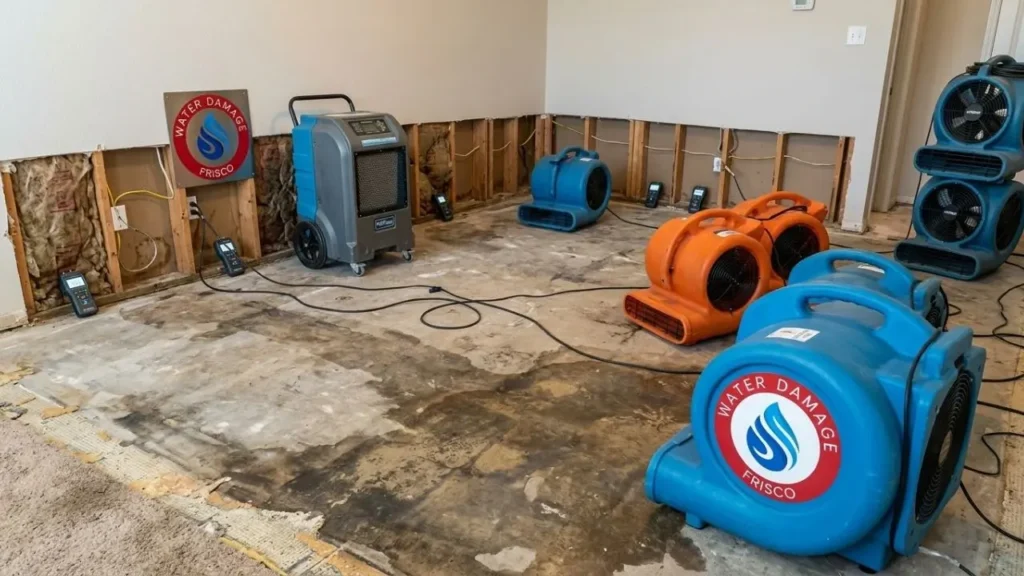
Industrial air movers and commercial dehumidifiers are deployed in a configuration calculated for the specific room dimensions, materials, and initial moisture readings. Under-slab events require extended drying cycles because moisture has penetrated concrete, a material that releases moisture slowly. We perform daily moisture readings and do not remove equipment until all readings return to pre-loss baseline levels. This typically takes 5 to 10 days for under-slab events. Cutting drying short is how hidden moisture leads to mold problems weeks after restoration is supposedly complete. We do not cut it short. Read our guide on how long water damage restoration takes for the full timeline breakdown.
Stage 6: Mold Prevention and Antimicrobial Treatment
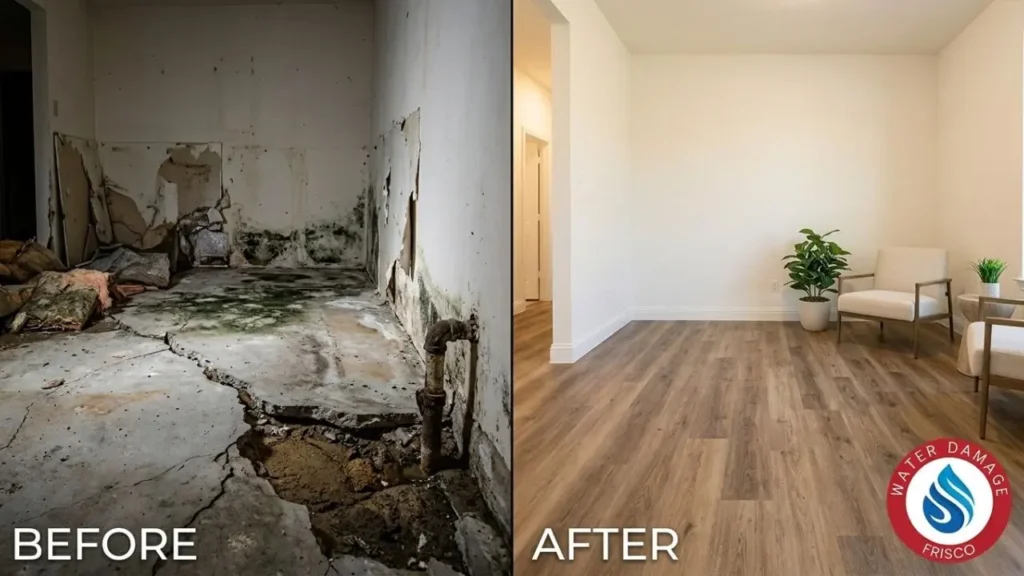
All exposed structural surfaces, concrete, framing, wall cavity faces, receive EPA-registered antimicrobial treatment before any reconstruction begins. If mold is already present, our certified mold remediation team performs full containment, removal, air scrubbing with HEPA filtration, and clearance testing before the space is closed up again.
Stage 7: Complete Reconstruction
Once drying is verified and the environment is clean, our water damage repair team handles all reconstruction: new flooring installation, drywall replacement and finishing, baseboard reinstallation, painting, and any required structural repairs. We restore your property to pre-loss condition from a single call. You do not coordinate between multiple contractors, we manage the entire process from day one to final walkthrough.
Stage 8: Insurance Documentation and Claim Management
We deliver a complete claim package, thermal images, moisture logs, daily readings, photographs, scope of work, and itemized replacement values, formatted to your carrier’s specifications. Slab leak claims are among the most complex residential insurance events because the coverage boundary between pipe repair and resulting water damage is frequently misunderstood by both homeowners and adjusters. Our full guide on water damage insurance claims in Texas explains exactly what you are entitled to claim and how to document it correctly.
Under-Slab Water Damage Restoration Cost in Frisco TX | 2026 Pricing Guide
Restoration costs for under-slab water damage in Frisco TX are driven by three variables: how long the leak has been running, how far moisture has migrated into building materials, and whether mold remediation is required. Here is a realistic breakdown:
| Damage Level | Typical Scenario | Extraction & Drying | Full Restoration |
|---|---|---|---|
| Minor | Detected early, 1 room, carpet replacement only | $1,200 – $2,500 | $2,500 – $6,000 |
| Moderate | 2–3 rooms, flooring + drywall replacement | $2,500 – $5,500 | $6,000 – $14,000 |
| Severe | Mold present, multiple rooms, structural damage | $5,500 – $9,000 | $14,000 – $30,000+ |
What Texas Homeowners Insurance Covers for Slab Leaks
Typically covered: All resulting water damage, flooring, drywall, insulation, baseboards, cabinetry, personal property, caused by a sudden and accidental slab leak. Many Frisco TX homeowners also have “service line” or “underground pipe” endorsements that cover the concrete work and pipe repair itself.
Typically NOT covered: Gradual leaks that were knowable and left unaddressed. Pipe repair costs under a basic policy without service line coverage. Mold damage that resulted from delayed action after discovery.
The most important insurance fact: How the event is documented on day one determines what is and is not covered. Water Damage Frisco creates insurance-formatted documentation from the moment we arrive, thermal images, moisture readings, photos, and timeline records, that protects your claim from the start. For a complete breakdown, read our guide on water damage insurance claims in Texas. For full 2026 Frisco TX pricing data, see our water damage restoration cost guide.
Slab Leak Water Damage Service Areas | Frisco TX and Collin County
Water Damage Frisco provides 24/7 under-slab water damage restoration throughout Collin County and the greater DFW area:
- Frisco, TX, Fastest response, primary service area
- McKinney, TX
- Plano, TX
- Allen, TX
- Prosper, TX
- Celina, TX
- Little Elm, TX
- The Colony, TX
- Carrollton, TX
- Dallas, TX
Why Frisco TX Homeowners Choose Water Damage Frisco for Slab Leak Cleanup
- ✅ IICRC-Certified to S500 Standard — Our technicians are certified to the industry’s governing protocol for water damage restoration. Certification means our methods are scientifically validated, not improvised.
- ✅ Non-Invasive Leak Detection First — We locate the leak with thermal imaging and acoustic equipment before anything is opened. Targeted access means minimal disruption and lower concrete repair costs.
- ✅ 24/7 Dispatch, 60-Minute Response — We answer every call around the clock and target a 60-minute arrival anywhere in Frisco TX and Collin County.
- ✅ Full-Service — One Call — From first response through final flooring installation, one company manages the entire event. No coordination between multiple contractors, no timeline gaps, no responsibility ambiguity.
- ✅ Insurance Documentation Built In — Thermal images, daily moisture logs, and carrier-formatted reports are created as standard practice. Your claim is supported from the moment we arrive.
- ✅ 10+ Years Restoring Frisco TX Homes — We understand Frisco’s specific soil conditions, pipe material history, and municipal water characteristics. That local knowledge informs every job we do. See all our restoration services in Frisco TX.
Frequently Asked Questions | Water Damage Under Slab Frisco TX
What are the first signs of water damage under a slab in Frisco TX?
The earliest and most reliable indicators are a sudden spike in your water bill, warm or damp spots on your floor, the sound of running water with all fixtures off, and new cracks appearing in walls or tile grout. Because Frisco sits on expansive Blackland Prairie clay, foundation movement from under-slab leaks tends to produce wall cracks faster here than in other regions.
How long can an under-slab leak go undetected?
Commonly 2 to 8 weeks. Because the concrete slab masks surface evidence, many Frisco TX homeowners only discover the problem from a high water bill or visibly damaged flooring, by which point mold is typically already present in flooring adhesive and wall base plates. The earlier it is caught, the lower the total restoration cost.
Can Water Damage Frisco find the leak without breaking my floor?
Yes. We use thermal imaging cameras and electronic acoustic detection to pinpoint the leak location within inches before anything is opened. This technology eliminates exploratory demolition entirely, the concrete is accessed only at the confirmed leak point.
Does Texas homeowners insurance cover under-slab water damage?
Most standard Texas policies cover the resulting water damage from a sudden slab leak, flooring, drywall, insulation, and personal property. Pipe repair costs may be covered under service line endorsements. Gradual leaks are typically excluded. See our complete guide on water damage insurance claims in Texas.
How much does slab leak water damage restoration cost in Frisco TX?
Minor events detected early cost $2,500–$6,000 for full restoration. Moderate damage across 2–3 rooms ranges from $6,000–$14,000. Severe events with mold and structural damage can reach $30,000. Most costs are covered by homeowners insurance. See our 2026 Frisco TX cost guide.
How quickly does mold grow after an under-slab leak?
Within 24 to 48 hours in the organic materials at the slab line, flooring adhesive, carpet backing, wall bottom plates. Frisco’s warm climate accelerates mold growth in summer months. An under-slab leak that has been active for more than 48 hours almost certainly has mold present in materials at floor level, even if none is visible from above. Read our guide on mold growth after water damage in Frisco TX.
How long does under-slab restoration take?
Emergency extraction happens on day one. Structural drying for under-slab events takes 5 to 10 days because concrete releases moisture slowly. Reconstruction, new flooring, drywall, baseboards, paint,adds 1 to 3 weeks depending on scope. For the full breakdown by damage class, see our guide on how long water damage restoration takes.
Stop the Damage Now | Call Water Damage Frisco 24/7
Under-slab water damage does not pause while you decide what to do. Every hour an active slab leak runs, more flooring saturates, more soil erodes, more mold establishes, and more of a manageable cleanup becomes a major restoration. The decision to call early is also the decision to pay less and recover faster.
Call (945) 297-3238 right now for 24/7 emergency slab leak detection and water damage restoration anywhere in Frisco TX and Collin County. You can also reach us at info@waterdamagefrisco.org or visit our contact page for a free on-site assessment.
5000 Preston Rd, Suite 200, Frisco, TX 75034
📞 (945) 297-3238
📧 info@waterdamagefrisco.org
🌐 waterdamagefrisco.org
🕐 Free Estimates , 24/7 , 365 Days a Year