
Frisco TX Water Damage Guide
No Basement to Check? Here’s Where Hidden Water Damage Signs no Basement Frisco TX Actually Shows Up
Basement checklists don’t work for a slab-on-grade home. Here’s where hidden water damage actually surfaces in a Frisco, TX house — and what each sign really means.
24-48 hrs
Mold can begin colonizing after moisture exposure
Most Frisco Homes
Are slab-on-grade with under-slab plumbing
60-Min
Response guarantee across Frisco and DFW
You Can’t Walk Down to the Basement and Check — So Where Do You Actually Look?
A lot of water damage advice starts with “go check your basement.” That instruction is useless if your home doesn’t have one, which describes most houses in Frisco and across North Texas. Water damage doesn’t skip slab-on-grade homes just because there’s no below-grade space for it to pool in — it just shows up in different places, and a lot of homeowners don’t know where those places are because every checklist they’ve read assumes a basement exists.
Here’s where hidden water damage actually surfaces in a North Texas slab home, and what each sign is actually telling you.
Staining at the Base of Walls — Not From a Leak Above, But From Below
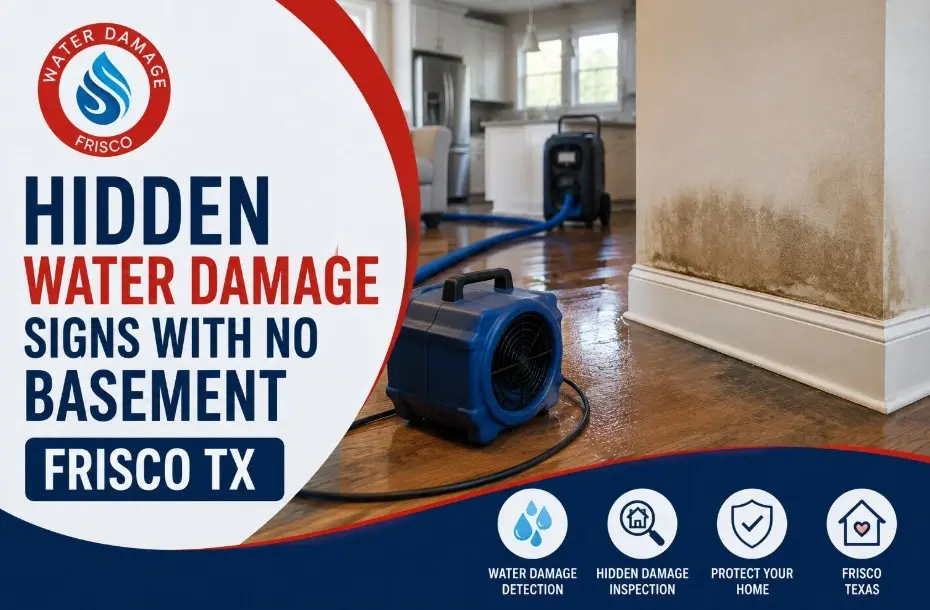
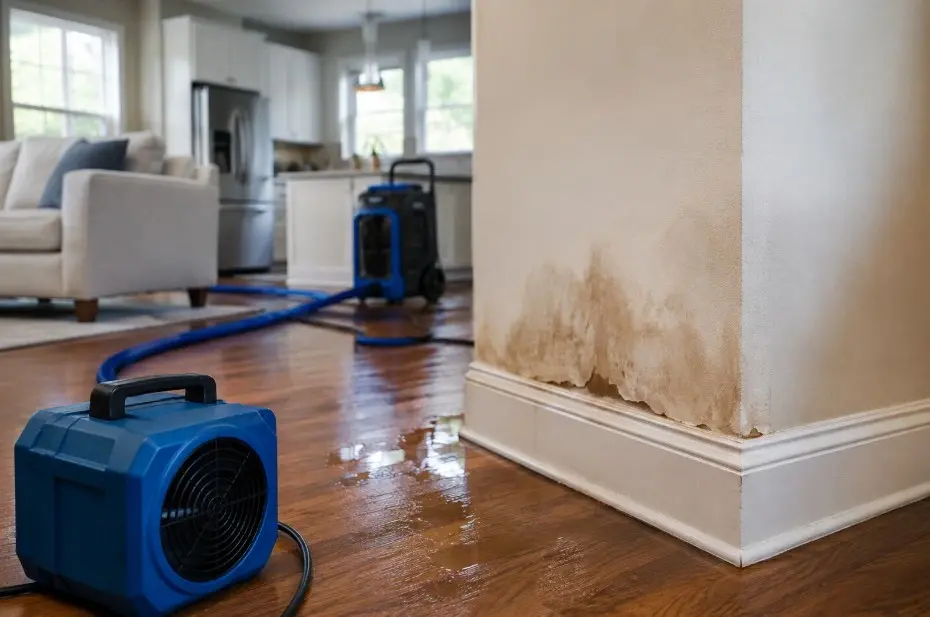
This is the sign that surprises people most, because it runs backward from what they expect. A basement checklist tells you to look for water stains coming down from above. In a slab home, one of the more distinctive signs is discoloration or a faint stain line low on a wall, right where it meets the floor — and it’s not always caused by a leak in the wall at all.
Concrete is porous, and even a well-built slab sits on ground that stays consistently damp. Moisture moves upward into concrete through a process called capillary action — sometimes described as “wicking” — carrying dissolved minerals with it. When that moisture reaches the surface and evaporates, it can leave behind a chalky white residue (efflorescence) or a faint discoloration at the base of walls and baseboards, particularly in older homes or additions where the vapor barrier beneath the slab wasn’t installed correctly. The U.S. Department of Energy’s building science guidance describes this exact mechanism: without a proper vapor and capillary break beneath a slab, moisture continues moving up into the concrete and whatever sits on top of it.
This is different from a plumbing leak, and it’s worth telling the difference apart, since the fix is completely different — a plumbing leak needs a plumber, while a chronic slab moisture issue needs a foundation or waterproofing assessment. Frisco’s own residential construction requirements call for an engineering inspection of the slab and its vapor barrier before the pour is approved — see the City’s Building Inspections Division for what that process covers, and the Adopted Codes page for the residential code amendments Frisco enforces on new and existing construction.
Flooring That’s Failing From Underneath, Not From a Spill
In a basement, damaged flooring usually points to a spill or standing water event. In a slab home, flooring failure is just as often a sign of moisture moving up through the slab itself, rather than any single water event you’d remember. Watch for:
- Tile that sounds hollow when tapped, or grout that’s crumbling — often a sign moisture has compromised the adhesive bond between the tile and the slab underneath.
- Laminate or engineered wood that’s cupping, separating at seams, or feels spongy — these materials have very little tolerance for sustained moisture exposure from below, even without a visible spill.
- Carpet with a persistent damp feel or musty smell along the edges, especially near exterior walls, even when nothing has been spilled recently.
None of these require a dramatic flood to develop. They’re often the cumulative result of slow moisture movement through the slab over months, which is exactly why they’re easy to write off as normal wear until the underlying cause is identified. If laminate or engineered flooring is already showing signs, our guide on whether water-damaged laminate flooring can be saved walks through what’s salvageable and what isn’t.
Ceiling Stains: Your Home’s Version of a Basement Leak, Just Upside Down
If a basement shows leaks at the bottom of the house, a slab home tends to show the equivalent signs at the top — ceiling stains, usually from a roof leak or a slow leak inside the attic that’s been dripping onto insulation and drywall from above. A ring-shaped water stain, even a faint one, means water has been present long enough to leave a mark, and it’s worth investigating the attic directly above that spot rather than assuming it will dry out and stop on its own. Our guide on where mold actually hides in a home without a basement covers the attic-specific moisture risks that often produce exactly this kind of ceiling staining, and our breakdown of common ceiling leak causes in Frisco homes covers what’s usually behind the stain itself.
An Unexplained Jump in Your Water Bill
This is the sign with no basement equivalent at all, because it’s specific to under-slab plumbing — a configuration that’s common in North Texas but far less common in homes built over basements or crawl spaces elsewhere. A water bill that’s noticeably higher than usual with no obvious explanation (no new appliance, no unusual usage) is one of the more reliable early indicators of a slab leak, often showing up well before any visible interior sign does.
If you’re on Frisco’s municipal water system, the City’s Utility Billing division can walk you through what’s driving a sudden increase, and if a repaired leak is confirmed, Frisco’s Partial Leak Credit program can offset part of the billed consumption once the repair is documented. Our guide to untreated water damage and foundation risk covers what a slab leak actually does to a North Texas foundation if it goes unaddressed.
Musty Odor With No Obvious Source
Just like a basement, a persistent musty smell without any visible water is a sign worth taking seriously rather than dismissing — but in a slab home, the source is more likely to be an attic, an HVAC closet, or moisture moving through the slab itself than a below-grade space. If you’ve noticed a smell that doesn’t go away with normal cleaning or ventilation, it’s a sign that moisture is present somewhere you haven’t checked yet, not that the smell will simply fade on its own. Our rundown of the top warning signs of mold covers how a musty smell tends to progress if the moisture source stays unaddressed.
Persistent moisture and mold conditions in a home also fall under Frisco’s adopted Code Enforcement Division standards, which apply the International Property Maintenance Code to residential properties across the city.
Why These Signs Get Missed More Often in Slab Homes
Basement water damage tends to get discovered because people go down there — to do laundry, store items, or use finished space — and the signs are at eye level in a space people actually visit. In a slab home, the equivalent signs are often at floor level along a baseboard nobody examines closely, inside an attic nobody visits regularly, or reflected only in a water bill nobody scrutinizes month to month. The absence of a basement doesn’t reduce the risk of hidden water damage — it just means the routine “walk downstairs and look” habit that catches problems early in other parts of the country doesn’t exist here, so these signs tend to go unnoticed longer before anyone connects them to a moisture problem.
What to Do If You’re Noticing Any of These Signs
A single sign in isolation — a small stain, a slightly higher water bill one month — isn’t necessarily an emergency. But two or more of these signs together, or any sign that’s progressively getting worse, is worth a professional moisture assessment. Our team uses moisture meters and thermal imaging, in line with IICRC S500 water damage and S520 mold remediation standards, to trace exactly where moisture is coming from, whether that’s a slab moisture issue, a hidden plumbing leak, or an attic-level problem — and to tell the difference between them, since the fix for each is completely different. If mold has already developed around any of these areas, our mold after water damage guide covers what that timeline typically looks like. If the assessment leads to repair work that needs a permit, Frisco’s Development Services Department is the city office that handles permitting and inspections for that work.
Frequently Asked Questions
Know What to Actually Look For
Your home doesn’t have a basement, but it isn’t immune to hidden water damage — the signs just show up somewhere else. If you’re noticing baseboard staining, flooring changes, ceiling stains, or an unexplained water bill increase, call for a moisture assessment across Frisco and the DFW metroplex.
Sources
- U.S. Department of Energy — Capillary Break Beneath Slab, Building Science Education
- EPA — A Brief Guide to Mold, Moisture and Your Home
- City of Frisco — Building Inspections Division
- City of Frisco — Adopted Codes
- City of Frisco — Utility Billing
- City of Frisco — Partial Leak Credit
- City of Frisco — Code Enforcement Division
- City of Frisco — Development Services Department
If the source may be a plumbing line, see how to tell if a pipe has burst inside a wall.
Need help right now? See our full guide to water damage restoration in Frisco, TX for emergency response, services, and coverage across the city.