Can Water-Damaged Laminate Flooring Be Saved?
Unlike hardwood, laminate flooring can’t be sanded, refinished, or dried out from within — once water gets under the surface layer, the clock works differently. Here’s how to tell what’s salvageable and what isn’t.
📞 Call (945) 297-3238 — Free InspectionWhy Laminate Reacts Differently to Water Than Hardwood
Laminate flooring is made of a compressed wood-fiber core (HDF/MDF) with a printed image layer and a protective top coating. That core is far more absorbent than solid hardwood — and once it swells, it does not shrink back down the way real wood can. This is the single biggest thing homeowners misunderstand about laminate water damage.
Per the EPA’s guidance on cleaning up after water damage, any porous material that stays wet beyond 24-48 hours becomes a significant mold risk — and laminate’s fiberboard core is highly porous, even though its surface looks waterproof.
The 3 Stages of Laminate Water Damage
Surface Water, No Visible Change
If water is wiped up within an hour or two and the seams weren’t submerged, laminate can sometimes escape damage entirely. This is the only stage where “just dry it and see” is a reasonable approach.
Swelling & Bubbling at the Seams
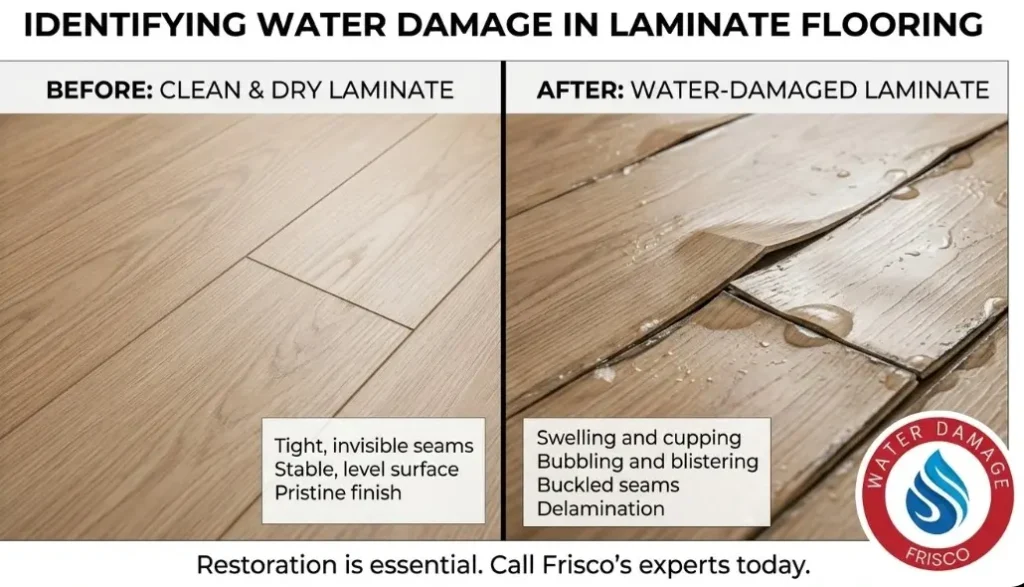
Water seeps into the seams between boards and the fiberboard core begins to swell. You’ll notice raised edges, bubbling, or a slightly spongy feel underfoot. This swelling is permanent — laminate does not shrink back once the core has absorbed water.
Delamination & Warping
The top wear layer separates from the swollen core, boards visibly warp or curl at the edges, and the flooring can no longer be reinstalled flat. At this stage, replacement is the only real option — and there’s often hidden moisture in the subfloor beneath it too.
What a Professional Assessment Actually Checks
Moisture Meters
Measures moisture in the subfloor beneath the laminate, not just the surface
Seam Inspection
Checks how far swelling has spread board-to-board
Thermal Imaging
Finds hidden moisture pockets under intact-looking sections
Subfloor Drying
Even if laminate must be replaced, the subfloor underneath still needs professional drying to prevent mold
Can It Be Saved? Quick Reference
| Sign | Likely Outcome |
|---|---|
| Water wiped up within 1-2 hours, no visible change | Good chance no damage occurred |
| Slight edge lifting at one seam only | Localized boards may be replaceable individually |
| Bubbling or swelling across multiple boards | Full section replacement usually needed |
| Boards feel soft, spongy, or separated from the core | Replacement required — core is compromised |
| Musty smell or discoloration under boards | Subfloor mold inspection required before any new flooring |
One advantage laminate has over hardwood: floating floor installations (no glue or nails) mean individual boards or full rows can often be replaced without redoing the entire floor — which can make laminate repairs less expensive than hardwood, even though the material itself can’t be dried and saved the way wood can.
Related Reading
Frequently Asked Questions
Rarely. Unlike hardwood, laminate’s fiberboard core swells permanently once it absorbs water. Even after drying, swollen or bubbled boards typically stay warped and need to be replaced.
It depends on the installation and how far the water spread. Floating floors often allow replacement of individual rows or sections, but if the color/batch is discontinued, a full-room replacement may be needed for a consistent look.
Yes. Water often travels through the seams into the subfloor beneath the laminate. Even if you replace the laminate itself, the subfloor needs to be professionally dried and inspected to prevent mold growth.
Most homeowners policies cover sudden, accidental water damage such as a burst pipe, including flooring. We document all moisture readings and provide a report that supports your claim.
Need help right now? See our full guide to water damage restoration in Frisco, TX for emergency response, services, and coverage across the city.