
Mold From AC Leak: What Really Happens Inside Your Frisco Home
Updated October 26, 2026 • Written by the restoration team at Water Damage FriscoMold from an AC leak is one of the most common hidden moisture problems in North Texas homes. Your air conditioner pulls gallons of humidity out of the air every summer day, and that water is supposed to leave the house through a drain line. When the line clogs, the pan rusts or the coil freezes, the water goes into your attic insulation, your ceiling drywall or your closet wall instead. In a warm, dark, enclosed space, mold can start to grow within a couple of days.
Quick answer: Yes, an AC leak can cause mold. The EPA says water-damaged materials should be dried within 24–48 hours to prevent mold growth. If you smell mustiness near a vent, see a stain on a ceiling below the air handler, or the leak has run for days, treat it as a mold risk and have it checked. For a free inspection in Frisco, call (945) 297-3238.
Suspect mold from an AC leak?
Our Frisco team inspects, finds the moisture source and removes the damage fast.
Call (945) 297-3238 NowHow an AC Leak Turns Into Mold
Mold needs three things: spores, a food source and moisture. Spores are already in every home. Drywall paper, wood framing, insulation and dust are the food. An AC leak supplies the last ingredient, constant moisture, and it usually does so in places you do not look at every day.
The EPA guidance is clear that the key to mold control is moisture control. Once the water source is fixed and wet materials are dried quickly, mold usually does not get started. The problem with AC leaks is that they are slow and hidden, so the drying window is often missed.
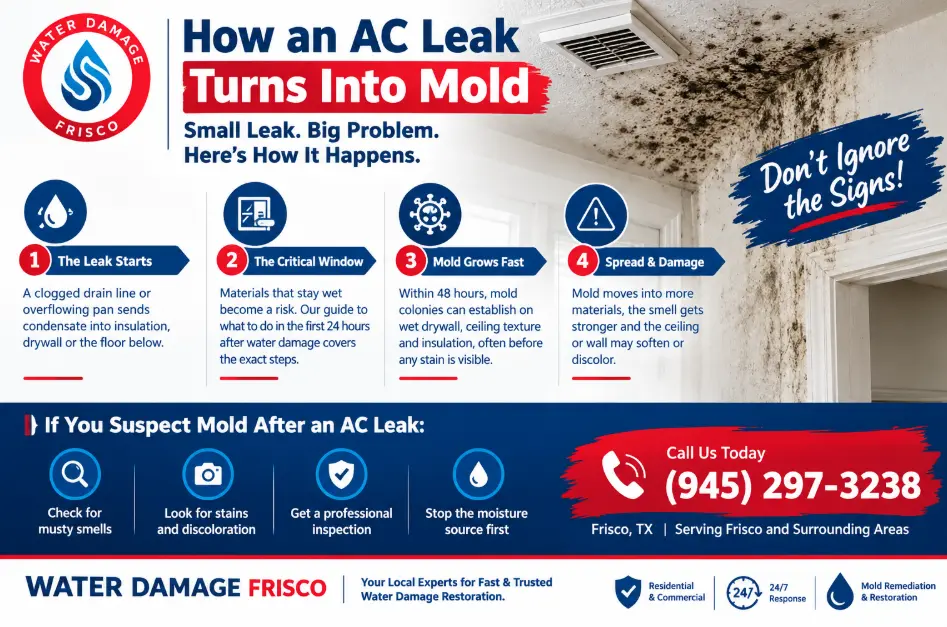
- Day 0 – The leak starts. A clogged drain line or overflowing pan sends condensate into insulation, drywall or the floor below.
- Days 1–2 – The critical window. Materials that dry in this period usually stay mold-free. Materials that stay wet become a risk. Our guide to what to do in the first 24 hours after water damage covers the exact steps.
- After 48 hours – Growth becomes likely. Mold colonies can establish on wet drywall paper, ceiling texture and insulation, often before any stain is visible.
- Weeks later – Spread and damage. Mold moves into more materials, the smell gets stronger and the ceiling or wall may soften or discolor.
The EPA also notes that this 48-hour mark is a guideline, not a guarantee. If you want the broader picture of how water turns into a mold problem, read mold after water damage in Frisco, TX.
Where Mold From an AC Leak Hides in Frisco Homes
Many homes in the Frisco area have the air handler in the attic or in a closet, which is exactly why these leaks go unnoticed. These are the places we check first:
- The drain pan and drain line. HVAC experts commonly point to the drain pan and evaporator coil as the starting point for mold in an AC system.
- Attic insulation under the air handler. Wet insulation holds water against the ceiling for weeks.
- The ceiling drywall below. A brown ring, sagging or a soft spot often means water has been there a while. See our guide on ceiling leak repair in Frisco and what to do when an AC is leaking into the ceiling.
- Closet walls and baseboards. Hall closets with a furnace or air handler are a classic hidden spot.
- Ductwork and vents. Moisture can reach duct insulation, and musty air can then spread through the home.
- Garage and utility rooms. Our post on mold prevention in Frisco attics, garages and closets explains why these areas stay damp.
8 Warning Signs of Mold From an AC Leak
You do not need to see mold to have it. These are the signs we see most often during Frisco inspections:
| Warning sign | What it can mean | What to do |
|---|---|---|
| Musty or earthy smell near vents or the air handler | Moisture or growth in the pan, coil, duct or nearby materials | Turn the system off and call for an inspection |
| Brown, yellow or dark ceiling stain | Water has repeatedly passed through the ceiling | Find the source, then check the attic side |
| Sagging, bubbling or soft drywall | Drywall has absorbed water, which is the food mold needs | Do not paint over it; see what a water bubble in a ceiling means |
| Visible spots on or near the drain pan, coil or vents | Active growth in the system | Do not keep running the AC; call a professional |
| Musty smell that returns after cleaning | The moisture source is still there | Get moisture readings, not more air freshener |
| Frequent sneezing, coughing or eye irritation indoors | Possible mold exposure, though many things cause these symptoms | Speak with a doctor and have the home inspected |
| Water stains or wet insulation in the attic | A hidden leak under the air handler | Photograph it and have it dried and checked |
| Warped baseboards or peeling paint near the unit | Long-term moisture in the wall | Open and inspect the wall cavity |
Not sure what you are looking at? Our guides to the top warning signs of mold, black mold versus regular mold and whether green mold is dangerous will help you recognize what is common and what needs fast action. Remember that color alone does not tell you how risky mold is.
Why Your AC Is Leaking in the First Place
Fixing the water source matters more than anything else. The EPA is blunt about it: if you clean mold but do not fix the water problem, the mold will most likely come back. The most common causes in this area are:
- A clogged condensate line, covered in detail in what to do about a clogged AC drain line.
- An overflowing pan or failed safety switch, explained in AC drain pan overflowing and the float switch.
- A frozen evaporator coil that melts and floods the pan, covered in AC freezing up and then leaking.
- Rusted pans, loose fittings or poor installation. Our overview of AC leaking water in Frisco, TX walks through each one.
If the leak came from an HVAC failure after a different water event, also read about HVAC problems after water damage.
What to Do Right Now If You Find Mold From an AC Leak
- Turn off the AC. The EPA advises against running an HVAC system you know or suspect is contaminated with mold, because it can spread mold through the building.
- Stop the water. Switch the system off at the thermostat and, if needed, the breaker. If a supply line is involved, review how to shut off the main water valve in Frisco.
- Document everything. Take photos and videos of the stains, the pan, the attic and any damaged items before anything is moved.
- Remove standing water and run fans or a dehumidifier in the affected room to start drying. Wet carpet and padding are often better replaced than saved; see wet carpet padding: drying or discarding.
- Do not paint, caulk or spray over the area. Covering a damp surface traps moisture and hides the evidence.
- Call a restoration professional if the area is large, hidden or has been wet more than 48 hours.
Get a Free Mold and Moisture Inspection
Tell us what you found. We will check the source, the moisture level and the damage.
Request a Free InspectionDIY or Professional? The Texas 25-Square-Foot Rule
Texas regulates mold work through the Texas Department of Licensing and Regulation (TDLR). In most cases, visible mold of less than 25 contiguous square feet can be cleaned up by people who are not licensed, according to the TDLR mold FAQ. When the contamination reaches 25 contiguous square feet or more, licensed professionals are generally required for assessment and remediation, with limited exemptions.
| Situation | Usually fine to handle yourself? |
|---|---|
| Small, surface-level spot on a hard surface, source already fixed | Often yes: scrub with detergent and water, dry completely, wear gloves, goggles and an N-95 respirator |
| Mold on drywall, ceiling texture, insulation or carpet | Usually no: absorbent materials often need to be removed |
| Mold inside the HVAC system or ductwork | No: get a professional evaluation before running the system |
| Hidden water in a ceiling, attic or wall | No: moisture mapping is needed to know how far it spread |
| 25 contiguous square feet or more | No: licensed assessment and remediation rules generally apply |
When to Call a Professional for Mold From an AC Leak
Call a restoration professional when any of these are true:
- The leak ran for more than 48 hours or you do not know how long it ran.
- The ceiling is stained, sagging or has fallen in places.
- You smell mold but cannot find it, which often means it is inside a wall, ceiling or the attic.
- Someone in the home has asthma, allergies, a weakened immune system or is a baby or an older adult.
- Mold appears to be in the ductwork, coil or air handler.
- You plan to file an insurance claim and need documentation.
If you are in Frisco or a nearby city, our team handles this every week. See our mold remediation services in Frisco, TX or the page for mold remediation in Frisco. We also help homeowners in neighborhoods across the city; our Frisco neighborhoods water damage guide shows which older and newer areas have different risks.
How Professionals Remove Mold and Dry an AC Leak Properly
A proper job fixes both the moisture and the damage. While every project is different, the process usually looks like this:
- Find and confirm the source with moisture meters and visual inspection, including the attic side of the ceiling.
- Contain the area so spores do not travel to clean rooms.
- Remove wet or affected porous materials such as insulation, ceiling drywall and padding.
- Clean hard surfaces and use HEPA filtration to capture airborne particles.
- Dry the structure completely with air movers and dehumidifiers. Our water damage restoration service in Frisco and water mitigation process explain this stage, and how long water damage restoration takes sets realistic expectations.
- Verify the results before rebuilding so the problem does not return.
Want a ballpark before calling? Our water damage cost calculator gives a quick estimate, and our mold removal in Frisco page covers what affects the price.
Does Insurance Cover Mold From an AC Leak?
It depends on your policy and on how the water got there. Policies often treat sudden, accidental discharge differently from long-term seepage or lack of maintenance, and many include limits on mold. Because the wording differs, read your policy and talk with your agent. We cannot give legal advice, but our guides on water damage insurance claims in Texas and what to do when a Texas mold insurance claim is denied explain the process and the paperwork to gather. Photos taken early make a big difference.
How to Prevent Mold From an AC Leak in North Texas
Our summers push air conditioners hard, which means more condensate and more chances for a drain to clog. These habits lower your risk:
- Schedule a yearly HVAC tune-up that includes flushing the condensate line and checking the pan and float switch.
- Change filters on schedule. A dirty filter can contribute to coil freezing.
- Install a secondary pan or float switch if your air handler is in the attic or above a finished ceiling.
- Add smart leak sensors near the air handler and water heater. See smart leak detectors and shut-off valves for options.
- Keep indoor humidity under control. The EPA recommends keeping it below 60 percent, ideally 30–50 percent.
- Look at the ceiling under the unit every few months. Early stains are far cheaper to fix than a replaced ceiling.
For the full prevention checklist after any leak, see how to prevent mold after water damage.
Local Frisco resources
Hiring an HVAC contractor to repair or replace equipment? The City of Frisco requires contractors to register with the Building Inspections Division before working in the city. You can read the City of Frisco contractor registration information and review the city’s Building Inspections Division page for permit questions, since HVAC replacement and ductwork changes may require a mechanical permit.
Mold From AC Leak: Frequently Asked Questions
How fast can mold grow after an AC leak?
The EPA says mold usually does not grow if wet materials are dried within 24–48 hours. After that, growth becomes more likely, but it is a guideline rather than a guarantee. AC leaks in attics and walls often run unnoticed for days, so the risk is higher than with a spill you see right away.
Is mold from an AC leak dangerous?
It can be. Mold can irritate the eyes, nose, throat and lungs, and people with asthma, allergies or weak immune systems are more sensitive. You cannot judge risk by color alone. If anyone in your home has symptoms, talk to a doctor and have the moisture and mold source addressed.
Can I keep running my AC if I think there is mold?
The EPA advises not running an HVAC system that you know or suspect is contaminated with mold, because it can spread mold through the building. In Texas heat that is hard to hear, so call quickly and ask for an inspection as soon as possible.
Does bleach get rid of mold from an AC leak?
For small spots on hard surfaces, the EPA suggests scrubbing with detergent and water and drying completely. Absorbent materials like drywall, ceiling tile and insulation often need to be removed rather than cleaned. Spraying a product over a damp area does not fix the moisture source.
How much does it cost to remove mold from an AC leak?
Cost depends on how large the area is, which materials are affected, whether the attic or ductwork is involved and how much drying is needed. Use our water damage cost calculator for a starting estimate, then request an on-site inspection for an accurate quote.
Who should I call for mold from an AC leak in Frisco, TX?
Call a restoration company that handles both the water and the mold, and confirm that any mold professional is licensed with TDLR. Water Damage Frisco serves Frisco and nearby cities and can be reached at (945) 297-3238.
Need Help With Mold From an AC Leak in Frisco?
Fast response, honest answers, and a plan to fix the moisture and the damage.
(945) 297-3238 See Frisco Mold RemediationWater Damage Frisco • 5000 Preston Rd Suite 200, Frisco, TX 75034
Related reading