
AC Freezing Up Then Leaking Water: What Is Really Happening
If you found ice on your air handler and then a puddle on the floor, the two problems are connected. An AC freezing up does not leak because the ice itself is broken. It leaks because the ice melts, and the meltwater is far more than the drain pan and condensate line are built to carry at once.
This is the sequence that turns a cooling problem into a water damage problem:
- Airflow drops or refrigerant runs low, so the evaporator coil gets colder than it should.
- Moisture from the air freezes onto the coil and builds into a sheet of ice.
- The ice blocks even more airflow, so the coil freezes harder and cooling stops.
- The system cycles off or the ice thaws, and the meltwater overflows the pan, drips from the air handler or soaks insulation.
In Frisco, many air handlers sit in attics or closets above finished rooms. That means a frozen coil often shows up first as a brown ceiling stain or a damp closet floor, not as a visible puddle. Our guide to AC leaking water in Frisco covers the general leak causes, and this article focuses on the freeze-then-melt pattern.
Water from a frozen AC already on the ceiling or floor?
Frisco’s local crew handles AC leak water damage around the clock.
Call Now: (945) 297-3238Signs Your AC Is Freezing Up
Catching the freeze early saves the compressor and your ceiling. Watch for these signs:
- Ice or frost on the copper refrigerant line, the indoor coil or the outdoor unit’s larger line.
- Weak airflow from the vents even though the blower is running.
- Warm or humid air from a system that ran fine the day before.
- Water around the indoor unit, in the drain pan or dripping from a ceiling vent.
- Long run times with the house never reaching the thermostat setting.
- A hissing or bubbling sound near the coil, which can point to a refrigerant leak.
Do not confuse this with winter pipe problems. If your concern is a frozen water line rather than a frozen coil, read how to keep pipes from freezing instead.
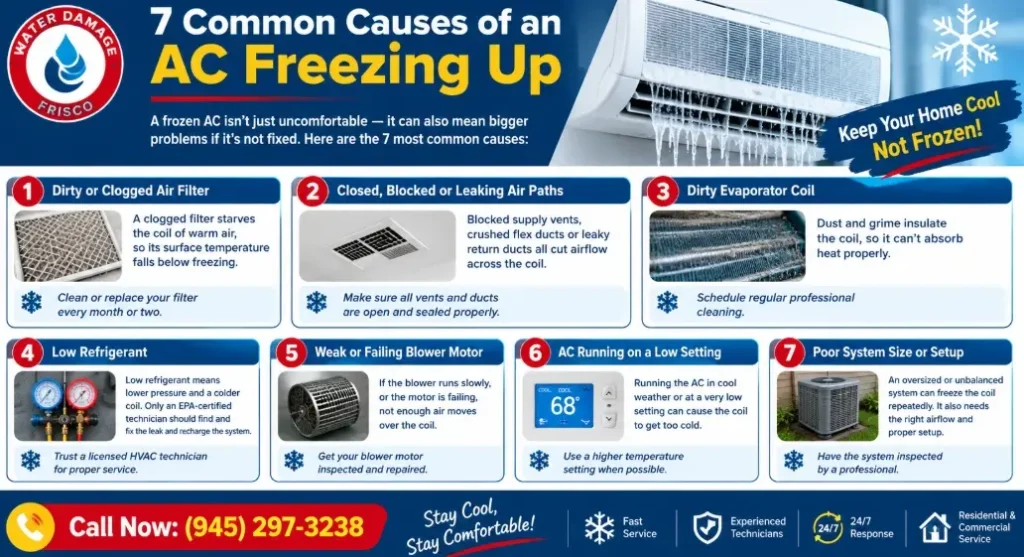
7 Common Causes of an AC Freezing Up
1. A dirty or clogged air filter
This is the most common cause. A clogged filter starves the coil of warm air, so its surface temperature falls below freezing. The U.S. Department of Energy advises cleaning or replacing the filter every month or two during the cooling season, and more often with constant use, dust or pets.
2. Closed, blocked or leaking air paths
Closed supply vents, furniture over a return grille, crushed flex duct and leaky return ducts all cut airflow across the coil. In North Texas homes, return ducts in hot attics are a frequent trouble spot.
3. A dirty evaporator coil
A film of dust and grime insulates the coil, so it cannot absorb heat properly. Over time that dirt lets ice form even with a clean filter. The Department of Energy recommends checking the evaporator coil every year and cleaning it as needed.
4. Low refrigerant
Refrigerant does not get used up. If the level is low, there is a leak. Less refrigerant means lower pressure and a colder coil, and the coil freezes even when airflow is fine. Only an EPA-certified technician should find the leak and recharge the system. Topping it off without a repair just delays the next freeze.
5. A weak or failing blower motor
If the blower runs slowly, or the capacitor or motor is failing, not enough air moves over the coil. The result looks just like a dirty filter, but replacing the filter does not fix it.
6. Running the AC in cool weather or at a very low setting
Cooling at night or during a cool spring or fall snap, or setting the thermostat far lower than the system can reach, lets the coil run below freezing. This is common in North Texas when a hot afternoon is followed by a cold night.
7. Poor system size, setup or airflow design
An oversized unit, undersized return or a poorly balanced duct system can freeze a coil repeatedly. A technician has to measure airflow and temperature split to confirm this one.
A clogged condensate line does not freeze the coil, but it makes the meltwater far worse, because the water has nowhere to go. If you suspect that too, see our guide on an AC drain line clogged and how to clear it.
What to Do Right Now When Your AC Is Frozen
Follow these steps in order. They protect the compressor and limit the water damage.
- Turn the cooling off. Set the thermostat to OFF. Running the compressor against a frozen coil can damage it.
- Switch the fan to ON. Moving room air across the coil melts the ice faster. Leave it on until the ice is gone.
- Protect the area. Place towels and a shallow pan or bucket under the air handler. If the unit is in the attic, check the secondary pan and look at the ceiling below.
- Turn off the breaker if water is dripping near the unit. Do not touch wet electrical parts, and stay away from the panel if water is near it.
- Replace the air filter. Use the right size and write the date on the frame.
- Open every supply vent and clear every return. Move furniture and rugs away from them.
- Do not chip or scrape the ice. The coil fins and copper lines damage easily, and a puncture means a costly refrigerant repair.
- Wait for a full thaw. Thin frost may clear in an hour or two. Thick ice can take several hours, sometimes most of a day.
- Restart the cooling and watch it. If ice returns within a day or two, stop and call a licensed HVAC technician.
DIY Fix or HVAC Technician?
Some causes are a five-minute fix. Others need a technician with the right tools and license.
| Cause | Homeowner can fix? | What to do |
|---|---|---|
| Dirty air filter | Yes | Replace it, then thaw and restart. |
| Closed or blocked vents and returns | Yes | Open and clear them all. |
| Dirty evaporator coil | No | Professional coil cleaning. |
| Low refrigerant or leak | No | EPA-certified technician must find the leak, repair it and recharge. |
| Failing blower motor or capacitor | No | Electrical repair by an HVAC technician. |
| Leaky or crushed ductwork | Sometimes | Visible gaps may be sealed, but airflow testing needs a pro. |
| Repeated freezing after a new filter | No | Full diagnosis of airflow, refrigerant and coil. |
Whenever a repair involves replacing equipment or wiring, ask the contractor whether a permit applies. The City of Frisco’s Building Inspections Division explains when a permit is required and how to request inspections.
Frozen Coil, Clogged Drain Line or Full Drain Pan: Which One Is Leaking?
All three produce water near the air handler, but they need different fixes. This table keeps the causes separate, so you do not treat the wrong problem.
| Cause of leak | Clue | Where to read more |
|---|---|---|
| Frozen evaporator coil | Ice on the coil or copper line, weak airflow, water appears after the unit stops or thaws. | This article. |
| Clogged condensate drain line | No ice, steady water while cooling runs, slime or debris at the line opening. | AC drain line clogged: signs and how to clear it |
| Overflowing drain pan or tripped float switch | Water standing in the pan, the unit shuts off, an attic or closet air handler leaks. | AC drain pan overflowing and the float switch |
| Water already reaching the ceiling | Brown stain, sagging drywall, bubbling paint under an attic unit. | AC leaking into the ceiling |
What to Do About the Water a Frozen AC Leaves Behind
Fixing the cooling problem does not dry the house. Meltwater can run into insulation, drywall, trim and flooring, and stay there. Here is how to handle the water side of the problem.
- Soak up standing water with towels or a wet vacuum, and run fans to keep air moving.
- Check the ceiling below an attic unit. A pale brown stain means water has already passed through the drywall. Poke nothing, and place a bucket under any sag. See ceiling leak repair in Frisco for what to do next.
- Look inside the closet or utility room. Baseboards, carpet and the subfloor stay wet longest. Wet padding is hard to dry in place, so read when wet carpet padding should be dried or discarded.
- Protect hardwood. Water under planks cups the boards, so use our steps to dry hardwood floors after water damage.
- Act within 24 to 48 hours. Damp drywall and insulation can begin to grow mold in that window. Our guide on what to do in the first 24 hours after water damage lays out the order of work.
- Look for hidden moisture. Attic and wall cavities hide water well, so check hidden water damage signs in Frisco homes.
If the leak is small and everything dries fast, you may not need anyone. If the water was in the attic, behind a ceiling or under flooring, professional drying is safer. Our AC leak water damage in Frisco service finds the wet areas with moisture meters, dries them and repairs the damage.
Not sure how far the water spread?
Ask for a free moisture check from our Frisco team.
Request a Free Inspection: (945) 297-3238How to Stop Your AC From Freezing Up Again
- Change the filter on a schedule. Check it monthly during the cooling season, and replace it whenever you can’t see light through it.
- Book a tune-up before summer. A technician cleans the coil, checks refrigerant, tests the blower and clears the condensate line. A second visit in the fall is a good idea for heavy-use homes.
- Keep air paths clear. Leave supply vents open and keep returns free of furniture, rugs and boxes.
- Avoid extreme thermostat settings. Pushing the setpoint far below what the system can reach keeps the coil running cold for hours.
- Install a float switch or leak sensor. A float switch shuts the system off when the pan fills, and a sensor in the pan alerts your phone. Our guide to smart leak detectors and shut-off valves explains the options.
- Watch for early warning signs. Weak airflow, long run times and damp spots near the air handler show up before the ice does.
For more filter and coil guidance, see the U.S. Department of Energy’s page on maintaining your air conditioner.
Safety First: Water, Electricity and Your AC
An air handler is wired to a breaker, and meltwater can reach outlets, junction boxes and light fixtures in the ceiling below. If water is near anything electrical, switch the breaker off from a dry spot and do not touch wet equipment. If you ever smell burning or see sparks, leave the area and call for help. The City of Frisco’s Fire Prevention Office offers local fire safety information for residents.
When a Frozen AC Becomes a Water Damage Emergency
Call a restoration company, not only an HVAC company, when any of these are true:
- The ceiling is stained, sagging or dripping.
- Carpet, padding or hardwood is wet and has stayed wet for more than a day.
- Water got into an attic, wall cavity or electrical fixture.
- You notice a musty smell, which can mean growth has started. Read about mold after water damage in Frisco, or book mold remediation in Frisco if you see growth.
- The AC itself was submerged or soaked, which calls for a look at HVAC problems after water damage.
For sudden or large leaks, our emergency water damage restoration in Frisco team can start drying fast. For planning, the water damage cost calculator gives a rough range, and our page on a water damage insurance claim in Texas explains what to document. We serve every neighborhood in Frisco, TX, from Stonebriar to Phillips Creek Ranch, and you can see more in our Frisco neighborhoods water damage guide. For wider help with leaks from other appliances, see appliance water damage in Frisco.
Water Damage Frisco is ready when you are
Fast response, full drying and repairs, one call away.
Call (945) 297-3238 NowAC Freezing Up FAQs
Why is my AC freezing up and then leaking water?
When airflow drops or refrigerant runs low, the evaporator coil gets colder than 32°F and moisture freezes on it. When the system cycles off or the ice thaws, the meltwater can exceed what the drain pan and condensate line can carry, so it overflows or drips near the air handler.
Is it safe to keep running an AC that is freezing up?
No. Turn the cooling off and run only the fan until the ice melts. Running the compressor against a frozen coil can damage it, and the extra ice means more water when it finally melts.
How long does a frozen AC take to thaw?
Light frost may clear in an hour or two. A thick layer of ice usually takes several hours, and in some cases most of a day. The fan setting speeds it up, and a cooling-off period is better than rushing it.
Can a dirty air filter make an AC freeze up?
Yes. A clogged filter is the most common cause because it cuts the warm airflow the coil needs. Replace it first, and if the coil freezes again, look at refrigerant, the blower and the coil itself.
What should I do if the water from my frozen AC reached the ceiling or floor?
Remove standing water, run fans, and have the wet materials checked within 24 to 48 hours. Wet drywall, insulation and padding often need professional drying to prevent mold. Call (945) 297-3238 for a free inspection in Frisco.
Does homeowners insurance cover water damage from a frozen AC?
It depends on your policy and on whether the damage was sudden or gradual. Many policies treat a sudden leak differently from long-term seepage, so take photos, keep receipts and read your policy or ask your agent. This is general information and not legal or insurance advice.