
Basement mold advice doesn’t apply to most Frisco homes. Here’s where mold actually grows in a North Texas slab home — and how to get ahead of it.
Most Mold Prevention Frisco TX attic garage closets Advice Assumes a Basement You Probably Don’t Have
Search “how to prevent mold” and nearly everything written on the topic assumes a basement: below-grade humidity, window wells, foundation seepage, floor drains. If you live in Frisco or almost anywhere else in North Texas, that advice mostly doesn’t apply — the overwhelming majority of homes here are built on concrete slab foundations poured directly onto expansive clay soil, with no basement at all. Construction here follows the building codes adopted by the City of Frisco, which is one reason the moisture-prone spaces in a Texas home look so different from a home up north.
That doesn’t mean North Texas homes are safe from the exact conditions basement mold advice is trying to prevent. It means those conditions show up in different rooms entirely. Here’s where mold actually tends to develop in a North Texas home, using the same underlying principles — humidity, hidden moisture, poor airflow — just applied to the spaces that actually exist here. If you want the fuller picture of how mold behaves once it’s established, our guide on top warning signs of mold is a good companion read.
Your Attic Is Doing What a Basement Would Do Elsewhere
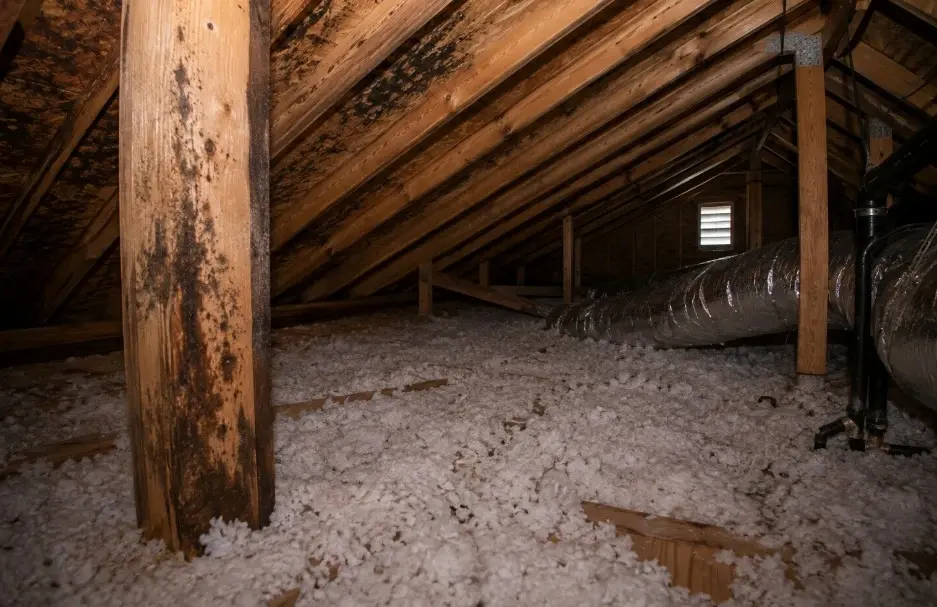
If there’s one space in a Texas home that plays the role a basement plays elsewhere — poorly monitored, rarely visited, prone to trapped moisture — it’s the attic. North Texas summers push attic temperatures dramatically higher than the rest of the house, and that heat combined with humid outside air creates condensation on the underside of roof sheathing and rafters, especially where ventilation is inadequate. The EPA’s guidance on moisture control notes that HVAC drip pans, ductwork, and any humidity-generating equipment need routine inspection specifically because these hidden, low-visibility spaces are where problems go unnoticed longest — which describes a Texas attic almost exactly.
Standard ventilation guidance calls for roughly one square foot of net free vent area for every 150 square feet of attic floor space, split between soffit intake and ridge or roof exhaust. Blocked soffit vents — often covered accidentally during insulation work — are one of the most common, entirely preventable causes of attic moisture buildup. Attic ventilation and insulation work in Frisco is also subject to the mechanical and energy code requirements covered under the City of Frisco Building Inspections Division, so any remodeling that touches roof or attic components is worth checking against current permit requirements. A musty smell in upper-floor rooms, dark staining on the underside of the roof deck visible from the attic access, or unusually high attic temperatures relative to outside air are all worth investigating before they become a larger problem — our page on whether green mold is dangerous covers what different mold colors can indicate once you spot something.
HVAC and Utility Closets: The Enclosed, Damp Space Every Texas Home Actually Has
Where a basement often houses a furnace and water heater in a larger, more ventilated space, most North Texas homes tuck this same equipment into a small, enclosed interior closet — exactly the kind of confined, low-airflow space mold needs. Condensate lines running from air handlers are a near-constant moisture source during Texas summers, when HVAC systems run almost continuously from May through September. A clogged or poorly draining condensate line can introduce ongoing moisture into a space with little air circulation to help it dry — a pattern we cover in more depth in our guide to HVAC problems after water damage in Frisco.
The EPA’s guidance on moisture control specifically calls out keeping HVAC drip pans clean and flowing, and ensuring ductwork is properly sealed and insulated in any non-conditioned space — advice that applies directly to these closets. Check the condensate line and drip pan periodically, and don’t ignore a musty smell coming from a utility closet just because it’s a small, easy-to-overlook space.
The Garage: Uninsulated, Unconditioned, and Often Where the Water Heater Lives
Mold Prevention Frisco TX attic garage closets are rarely climate-controlled, which means they experience the full range of outdoor humidity swings without the moderation the rest of the house gets from HVAC. Combined with the fact that many homes locate the water heater in the garage — a component with a documented failure risk as it ages — this creates a space where a slow leak can go unnoticed for a long time in an already humid environment. Cardboard boxes and stored items directly against garage walls or on the floor are particularly vulnerable, absorbing ambient moisture even without a direct leak.
Interior Closets Against Exterior Walls: The Quiet North Texas Equivalent of a Basement Corner
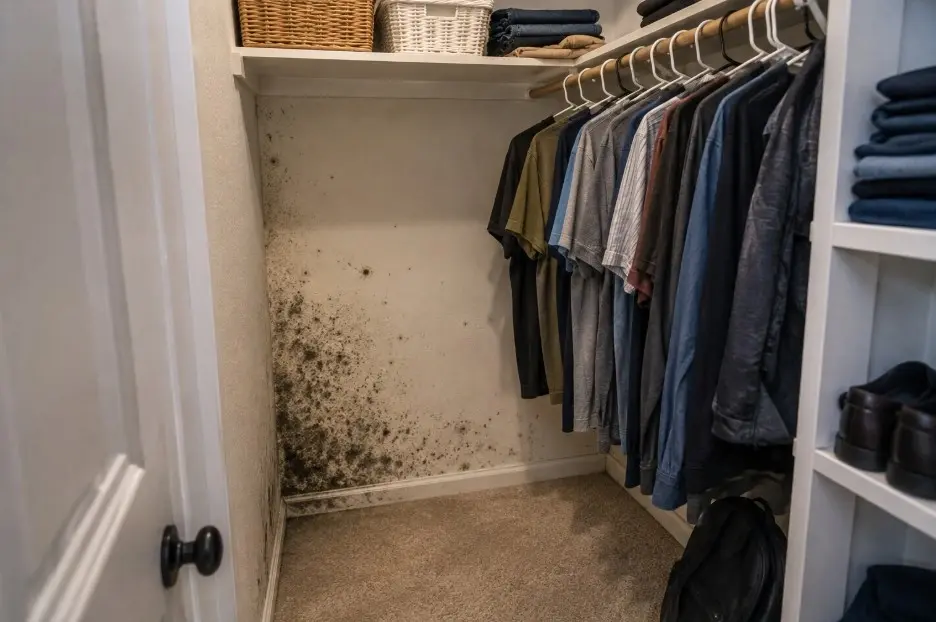
Basements often develop mold in corners where exterior walls meet the floor, since those spots run cooler and see less air circulation. In a Texas slab home, interior closets built against an exterior wall create a similar dynamic — especially on a home’s north-facing or heavily shaded side, where the wall stays cooler than surrounding areas. Combined with stored fabric, cardboard, or paper goods and minimal air movement, these closets can develop the same kind of quiet, unnoticed mold growth basements are known for, just in a completely different part of the house. If dampness in a closet has already led to visible spotting, our page on what to do immediately about black mold in a Frisco home walks through the right first steps.
The Universal Rule Still Applies: Humidity Is the Actual Target
Regardless of which space you’re dealing with, the EPA’s core guidance doesn’t change: indoor relative humidity should generally stay between 30 and 50 percent, and any area that stays consistently damp or poorly ventilated is a candidate for mold regardless of whether it’s below ground. In North Texas, where outdoor humidity is high for a large part of the year and standing or trapped moisture is common after storms, this means indoor spaces without active airflow or climate control — attics, utility closets, garages, and enclosed interior closets — deserve the same attention a basement would get in a home that had one. Our page on the dangers of stagnant water in Frisco homes covers the health side of this same humidity problem in more detail.
Mold assessment and remediation work in Texas is also a regulated activity — any assessor or remediator you hire should carry a current license from the Texas Department of Licensing and Regulation’s Mold Assessors and Remediators program, which sets minimum training and practice standards for anyone conducting this work in the state.
A Practical Checklist for North Texas Homes
- Check attic ventilation annually. Confirm soffit vents aren’t blocked by insulation and that ridge or roof vents are clear.
- Inspect HVAC condensate lines and drip pans at the start of summer, before the system runs continuously for months.
- Monitor the garage water heater for corrosion or moisture at the base, particularly as it approaches 8 to 10 years old.
- Keep stored items off the floor and away from exterior walls in interior closets and the garage — the same principle basement storage guidance follows, just applied to different rooms.
- Use a hygrometer in any enclosed space you’re unsure about — a $15 tool answers the humidity question definitively rather than guessing from a musty smell alone.
If You’re Already Seeing Signs
Musty odor without visible growth, dark staining in the attic, or recurring dampness in a utility closet or garage are all worth a professional assessment rather than a guess. Our mold remediation team, serving Frisco and the surrounding DFW metroplex, uses thermal imaging and IICRC S520-compliant protocols to find hidden moisture in exactly these kinds of enclosed, hard-to-inspect spaces — attics and utility closets in particular hide moisture problems well past the point a basement would have already shown visible symptoms. If you’re not sure whether what you’re looking at is actually mold, our guide on mold after water damage covers the visual warning signs and growth timeline. And if prevention has already slipped past the point of no return, how to prevent mold after water damage covers the critical first 24–48 hours.
Frequently Asked Questions
Know Where to Actually Look
Basement mold advice was never written with your house in mind. If you’re dealing with a musty smell or suspected moisture in your attic, utility closet, or garage, call (945) 297-3238 for an assessment across Frisco and the DFW metroplex.
EPA — Mold Course Chapter 9: Moisture and Mold Prevention
EPA — What Are the Main Ways to Control Moisture in Your Home
City of Frisco — Building Inspections Division
City of Frisco — Adopted Building Codes
Texas Department of Licensing and Regulation — Mold Assessors and Remediators Program
Need help right now? See our full guide to water damage restoration in Frisco, TX for emergency response, services, and coverage across the city.