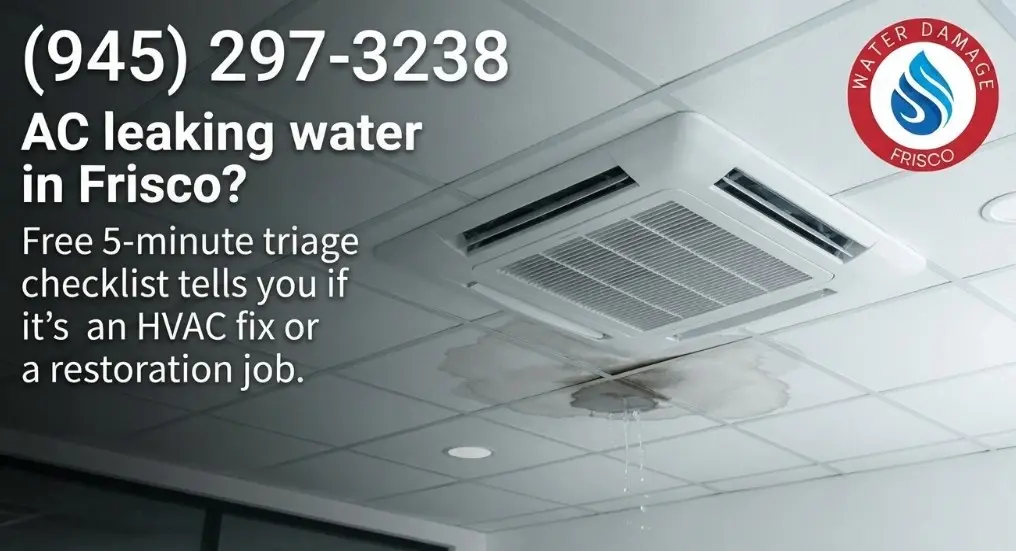
AC Leaking Water in Frisco? Here’s How to Tell If It’s an HVAC Fix or a Restoration Job
An AC leak in a Frisco attic can mean a $150 drain-line flush or a five-figure ceiling rebuild. Here’s the 5-minute triage checklist that tells you which one you’re dealing with.
📞 Call (945) 297-3238 — Free InspectionYour AC Isn’t Leaking Water. It’s Leaking a Decision.
Every homeowner in Frisco eventually finds the same thing: a soft, spreading stain on a hallway ceiling, right under the attic where the air handler lives. The instinct is to Google “why is my AC leaking water,” get an HVAC-focused answer about condensate lines and clogged drains, call a tech, and move on.
That instinct is only half right. The clog is an HVAC problem. The stain on your ceiling is a restoration problem. They don’t get fixed by the same visit, and treating them as one issue is exactly how a $150 drain-line flush turns into a $9,000 drywall-and-mold job six weeks later.
This guide isn’t another explainer on how condensate forms. It’s a triage framework: how to tell, in the first five minutes, whether you need an HVAC tech, a restoration crew, or both — and why Frisco’s specific housing stock makes this call more urgent here than almost anywhere else in the Metroplex.
Why This Hits Harder in Frisco Than in Older DFW Suburbs
Most homes built across Frisco since the early 2000s share a layout that older Dallas neighborhoods don’t: the air handler sits in the attic, directly above bedrooms and hallways, feeding ductwork down through the ceiling. Combine that with slab-on-grade foundations and blown or spray-foam attic insulation, and you get a structure that hides a slow leak unusually well. Insulation absorbs and holds the water instead of letting it show quickly, so by the time a stain reaches the drywall, the moisture has often been sitting for days.
Then add the climate. A Frisco system can run close to continuously from June through September, generating condensate the entire time. A marginal drain line that copes fine in April can overflow the first week of a 100-degree July stretch — which is exactly why AC-related water calls spike in the same months homeowners are least prepared for a “water” problem.
Two Different Problems Wearing the Same Symptom
Here’s the distinction that actually matters, and the one most explainer articles skip past:
The Mechanical Failure
A clogged condensate line, a cracked drain pan, a frozen coil, or a disconnected line. This is squarely HVAC territory. A technician clears it, and the water stops.
What the Water Already Did
Once condensate has soaked attic insulation, drywall, or framing, clearing the clog doesn’t undo that. Wet building material stays wet until it’s actually dried out — and the EPA’s guidance is that mold can begin establishing itself within 24 to 48 hours of sustained moisture exposure.
Most homeowners only book one visit and assume it covers both problems. It rarely does.
The 5-Minute Triage Checklist
Before you decide who to call, walk through this:
- Look at the stain, not just the ceiling. Is it a small, dry, brownish ring that hasn’t grown in days? Or is it soft, spongy, or actively spreading? Dry and stable leans toward “HVAC-only.” Soft and spreading means water is still active in the structure.
- Press gently on the drywall near the stain. If it flexes, dimples, or feels damp, moisture has already moved past the surface.
- Check the attic directly, if it’s safe to do so. Look at the insulation under and around the air handler. Compressed, discolored, or visibly wet insulation means the leak has been running longer than the ceiling stain suggests.
- Note how long it’s been happening. A leak you noticed yesterday is a different conversation than a stain that’s been “there for a while” and just got bigger.
- Smell the room. A musty or earthy smell, especially in a closed hallway or closet, is often the first sign of mold before you can see it.
What an HVAC Tech Fixes — and What They Walk Away From
This is the part vendor comparisons rarely spell out plainly: a standard HVAC service call is scoped to the unit, not the structure. A technician will typically clear the drain line, check the pan, and confirm the system is draining correctly again. That’s the right and necessary first step.
What that visit does not include: moisture readings inside the drywall, checking whether insulation above the stain is still holding water, or drying out framing that’s been damp for days. That’s a different skill set and a different scope of work — which is why homes that only get the HVAC side handled are the ones that come back six weeks later with a mold problem that costs far more than the original repair would have.
If your system has already caused HVAC-related water damage, the drain-line fix and the structural dry-out are two separate jobs, and it’s worth having both confirmed before you consider it resolved.
Water spreading right now? Every hour matters.
📞 Call (945) 297-3238 — 24/7 DispatchWhen It’s No Longer an HVAC Call
Call a restoration team, not just an HVAC company, when any of the following are true:
- The stain has been growing for more than a day or two
- Drywall feels soft, spongy, or damp to the touch
- You can see or smell mold, or the room has a persistent musty odor
- The leak is coming from an attic air handler directly above a bedroom, hallway, or closet
- You’re not sure how long the leak has actually been running
A restoration crew brings moisture meters and thermal imaging to find water that isn’t visible yet — which matters more than it sounds, because mold after water damage almost always starts in the material you can’t see before it shows up on the surface.
What Water Damage Frisco Does Differently
We built our process around exactly this gap. When you call, we don’t just ask “is your AC leaking” — we ask how long it’s been happening and where, because that determines whether this is a same-day dry-out or a longer job.
- 60-minute guaranteed on-site response in Frisco and the surrounding DFW area, 24/7, including holidays
- Thermal imaging and moisture meters to check attic insulation, drywall, and framing — not just the drain pan
- Direct insurance coordination — we document the damage and work with your adjuster so you’re not managing that process alone
- Certified technicians who handle the structural dry-out, not just the mechanical source
Insurance: What Usually Gets Covered, What Usually Doesn’t
Homeowners policies generally distinguish between sudden, accidental water damage and damage from ongoing neglect.
| Situation | Typically Covered? |
|---|---|
| Condensate line clogs and overflows once (sudden event) | Usually yes |
| Leak dripping for weeks due to a never-changed filter | Often classified as maintenance — usually no |
| Undocumented, unknown duration leak | Depends on adjuster — documentation is critical |
That’s exactly why documentation matters from the first hour: photos of the stain, the standing water, and the source, along with a dated inspection. If you’re not sure how your specific situation will be treated, our guide on filing a water damage insurance claim in Texas walks through what adjusters typically look for.
Areas We Serve Across DFW North Texas
Our crews are stationed across the North Dallas metro so our 60-minute response guarantee holds up wherever your AC leak happens to be.
Frequently Asked Questions
Not always — but the moment water has reached drywall, insulation, or framing, treat it as one. A stain that’s still small and dry can usually wait for a same-day HVAC appointment. A soft, spreading, or musty-smelling one shouldn’t wait.
If you catch it within hours and the drywall is still completely dry, sometimes yes. But if there’s any doubt about how long the leak has been running, a moisture check costs far less than discovering hidden mold later.
It depends on how much material got wet and for how long. Our water mitigation process page breaks down the typical timeline for a contained ceiling leak versus a larger structural dry-out.
All of the above. HVAC condensate leaks are one of the most common calls we get in the summer months, alongside burst pipe damage and storm-related flooding.
Run through the triage checklist above. If two or more items apply, it’s worth a free inspection call rather than guessing.
The Bottom Line
An AC leak is really two separate questions: what’s wrong with the unit, and what has the water already done to your home. Fixing the first without checking the second is the single most common reason a small stain turns into a large repair.
If you’re staring at a ceiling stain in Frisco right now and you’re not sure which side of that line you’re on, call for a free, no-obligation inspection — we’ll tell you honestly whether this is an HVAC fix, a restoration job, or both.
📞 Call (945) 297-3238 Now
Need help right now? See our full guide to water damage restoration in Frisco, TX for emergency response, services, and coverage across the city.