
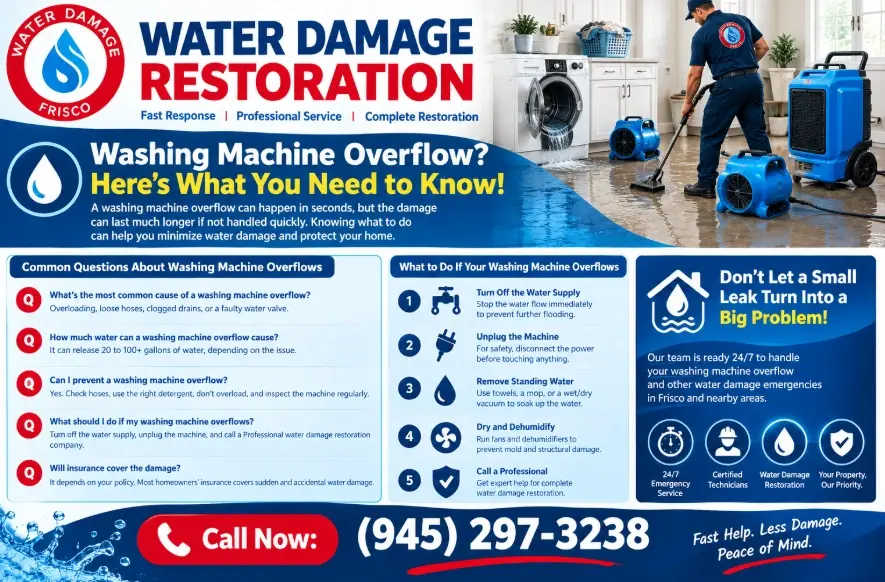
Washing Machine Overflowed What to Do Right Now: The First 10 Minutes
If your washing machine overflowed, what to do first is simple: stop the water, make the room electrically safe, and start removing water before it soaks into the flooring and the walls. A laundry tub can spill tens of gallons in minutes, and a failed supply hose keeps pouring until somebody closes the valve. In Frisco homes, that water rarely stays in the laundry room. It travels under baseboards, into hallway flooring and, in two-story houses, down through the ceiling below.
- Protect yourself firstDo not wade through water toward outlets, power strips or the breaker panel. If you see sparks or smell burning, leave the area and call 911.
- Shut off the water supplyClose the hot and cold valves behind the washer by turning them clockwise. If a valve is stuck or out of reach, close the main water shutoff for the house.
- Cut the powerUnplug the washer only if the floor and outlet are dry. Otherwise switch off the laundry room breaker from a dry position, or have an electrician do it.
- Identify the sourceA burst hose, a clogged standpipe, a stuck inlet valve and a tub that overfilled with suds each call for a different cleanup, because the source decides how clean the water is.
- Remove the standing waterUse towels, a mop and a wet/dry vacuum plugged into a dry, protected outlet elsewhere. Bail the water out of the washer drum as well.
- Lift belongings off the floorMove rugs, baskets, cardboard boxes and laundry. Put blocks or foil under furniture legs so stains do not transfer to wet wood.
- Start air movementRun box fans and the air conditioner, and add a dehumidifier if you have one. Open interior doors so air reaches the hallway and adjoining rooms.
- Document everythingTake photos and short videos of the water, the washer, the hoses and every wet surface before you clean. Write down the time it happened.
- Decide on professional helpIf the floor is still damp after a few hours, or water went past tile, call a certified team. Our first 24 hours checklist after water damage explains what to expect.
Our Frisco crew extracts the water and dries the structure, day or night. Call (945) 297-3238 now.
Is Washing Machine Overflow Water Clean? Water Categories Explained
The water category decides what can be dried and what must be thrown away. The restoration industry (IICRC standards) sorts floodwater into three categories, and a washing machine overflow can fall into more than one. Read our guide to water damage categories explained for the full breakdown. For the washer, the practical picture looks like this.
| Source of the overflow | Typical category | What it means for you |
|---|---|---|
| Burst or loose supply hose, failed inlet valve | Category 1 (clean) | Fresh supply water. Fast action usually lets floors, rugs and pad be saved. |
| Tub overfilled, wash or rinse water spilled | Category 2 (gray) | Carries detergent, lint and soil. Porous materials such as carpet pad need more caution. |
| Drain or standpipe backing up, sewage smell | Category 2 to 3 | Possible contamination. Do not clean it yourself; read about sewage backup health risks in Frisco. |
| Any of the above left for 48 hours or more | Can worsen by one category | Bacteria multiply in standing moisture, so time changes the classification. |
How to Dry Out the Floor After a Washing Machine Overflow
Mopping the surface is the easy part. The real problem is moisture that wicks into the subfloor, the bottom of the drywall and the baseboards, where you cannot see it. Professionals handle this with extraction and then controlled drying; our post on water extraction versus structural drying explains why both steps matter. Many North Texas homes also sit on concrete slabs, which hold moisture and release it slowly into the wall bases around the laundry room.
| Flooring | What to do | Warning sign |
|---|---|---|
| Ceramic tile, sealed vinyl | Squeegee and mop, then dry grout lines and transitions with fans. | Water seeping under planks or tile edges into the subfloor. |
| Laminate | Lift water fast and keep it moving; laminate swells quickly at the seams. See whether water-damaged laminate flooring can be saved. | Edges lifting, peaking or a hollow sound underfoot. |
| Hardwood | Do not rely on fans alone. Learn how to dry hardwood floors after water damage before boards cup. | Cupping, crowning or a sticky, dark finish. |
| Carpet and pad | Pad acts like a sponge. Check whether wet carpet padding should be dried or discarded. | A damp smell even after the surface feels dry. |
With professional equipment, structural drying commonly takes about three to five days, depending on materials and how far the water travelled. For the typical sequence, see how long water damage restoration takes, or compare it with the water damage restoration timeline in Frisco, TX. Never use a standard household vacuum on wet floors, and do not turn on a space heater to speed things up, because trapped heat can warp flooring.
We measure moisture in floors, wall bases and ceilings so nothing stays wet behind the surface. Call (945) 297-3238.
What to Keep, Dry or Throw Away After a Washer Flood
| Item | Recommended action |
|---|---|
| Clothes and linens | Wash on the hottest safe setting once the washer is cleared for use. Discard anything soaked by drain backup. |
| Cardboard, paper, particle board | Throw away if soaked. They hold water and feed mold. |
| Solid wood furniture | Wipe, lift off the floor and dry in moving air. |
| Mattresses, upholstery | Dry within a day or two for clean water. Discard if gray or contaminated water soaked them. |
| Baseboards and drywall bottoms | Check with a moisture meter. Wet sections may need to be opened to dry the cavity. |
| Electronics and the washer itself | Do not power on until checked. Have a technician inspect the hoses, inlet valve and pump before the next load. |
Hidden Damage After a Washing Machine Overflow in Frisco Homes
Visible puddles are only part of the loss. Water follows gravity and gaps, so inspect these spots in the hours after the cleanup:
- Wall bases and baseboards: paint bubbling or a soft bottom edge means water has wicked into the drywall.
- Cabinets and toe-kicks: laundry cabinets hide moisture that swells particle board.
- The ceiling below an upstairs laundry room: stains, sagging or a bulge are warnings. Our guides on a water bubble on a wall or ceiling and ceiling leak repair in Frisco show what to do next.
- Adjoining rooms: water can slip under a door and run along hallway flooring.
- Outlets and wiring: have an electrician check any outlet that got wet.
When damage does not announce itself, review these hidden water damage signs in a home with no basement. Left damp, wet materials can grow mold. The EPA notes that water-damaged areas should be dried within 24 to 48 hours to prevent it. If you smell mustiness, read about mold after water damage in Frisco and how to prevent mold after water damage, and book mold remediation in Frisco if growth has already started.
Washing Machine Overflow Timeline: The First 72 Hours
| Time since overflow | What is happening |
|---|---|
| 0 to 1 hour | Water spreads under baseboards and into floor seams. Extraction now saves the most material. |
| Within 24 hours | Carpet pad and subfloor stay saturated. Laminate swells and odors begin. |
| 24 to 48 hours | Mold growth can start on damp surfaces, and the water category can worsen. |
| 48 to 72 hours | Hardwood cups, drywall softens and repairs expand from drying to replacement. |
DIY Cleanup or a Water Damage Restoration Company?
A small spill on sealed tile that you dry within an hour or two can be a do-it-yourself job. Call a professional when any of these apply:
- Water reached carpet, pad, hardwood or laminate.
- The wall base, cabinet or a ceiling below is wet.
- The water came from a drain or standpipe backup, or it smells.
- More than 24 hours have passed and the area still feels damp.
- You are unsure how far the water went.
Weigh the trade-offs in DIY versus professional water mitigation. Our washing machine leak water damage cleanup in Frisco covers extraction, drying and monitoring, and our IICRC-certified restoration standards guide the work. For larger losses we also provide emergency water damage restoration in Frisco, water mitigation services and full water damage restoration in Frisco, TX. Wondering about price? Use the water damage cost calculator or read our water damage cost estimate for Frisco homes.
Insurance After a Washing Machine Overflow in Texas
Many Texas homeowners policies cover sudden and accidental discharge from a household appliance, while gradual leaks and lack of maintenance are commonly excluded. Your policy language and deductible decide the outcome, so read both before you file. We are not a law firm or an insurer, and this is general information rather than legal advice.
- Photograph and video the damage before cleanup, and keep damaged items until the adjuster has seen them.
- Keep receipts for towels, fans, hoses, plumber visits and professional drying.
- Report the claim promptly and ask whether mitigation costs are covered; see whether insurance covers water mitigation.
- Follow the steps in our water damage insurance claim guide for Texas.
Frisco Resources to Know After a Laundry Room Flood
- Water or sewer emergency: the City of Frisco Utility Billing page lists the after-hours water and sewer emergency line, 972-292-5800, and the billing office at 972-292-5575.
- High water bill after a leak: the City offers a Frisco partial leak credit for leaks on the customer’s side of the meter. The repair must be finished within 90 days of detection, the request must be filed within 90 days of the repair, and a repair invoice is required.
- Repairs and permits: before replacing plumbing, wiring or drywall in a larger rebuild, review City of Frisco residential permit requirements or call Plans and Permits at 972-292-5301.
- Be ready for bigger events: the City’s Frisco emergency preparedness resources help with planning for storms and outages.
Living in one of our service neighborhoods? See the Frisco neighborhoods water damage guide or our local water damage restoration page for Frisco.
Why Washing Machines Overflow
Knowing the cause helps you avoid a repeat. The usual culprits are:
- A clogged, kinked or undersized drain hose or standpipe.
- A water inlet valve stuck open, so the tub keeps filling.
- A faulty water-level sensor or pressure switch.
- Too much detergent, especially in high-efficiency machines, creating excess suds.
- Worn or loose supply hoses.
If a floor drain gurgles or a toilet backs up at the same time, the main drain line may be blocked; our guide on a toilet overflowing and not stopping covers the first steps. For other household sources, see appliance water damage in Frisco.
How to Prevent the Next Washing Machine Overflow
- Replace rubber supply hoses with braided stainless steel hoses, and inspect them every few months. Many plumbers suggest replacement every three to five years.
- Leave a few inches behind the washer so hoses do not kink.
- Turn the supply valves off when you travel; see how to prevent water damage while you are away.
- Install a leak sensor and an automatic shutoff. Smart leak detectors and shut-off valves alert you before a spill becomes a flood.
- Use the correct detergent amount and avoid overloading the drum.
- Clean lint filters and have the drain line cleared if the washer drains slowly.
Do not let moisture sit in your floors. Call (945) 297-3238 and we will start drying your home.
Washing Machine Overflow FAQs
What should I do first when my washing machine overflows?
Close the washer’s hot and cold water valves, cut the power safely, and find the source. Then remove standing water, start fans and photograph the damage. If you cannot reach the valves or power safely, call a professional.
Is it safe to turn off the power after a washer overflows?
Yes, but only from a dry position. Unplug the washer if the outlet is dry, or switch off the breaker. Never touch plugs, cords or the panel while standing in water.
Can a washing machine overflow cause mold?
Yes. Mold can start on damp materials within 24 to 48 hours. Drying fast and checking wall bases, cabinets and carpet pad greatly lowers the risk.
How long does it take to dry a floor after a washing machine overflow?
Surface water can be removed in an hour, but structural drying of subfloors and wall bases commonly takes about three to five days with professional equipment.
Does homeowners insurance cover a washing machine overflow in Texas?
Many policies cover sudden and accidental appliance discharge but exclude gradual leaks and neglected maintenance. Review your policy and deductible, and report the loss quickly.
Is it safe to run the washer again after it overflowed?
Not until the cause is found and fixed. Have the hoses, inlet valve, drain line and pump checked first, or the machine may flood again.
Do I need a restoration company for a small overflow?
A small spill on sealed tile may be a DIY job. If water reached carpet, wood, drywall or a ceiling below, professional drying prevents hidden damage and mold.
Need help right now? Call (945) 297-3238 and our Frisco team will explain the next step.