
Washing Machine Leaking From Bottom? Start With This Quick Answer
A washing machine leaking from bottom almost always traces back to a short list of parts: the drain pump and its filter, the drain hose, the tub-to-pump hose or, in older machines, a worn tub seal. Water that runs down from the back is usually an inlet hose or valve instead. Finding the part matters, but so does the second job that most guides skip: checking where the water went after it left the machine.
A washer moves roughly 15 to 30 gallons through a single load, and a leak does not stay on the surface. It slips under flooring, wicks into baseboards and soaks the pad or subfloor while the top of the floor looks nearly dry. This guide helps Frisco, TX homeowners diagnose a washing machine leaking from bottom, understand the eight most common causes and check for hidden damage before it becomes mold or a rotted subfloor.
- Leak only while draining: check the drain pump filter, drain pump and drain hose.
- Leak while filling: check the inlet hoses, washers and inlet valve.
- Leak during spin with a grinding noise: suspect the tub seal and bearing.
- Any leak that soaked flooring or a wall: dry it within 24 to 48 hours or call a professional.
Water already on the floor?
Frisco Water Damage Crews Are On Call 24/7
If the leak spread beyond the laundry area, our team can extract the water and dry the structure fast. See washing machine leak water damage cleanup in Frisco or call now.
Call Now: (945) 297-3238Stop the Water First: 5 Steps Before You Diagnose
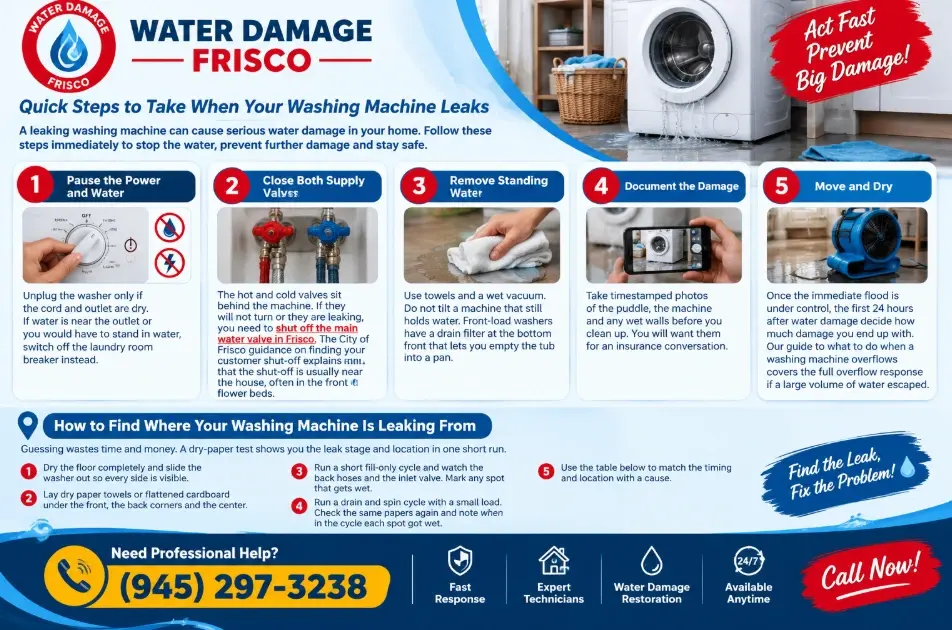
A washing machine leaking from bottom can flood a laundry room in minutes. Do these steps in order. They take under ten minutes and keep a small leak from becoming a big one.
- Pause the cycle and cut power. Unplug the washer only if the cord and outlet are dry. If water is near the outlet or you would have to stand in water, switch off the laundry room breaker instead.
- Close both supply valves. The hot and cold valves sit behind the machine. If they will not turn or they are leaking, you need to shut off the main water valve in Frisco. The City of Frisco guidance on finding your customer water shut-off explains that the customer shut-off is usually near the house, often in the front flower beds.
- Remove standing water. Use towels and a wet vacuum. Do not tilt a machine that still holds water. Front-load washers have a drain filter at the bottom front that lets you empty the tub into a pan.
- Photograph everything. Take timestamped photos of the puddle, the machine and any wet walls before you clean up. You will want them for an insurance conversation.
- Move the washer out only after it is drained. With two people, slide it forward so you can see the hoses, the floor and the wall behind it.
Once the immediate flood is under control, the the first 24 hours after water damage decide how much damage you end up with. Our guide to what to do when a washing machine overflows covers the full overflow response if a large volume of water escaped.
How to Find Where Your Washing Machine Is Leaking From
Guessing wastes time and money. A dry-paper test shows you the leak stage and location in one short run.
- Dry the floor completely and slide the washer out so every side is visible.
- Lay dry paper towels or flattened cardboard under the front, the back corners and the center.
- Run a short fill-only cycle and watch the back hoses and the inlet valve. Mark any spot that gets wet.
- Run a drain and spin cycle with a small load. Check the same papers again and note when in the cycle each spot got wet.
- Use the table below to match the timing and location with a cause.
Washing Machine Leaking From Bottom: Leak Location Decoder
| What you see | Most likely cause |
|---|---|
| Water appears as the tub fills, mostly at the back corners | Inlet hose, hose washer or inlet valve |
| Water appears only while the machine drains | Drain hose, drain pump, pump filter or standpipe |
| Water appears under the center of the machine during spin | Tub seal and bearing, or a cracked drain pump |
| Water appears as soon as the tub holds water, even without draining | Tub-to-pump hose or a cracked tub |
| A slow seep continues while the machine is off | Inlet valve that will not close, or a leaking supply valve behind the machine |
| Suds or water pour from the front or the dispenser | Too much detergent or an overfilled drum |
One caution: water that leaks from the door seal of a front-load washer runs down the front and can look like a bottom leak. If the door area is wet, inspect the door boot and its recirculation tube before you replace a pump.
Washing Machine Leaking From Bottom: 8 Common Causes
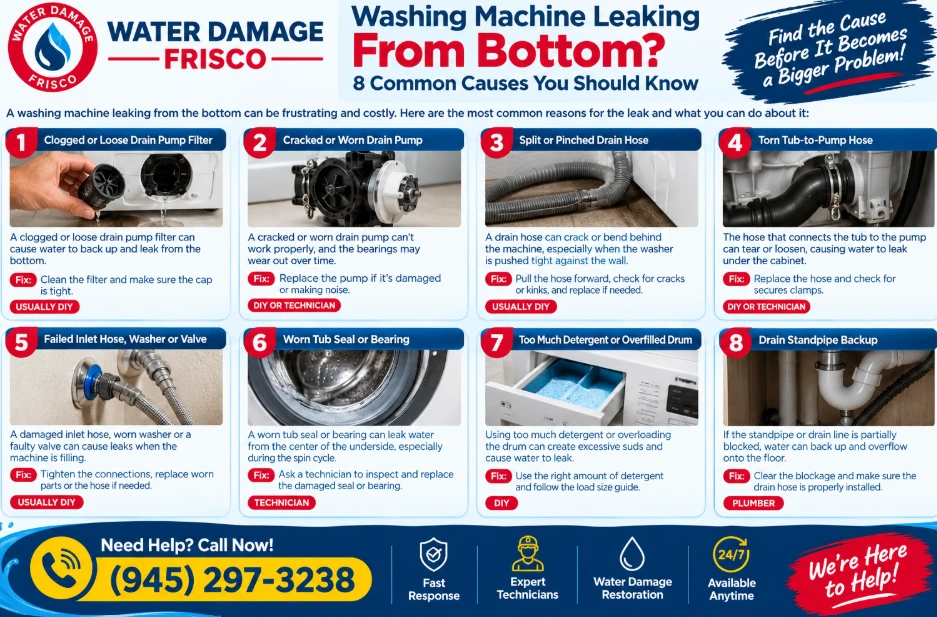
These are the most common reasons for a washing machine leaking from bottom, listed from the easiest fix to the most involved. The label on each card shows who normally handles the repair.
1. Clogged or loose drain pump filter
Most front-load washers hide a small filter behind a bottom-front panel. Lint, coins and hair clog it, or the cap is left slightly loose after cleaning, and water weeps out during the drain cycle.
Fix: Drain it into a shallow pan, clean the filter and thread the cap back on hand-tight.
Usually DIY2. Cracked or worn drain pump
The pump housing can crack and its bearings can wear out. The leak appears underneath the machine, mostly while it drains or spins, and you may hear a loud hum or grinding.
Fix: The pump is normally replaced as a complete unit. Unplug the washer before you touch it.
DIY or technician3. Split or pinched drain hose
A drain hose can crack where it bends behind the machine, especially when the washer is pushed tight against the wall. A loose clamp produces the same drip at the connection.
Fix: Pull the machine forward, check the full hose length, straighten kinks and replace any hose that is cracked or soft.
Usually DIY4. Torn tub-to-pump hose
On front-load machines a hose links the tub to the drain pump. When it splits, water leaks under the cabinet as soon as the tub holds water, not only when it drains.
Fix: Replace the whole hose. Cutting out the damaged section rarely holds.
DIY or technician5. Failed inlet hose, washer or valve
Water that trickles down the back of the machine and spreads under it often comes from a worn inlet hose, a missing rubber washer or a failing water inlet valve. The leak starts when the tub fills and can continue after the cycle if the valve will not close.
Fix: Tighten the connections, replace flat or missing washers and swap any hose that is bulging, rusty or older than five years.
Usually DIY6. Worn tub seal or bearing
Water leaks from the center of the underside, mostly during the spin cycle, and the drum often rumbles or squeals. The seal is behind the drum, so the repair is major.
Fix: Ask a technician to compare the repair cost with the age of the machine before you decide.
Technician7. Too much detergent or an overfilled drum
Regular detergent in a high-efficiency washer, or an overloaded drum, creates suds that push water out through the overflow path and down the front and bottom of the machine.
Fix: Switch to HE detergent, measure the dose, run a rinse cycle and reduce the load size.
DIY8. Drain standpipe backup
If the household drain or standpipe is partially blocked, wash water cannot leave fast enough. It rises, overflows the standpipe and runs across the floor, so it looks like the washer itself is leaking.
Fix: Clear the standpipe and check that the drain hose is not pushed in so far that it seals the pipe. Repeated backups need a plumber.
PlumberHoses cause more flooded laundry rooms than any other part, which is why we wrote a separate guide on how often to replace washing machine hoses. The same logic applies to other appliances in your home, as you can see in our post on why a dishwasher leaks. For the wider picture, read about appliance water damage in Frisco.
What Hidden Damage to Check After a Washing Machine Leak
This is the part that most repair guides leave out. Fixing the part stops a washing machine leaking from bottom. It does not dry the floor, the wall or the subfloor. Work through the checklist below once the area is safe to enter.
| Where to look | What to check | Why it matters |
|---|---|---|
| Flooring under and around the washer | Lifting seams, cupping boards, crumbling grout or a bubbled vinyl surface. | Hard flooring reacts first. See how to dry hardwood floors after water damage and whether water-damaged laminate flooring can be saved. |
| Carpet and pad in the next room or hallway | A squishy feel, a damp smell or darker carpet near the wall. | Pad acts like a sponge. Read whether to dry or discard wet carpet padding before you decide. |
| Subfloor and slab edges | A soft or spongy spot, dark staining at flooring edges or a musty odor that keeps coming back. | Most Frisco homes sit on a concrete slab, so water has no crawl space to drain into. It spreads sideways instead. See hidden water damage signs in Frisco homes. |
| Baseboards and lower drywall | Swollen baseboards, peeling paint, a faint tide line or bubbles on the wall. | Drywall wicks water upward, so the damage can sit well above the visible wet line. Compare with a bubbling wall or ceiling. |
| Cabinets, utility sink and closets | Swollen particleboard, warped doors or a sour smell inside the cabinet base. | Laminated particleboard swells and rarely recovers once it has soaked. |
| The ceiling below an upstairs laundry | A brown stain, a sag, a drip or a bubble in the ceiling. | Two-story homes are common in Frisco. See ceiling leak repair in Frisco. If water drips from a light fixture, switch off that circuit at the breaker. |
| Outlets, the dryer and the laundry electrical | Water on or near an outlet, a tripped breaker or a burning smell. | Do not touch wet electrical equipment. Switch off the breaker and call a licensed electrician. |
| Air quality and humidity | A musty smell, window condensation in the laundry room or spotting in corners. | These are early mold signals. Review the warning signs of mold and mold growth after water damage in Frisco. |
Restoration crews use a moisture meter and, where needed, a thermal camera to map wet areas behind surfaces. A moisture reading beats a visual guess every time. If you want a sense of budget before you call, try our water damage cost calculator.
If water reached the subfloor or the slab edge and stayed there, it can lead to foundation risks from untreated water damage. Fast drying is what stops that chain.
Not sure how far the water went?
Get a Moisture Inspection in Frisco, TX
We find hidden moisture with professional meters and dry it before mold starts. You can also request a free inspection online.
Call Now: (945) 297-3238Is Washing Machine Leak Water Clean or Contaminated?
It depends on where the water came from. Water from a supply hose starts out clean, which restoration professionals call Category 1. Water from the drain side, such as the pump, the drain hose or the tub itself, carries detergent, lint and body soils and is usually treated as Category 2 gray water. Gray water that sits on porous materials becomes more contaminated over time. Our guide to water damage categories explains how each category changes the cleanup.
In practice, this means that drain-side leaks should not be left to dry on their own. Wet carpet, pad and drywall that absorbed gray water often need professional treatment.
What Happens After a Washing Machine Leak: Hour by Hour
| Time | What is happening | What to do |
|---|---|---|
| First hour | Water spreads to the lowest point and begins to soak into baseboards, pad and flooring edges. | Stop the leak, remove standing water and photograph the area. |
| Within 24 hours | Moisture settles into the subfloor and lower drywall. Wood-based materials start to swell. | Dry surfaces and use fans. Follow what to do in the first 24 hours after water damage. |
| 24 to 48 hours | Mold can begin on materials that stay wet, especially in closed spaces like wall cavities and cabinet bases. | This is the window to dry thoroughly. Read how to prevent mold after water damage. |
| After 72 hours | Odors, staining and flooring distortion become obvious, and some materials can no longer be saved. | Professional drying and a moisture inspection are strongly advised. |
EPA guidance notes that drying wet materials within 24 to 48 hours generally prevents mold growth. If that window passes, read how mold develops after a water leak in Frisco and consider a mold inspection.
Repair It Yourself or Call a Professional?
A washing machine leaking from bottom creates two separate problems: a broken machine and a wet house. Match each one with the right person.
| Situation | Best next step |
|---|---|
| One hose, filter or connection is clearly the source and the floor dried within an hour | DIY repair or an appliance technician. Keep checking the floor for a day. |
| The leak involves the tub seal, bearing or a cracked tub | Appliance technician, who can compare repair cost with replacement. |
| A clogged standpipe or a backup in the household drain | Licensed plumber. The plumber normally handles permits, and you can review the City of Frisco residential permit requirements if the work changes your plumbing. |
| Water went under flooring, into a wall, into a cabinet base or through a ceiling | Call a restoration team the same day. See emergency water damage restoration in Frisco. |
| The leak ran overnight, while you were away, or you cannot tell how long it ran | Professional moisture inspection, even if the surface looks dry. |
| Musty smell or visible spotting more than a day after the leak | Professional assessment. See mold remediation in Frisco, TX. |
A hidden leak can also show up as an unexplained jump in your water bill. Compare the usage on your statement with a normal month and contact City of Frisco Utility Billing if the numbers do not make sense. Our Water Damage Frisco blog has more guides for Frisco homeowners.
When to Call a Water Damage Restoration Team in Frisco, TX
Call when the water has gone somewhere you cannot dry with towels and fans. A professional team will remove the water with commercial extraction, then use air movers and dehumidifiers to dry the structure and confirm the readings. That is the difference between water extraction versus structural drying, and it is why a floor that feels dry can still be wet underneath.
For leaks that started at the washer, our crew handles washing machine leak water damage cleanup in Frisco, removes damaged pad and baseboards where necessary and documents the drying for your insurance file. We also provide water damage restoration in Frisco, TX and water extraction in Frisco when the problem is larger than the laundry room. See our Frisco service area and the Frisco neighborhoods we serve, or schedule a damage inspection if you want a technician to look at the damage first.
How to Prevent a Washing Machine Leaking From Bottom Again
- Replace the supply hoses on a schedule. Swap rubber hoses for braided stainless steel and replace them every three to five years. See recommended hose replacement intervals.
- Leave space behind the machine. A few inches of clearance keeps the drain hose from kinking or pinching against the wall.
- Use the right detergent in the right amount. HE machines need HE detergent, measured carefully, and a drum that is not overloaded.
- Level the washer. An unlevel machine vibrates, which loosens fittings and wears hoses.
- Clean the drain pump filter every few months on front-load machines and check that the cap is tight.
- Install a leak sensor or automatic shut-off valve. Compare options in smart leak detectors and automatic shut-off valves.
- Use a drain pan in upstairs laundry rooms and close the supply valves when you travel, as described in preventing water damage while you are away.
Does Insurance Cover a Washing Machine Leak?
If a washing machine leaking from bottom damaged your home, note that many Texas homeowners policies cover sudden and accidental water discharge from an appliance, but they often exclude slow leaks that went on for weeks and damage caused by poor maintenance. Wording varies, so confirm with your agent. Photos, repair receipts and drying records strengthen a claim, and you can learn more about a water damage insurance claim in Texas. This is general information and not legal or insurance advice.
Washing Machine Leaking From Bottom: Frequently Asked Questions
Is it safe to keep using a washing machine leaking from bottom?
No. Unplug the machine, close both supply valves and stop using it until the source is found. Every extra cycle sends more water into the flooring, subfloor and walls, and water near the power cord or outlet is an electrical hazard.
Why is my washing machine leaking from bottom only during the spin cycle?
A spin-only leak usually points to a worn tub seal or bearing, a cracked drain pump or a split drain hose. These parts are stressed when water is pumped out at speed, so the leak shows up late in the cycle. A grinding or rumbling noise alongside the leak strongly suggests the tub seal and bearing.
Can a clogged filter make a washing machine leak from the bottom?
Yes. On most front-load washers the drain pump filter sits behind a small panel at the bottom front. If it is clogged or the cap is not tightened fully, water can seep out around it. Draining the filter into a shallow pan, cleaning it and reseating the cap hand-tight is a safe first check.
How can I tell whether the leak reached the subfloor?
Look for flooring that lifts or cups, a soft or spongy spot underfoot, dark staining along edges or seams and a musty smell that returns after you dry the surface. A moisture meter gives a definite answer because it compares the readings with a dry area of the same material.
How long does it take for mold to grow after a washing machine leak?
Mold can begin within 24 to 48 hours when materials stay wet, which is why EPA guidance stresses drying wet materials within that window. A leak that ran overnight or while you were away deserves a professional moisture check even if the floor looks dry on top.
Does homeowners insurance cover a washing machine leak?
Many Texas policies cover sudden and accidental water discharge from an appliance, but they often exclude long-term seepage or damage caused by lack of maintenance. Coverage depends on your exact policy wording, so photograph everything, keep receipts and ask your insurance agent before you throw anything away.
Should I call an appliance technician or a water damage company first?
Do both, in this order: stop the water, then call the right professional for each problem. A technician repairs the machine. A restoration team removes the water that has already left the machine and dries what it reached. If water went under flooring or into a wall, call restoration the same day.
Need Help With a Washing Machine Leak in Frisco?
A washing machine leaking from bottom is only half of the problem. If water reached your floors, walls or ceiling, our Frisco team can find it, remove it and dry it before it turns into mold or structural damage.
Free damage assessment
Call Frisco’s Water Damage Team Now
We answer around the clock and serve Frisco and nearby DFW communities. Tell us what happened and we will explain the next steps.
Call Now: (945) 297-3238