How Often to Replace Washing Machine Hoses: The 3-to-5-Year Rule
The standard advice on how often to replace washing machine hoses is every three to five years, and immediately if a hose shows bulges, cracks, rust or a leak. A hose that bursts can release water at full line pressure for as long as nobody is home, which is why the hoses are worth replacing before they fail. This guide explains which hose to choose, the warning signs to look for, how to replace them yourself and what changes in a Frisco home.
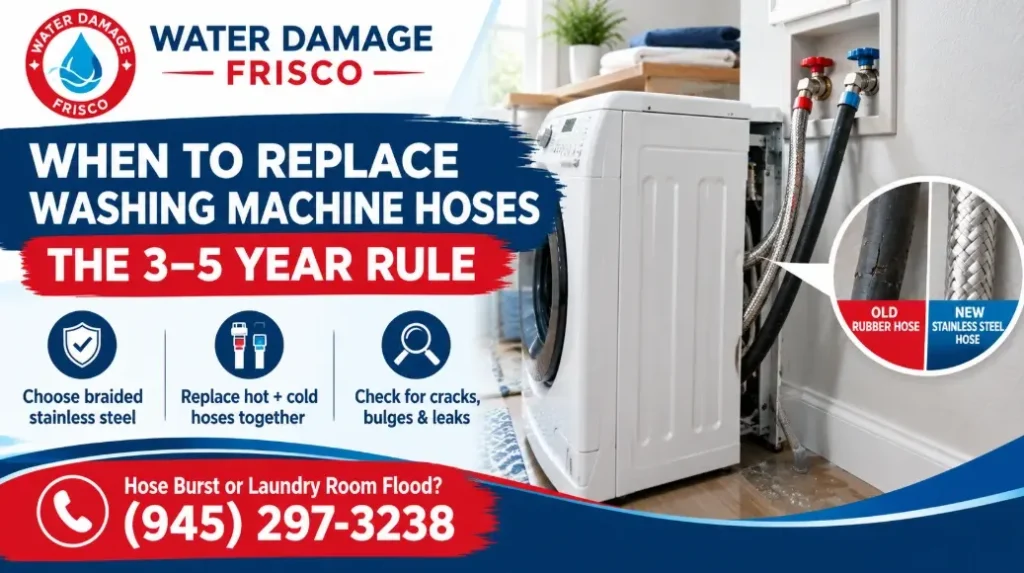
- Replace every 3 to 5 years, both the hot and cold supply hoses together.
- Choose braided stainless steel over plain rubber, but do not treat it as permanent.
- Write the date on the hose and close the wall valves when you travel.
Hose already burst or leaking?
If a washing machine hose has already flooded your laundry room, our Frisco team answers around the clock, removes the water and dries the structure.
Rubber vs Braided Stainless Steel Hoses: Which Lasts Longer?
A washing machine has a hot supply hose, a cold supply hose and a drain hose. The two supply hoses are the ones under constant pressure, so they are the ones that burst. Most new homes ship with plain rubber hoses, and many older ones still have them.
| Feature | Plain rubber hose | Braided stainless steel hose |
|---|---|---|
| Typical replacement advice | Every 3 years is prudent | Every 3 to 5 years |
| Typical failure | Bulging, cracking, splitting | Corroded couplings, fraying braid, aging inner liner |
| Resistance to pressure | Lower | Higher |
| Warning signs visible | Easy to see | Harder, because the braid hides the liner |
| Best choice | Replace with braided | Keep, but inspect and replace on schedule |
The braid adds strength, but the rubber liner inside it and the metal couplings still age, so braided hoses can still fail. Many manufacturers give the same three-to-five-year guidance for both types.
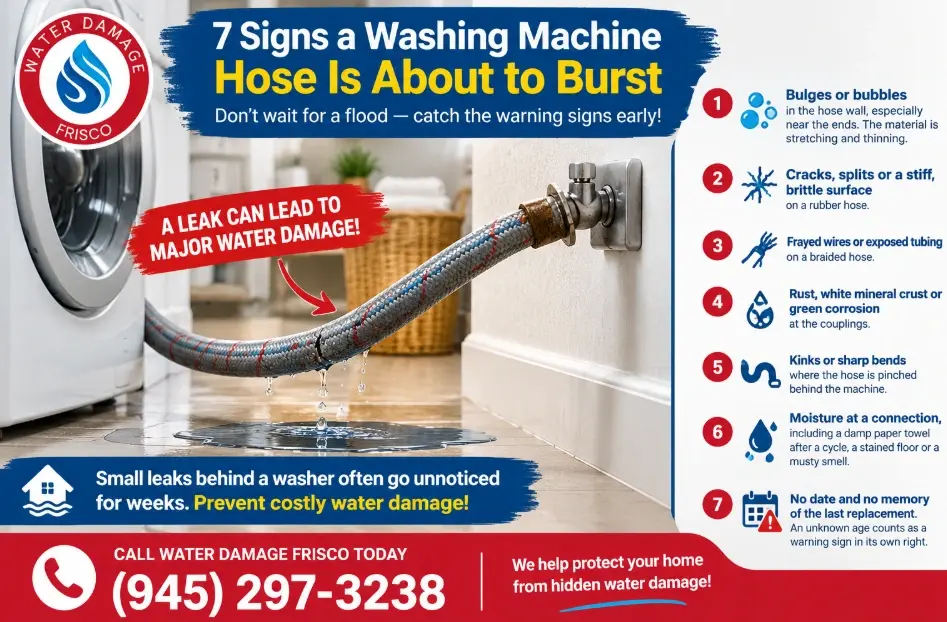
7 Signs a Washing Machine Hose Is About to Burst
The calendar is only half of the answer to how often to replace washing machine hoses; condition matters just as much. Pull the washer forward a few inches and inspect the hoses with a flashlight every few months. Replace a hose at once if you see any of the following.
- Bulges or bubbles in the hose wall, especially near the ends. The material is stretching and thinning.
- Cracks, splits or a stiff, brittle surface on a rubber hose.
- Frayed wires or exposed tubing on a braided hose.
- Rust, white mineral crust or green corrosion at the couplings.
- Kinks or sharp bends where the hose is pinched behind the machine.
- Moisture at a connection, including a damp paper towel after a cycle, a stained floor or a musty smell.
- No date and no memory of the last replacement. An unknown age counts as a warning sign in its own right.
Small leaks behind a washer often go unnoticed for weeks. Our guide to hidden water damage signs in Frisco homes shows what to look for in the wall and floor around the laundry area.
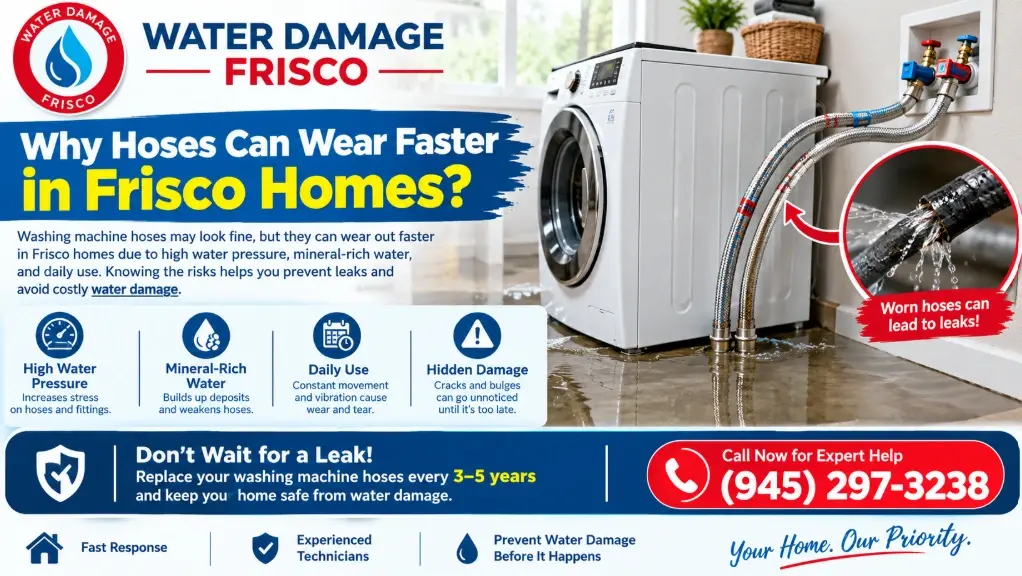
Why Hoses Can Wear Faster in Frisco Homes
Three local conditions are worth knowing about.
- Water pressure. The City of Frisco explains that plumbing code limits pressure to a maximum of 80 psi and that homes built after 2001 usually have a pressure reducing valve. If that valve fails, high pressure and pipe hammering can stress hoses and fixtures. Read the City’s pressure reducing valve guide, and note that replacing a valve requires a permit.
- Mineral-rich water. Minerals can build up at the couplings and inlet screens and speed corrosion where the hose meets the machine.
- Laundry closets and upstairs rooms. Many Frisco homes place the washer in an interior closet or on an upper floor, so a burst hose soaks drywall, subfloor and ceilings below.
If you are unsure whether your home has a working valve or whether a permit applies, the Frisco Building Inspections Division can be reached at 972-292-5301.
Found a damp wall behind the washer?
Do not wait for it to dry on its own. We find the hidden moisture and dry it before mold or damage spreads.
How to Replace Washing Machine Hoses Step by Step
Once you know how often to replace washing machine hoses, the job itself is straightforward for most homeowners and takes about half an hour. Buy two new supply hoses, new rubber washers if they are not included, and a bucket.
- Unplug the washer and close both wall valves. If a valve will not close fully, use our guide to how to shut off the main water valve in Frisco and replace the valve afterwards.
- Place a bucket and towels under the connections to catch the water trapped in the hoses.
- Disconnect the old hoses at the wall and at the back of the machine.
- Clean the inlet screens while the hoses are off.
- Fit the new hoses with new washers. Hand-tighten, then add a short extra turn with pliers as the manufacturer directs. Over-tightening damages the washer seal.
- Write the date on each hose. This is also useful evidence of maintenance if you ever need to file a claim.
- Open the valves slowly, run a short cycle and check every coupling with a dry paper towel. Leave a few inches behind the washer so the hoses do not kink.
Inspect the drain hose and its connection to the standpipe at the same time. Make sure it is secure and not kinked.
Upgrades That Reduce the Risk of a Washer Flood
- Close the wall valves when you travel, a habit explained in our guide to how to prevent water damage while away.
- Install quarter-turn lever valves in place of old multi-turn valves so they close quickly in an emergency.
- Add a leak sensor or an automatic shut-off. See smart leak detectors and automatic shut-off valves.
- Use a washing machine pan piped to a drain where the machine sits upstairs.
- Fit water hammer arrestors if you hear banging when the washer valve closes.
- Test your pressure if hoses fail repeatedly, since high pressure is a common cause.
What to Do If a Washing Machine Hose Has Already Burst
Act in this order: close both wall valves or the main valve, unplug the washer if you can reach the outlet without standing in water, and start removing water. Move belongings and lift anything absorbent. Our guide on what to do when a washing machine overflowed covers the first ten minutes, and the first 24 hours after water damage checklist covers what comes next.
A burst supply hose usually releases clean water at first, but it can degrade as it sits in building materials, as explained in our overview of water damage categories. Wet flooring and padding should be assessed quickly. See wet carpet padding drying and replacement, and the risks of mold after water damage in Frisco if moisture stays in place.
Our crews follow IICRC-certified practices. Extraction removes the standing water, while structural drying removes what is inside the walls, which is the difference explained in water extraction versus structural drying. For the usual schedule, see our water damage restoration timeline in Frisco, and for a budget range use the water damage cost calculator. We also provide emergency water damage restoration in Frisco at any hour.
Insurance and Burst Washing Machine Hoses in Texas
Sudden hose failures are a common cause of household water claims, and policies often respond to sudden and accidental discharge but not to damage from neglect or slow leaks. Keep receipts showing how often you replace washing machine hoses, and a photo of the dated label. Photograph the failed hose, the leak and all affected property before cleanup, and review our Texas water damage insurance claim guide. For wider context, see appliance water damage in Frisco.
Frisco resources worth saving
- City of Frisco Public Works: water and utility services, 972-292-5800
- City of Frisco Building Inspections Division: permit questions, 972-292-5301
- City of Frisco pressure reducing valve guide: pressure limits and valve failure signs
- City of Frisco Cold Weather Tips: where main shut-off valves are usually found
See our Frisco neighborhoods water damage guide and Frisco water damage restoration page for local coverage.
Frequently Asked Questions About How Often to Replace Washing Machine Hoses
How often should I replace washing machine hoses?
Most plumbers and hose manufacturers recommend replacing washing machine hoses every three to five years, and sooner if you see bulges, cracks, rust or leaks. Replace the hot and cold supply hoses together, and inspect the drain hose at the same time.
Do braided stainless steel hoses last forever?
No. Braided stainless steel hoses are more durable than plain rubber, but the rubber liner inside the braid and the couplings still age. They can corrode, kink or fray, so they should follow the same three-to-five-year schedule.
How can I tell how old my washing machine hoses are?
Look for a date stamp or label on the hose. If there is none, assume the hoses are as old as the washer or the last time anyone replaced them. When in doubt, replace them and write the installation date on the new hoses with a permanent marker.
Is it safe to leave the washer water valves open all the time?
Many homeowners do, but the hoses stay under full line pressure around the clock. Closing the valves after laundry day, and always when you travel, reduces the chance of a burst hose flooding the home while nobody is there.
Do I need to replace the drain hose too?
Yes, inspect it at the same time. The drain hose is not under line pressure, but a cracked, kinked or loose drain hose can still leak or overflow at the standpipe. Replace it if it is brittle, split or damaged.
What should I do if a washing machine hose bursts?
Close both wall valves or the main water valve, unplug the washer, and remove standing water quickly. Then follow our guide to what to do when a washing machine overflows and call a restoration team if water has reached walls, flooring or the subfloor.
Who pays when a washing machine hose bursts in a rental?
It depends on the lease, the cause and who maintained the appliance. Texas rental situations are covered in our Texas rental water damage and tenant rights guide. Report the loss in writing right away and photograph the damage.
Does homeowners insurance cover a burst washing machine hose?
Policies commonly cover sudden and accidental water damage, but may exclude damage from long-term leaks or neglected maintenance. A dated hose label and replacement receipts help show that the appliance was maintained. Read our Texas water damage insurance claim guide for the full process.
Replace Washing Machine Hoses Before They Replace Your Flooring
A hose costs very little compared with the damage it can cause. If you have already seen a leak, or if water has reached the wall or floor, we can help. Read about our water damage restoration in Frisco, TX or reach us through the contact page.
Get the water out before it spreads
Call now for a fast response anywhere in Frisco, or request a free estimate and we will get back to you quickly.
Related reading: More Frisco water damage guides on our blog.