
Does Homeowners Insurance Cover Water Heater Leak Damage in Texas?
If your tank just flooded the garage or soaked the hallway, you want one answer first: does homeowners insurance cover water heater leak damage? In most Texas policies the answer is yes when the leak was sudden and accidental, and usually no when it was a slow drip that went unnoticed. Even when the claim is accepted, the policy normally pays for the damage the water caused, not for the water heater itself.
Standing water right now? Call us at (945) 297-3238 and we will start extraction and drying while you call your insurer.
Call (945) 297-3238 Now- What a Texas policy usually pays for
- Sudden vs. gradual leaks
- Is the water heater itself covered?
- Why claims get denied
- Mold after a water heater leak
- How to file the claim, step by step
- Deadlines your insurer must meet
- Should you file at all?
- Frisco homes: garages, attics and permits
- FAQs
What Does Homeowners Insurance Usually Cover After a Water Heater Leak?
Think of two separate questions: the appliance and the damage. Homeowners policies are built to protect the house and your belongings from sudden events. They are not built to maintain the equipment inside it. The Texas Department of Insurance describes the pattern plainly: sudden and accidental water damage from things like a burst pipe, an overflowing toilet or a broken washer hose is generally covered, while gradual leaks are not (see TDI’s page on when water damage and mold are covered).
Usually covered
- Sudden tank rupture or split seam
- Wet drywall, insulation, flooring and cabinets
- Belongings damaged by the water, subject to limits
- Reasonable emergency drying and cleanup
- Mold that follows a covered loss, depending on your mold terms
Usually not covered
- Repair or replacement of the heater for age, rust or wear
- Leaks that ran for weeks or months
- Damage tied to ignored maintenance
- Flood or surface water entering the home
- Mold above your policy’s limit or exclusion
The same “sudden versus gradual” logic shows up across appliance losses. If you want to compare, we break down the rules for burst pipe coverage under Texas homeowners insurance and give a broader overview in our Texas water damage insurance claim guide.
Sudden vs. Gradual: The Line That Decides Your Water Heater Claim
Adjusters look for one thing first: how fast did the water escape? A tank that splits overnight and floods a garage is a very different claim from a pinhole that has stained the same patch of subfloor for months. Policies often use language such as “continuous or repeated seepage,” and that wording is where many denials start. Here is how common situations tend to be viewed. Your own policy wording always controls.
| What happened | How insurers usually treat it |
|---|---|
| Tank split open and flooded the garage overnight | Often covered Resulting water damage is usually claimable. The tank is not. |
| Supply line or connector failed suddenly | Often covered Treated as a sudden plumbing or appliance discharge. |
| Pressure relief valve discharged heavily | Depends The cause matters. Keep the valve and get a plumber’s report. |
| Pinhole drip behind the unit for months | Often denied Looks like gradual seepage. |
| Rusted tank base weeping for weeks | Often denied Classified as wear and tear. |
| Fire or lightning damaged the heater | Depends A listed peril, so the unit itself may be covered. |
| Storm water or flooding reached the heater | Not under homeowners Needs a flood policy. See water damage vs. flood damage in Frisco. |
Not sure which side of the line your leak falls on? Our guide to why your water heater is leaking and the page on a water heater leaking from the bottom explain which leak patterns point to a sudden failure and which point to long-term corrosion.
Will Insurance Pay for the Water Heater Itself?
Usually not. Policies generally do not pay to repair or replace an appliance that simply wore out, and a leaking tank most often fails because of age, sediment or corrosion. If a covered event such as a fire or lightning strike destroys the unit, the picture changes, so ask your agent. Texas water also tends to be hard on tanks, which is why we wrote a separate piece on how long a water heater lasts in Texas.
A home warranty is a different product. It may help pay to fix or replace the appliance, but it generally does not pay for the flooring, drywall and belongings the water ruined. Many homeowners need both contracts working together, and each has its own exclusions.
Replacing the unit? In Frisco, installs run through the city’s permit process. The published City of Frisco permit fee schedule includes a plumbing line for each water heater, and the Frisco Building Inspections Division (972-292-5301) can confirm what applies to your swap before the plumber starts.
Find Out What the Leak Really Damaged
Hidden moisture in walls, insulation and subfloors is what turns a small claim into a big one. We map it, photograph it and document it.
Request a Free Water Damage AssessmentPrefer to talk? Call (945) 297-3238
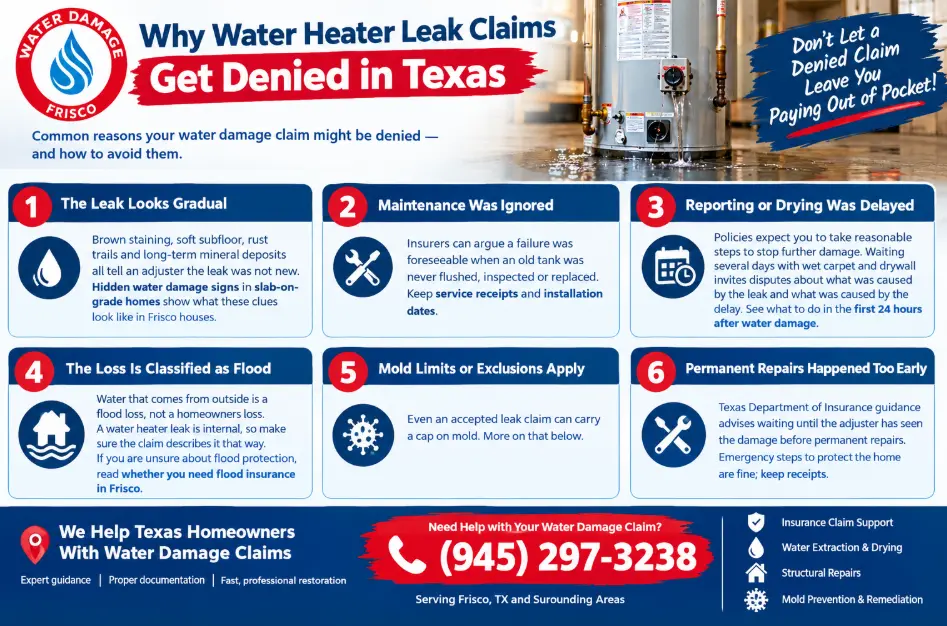
Why Water Heater Leak Claims Get Denied in Texas
1. The leak looks gradual
Brown staining, soft subfloor, rust trails and long-term mineral deposits all tell an adjuster the leak was not new. Our article on hidden water damage signs in slab-on-grade homes shows what these clues look like in Frisco houses.
2. Maintenance was ignored
Insurers can argue a failure was foreseeable when an old tank was never flushed, inspected or replaced. Keep service receipts and installation dates.
3. Reporting or drying was delayed
Policies expect you to take reasonable steps to stop further damage. Waiting several days with wet carpet and drywall invites disputes about what was caused by the leak and what was caused by the delay. See what to do in the first 24 hours after water damage.
4. The loss is classified as flood
Water that comes from outside is a flood loss, not a homeowners loss. A water heater leak is internal, so make sure the claim describes it that way. If you are unsure about flood protection, read whether you need flood insurance in Frisco.
5. Mold limits or exclusions apply
Even an accepted leak claim can carry a cap on mold. More on that below.
6. Permanent repairs happened too early
Texas Department of Insurance guidance advises waiting until the adjuster has seen the damage before permanent repairs. Emergency steps to protect the home are fine; keep receipts.
Mold After a Water Heater Leak: Is It Covered?
TDI notes that when mold develops on an item damaged by a covered sudden loss, it would be covered, while mold from gradual leaks or floods generally is not. Real policies vary a lot, and many include mold sub-limits or endorsements, so read your declarations page. Mold can begin to form quickly in warm, humid North Texas homes, which is one more reason to dry fast. Read our guide to mold after water damage in Frisco and our breakdown of Texas mold insurance claim denials before you accept a mold settlement.
How to File a Water Heater Leak Insurance Claim in Texas (7 Steps)
Follow this order to protect both the house and the claim. If the water is spreading, the first priority is shutting it off, so keep our guide to shutting off the main water valve in Frisco handy.
Stop the water and make the area safe
Close the cold-water inlet valve on top of the heater, then cut power at the breaker (electric) or turn the gas control to off (gas). If you smell gas, leave the house and call 911. If you cannot isolate the heater, shut off the whole house at the main valve.
Document everything before you clean
Take wide and close-up photos and video of the heater, the source of the leak, the data label (age and model), wet materials and damaged belongings. Note the date and time you found it.
Call your insurance company right away
Report the loss, get a claim number and write down who you spoke with. Deadlines for notice vary by policy, and the sooner you report, the harder it is to argue the damage was ignored.
Dry the structure and keep receipts
Your policy expects reasonable steps to prevent further damage. Professional extraction and drying within the first day or two limits swelling, mold and secondary damage. Do not make permanent repairs until the adjuster has seen the loss.
Keep the failed part
Ask your plumber and adjuster before anything is thrown away. The split tank, connector or valve can show whether the failure was sudden.
Share records with the adjuster
Provide photos, moisture readings, the drying log, the plumber’s report and itemized repair estimates. Ask for any request in writing.
Follow up in writing and watch the deadlines
Track each date the insurer must respond. If the claim stalls or is denied, ask for the reason in writing and use the Texas Department of Insurance complaint process if needed.
Texas Claim Deadlines Your Insurer Must Meet
Texas law puts clocks on your insurer. According to the Texas Department of Insurance, the company has 15 business days to tell you it received the claim and 15 business days after getting what it needs to decide whether to pay. It may extend the decision by 45 days if it explains why, and any rejection must be explained in writing. Once approved, payment is due within 5 business days. Deadlines can be extended after weather catastrophes.
Read the full rules in TDI’s insurance claim deadlines explainer and its steps for getting your claim paid. If you need help with your adjuster, see working with an insurance adjuster. If your company is not following the rules, TDI explains how to file an insurance complaint.
Should You File a Claim for a Water Heater Leak?
Not every leak should become a claim. Compare a written repair estimate with your deductible, then talk to your agent before you decide. Claims are tracked in the industry’s loss database, and the Texas Attorney General’s mold remediation guidance cautions that some homeowners with water or mold claims later struggle to renew or obtain coverage. Use our water damage cost calculator to size the damage first. This is general information, not insurance or legal advice, so confirm details with your insurer or a licensed professional.
Curious how drying costs get covered? See does insurance cover water mitigation for what is typically reimbursed.
Frisco Homes: Garage, Attic and Slab Water Heaters
Many Frisco homes put the tank in a garage, closet or attic. An attic leak can soak insulation and ceilings for days before a stain shows, and slab-on-grade houses have no basement to reveal a slow leak. Those hidden-damage patterns are why a documented inspection matters. Our article on a water heater leaking in the attic or garage covers what to check, and our appliance water damage guide for Frisco homes compares the other common household sources.
How Water Damage Frisco Helps Document and Dry the Loss
We do not decide coverage. Your insurer does. What we do is stop the damage from growing and give you records an adjuster can use: moisture mapping, thermal imaging, photos, and a daily drying log. Our team handles water heater leak water damage cleanup in Frisco, from extraction to structural drying under our water mitigation services, and our emergency water damage restoration in Frisco crews can start the same day. Wet hardwood? Read how to dry hardwood floors after water damage. Left too long, moisture can reach framing and foundations, as in untreated water damage and foundation risk.
Prevent the Next Water Heater Leak
Insurers pay for accidents, but prevention protects your deductible and your records. Flush the tank on the manufacturer’s schedule, test the pressure relief valve, add a drain pan and replace aging units before they fail. A water sensor and an automatic shutoff are inexpensive protection, and we compare options in smart leak detectors and automatic shut-off valves.
Frequently Asked Questions About Water Heater Leak Insurance Claims
Does homeowners insurance cover a leaking water heater itself?
Usually not. Standard policies treat the tank as a wear-and-tear item, so repair or replacement is typically on you. The exception is when a covered event such as fire or lightning damages the unit. The water damage the leak causes to your home is a separate question and is often covered when the leak was sudden. See our guide on why a water heater leaks for the causes.
Is a slow water heater leak covered by insurance in Texas?
Rarely. The Texas Department of Insurance explains that most home policies cover sudden and accidental water damage but not gradual leaks or seepage. A drip that ran for weeks or months before anyone noticed is the kind of loss insurers most often deny.
Will insurance pay for water extraction, drying and mold after a water heater leak?
If the leak is a covered loss, reasonable emergency drying is normally part of the claim. Mold is policy-specific, so read your mold limits and endorsements. Our pages on whether insurance covers water mitigation and Texas mold insurance claim denials go deeper.
How long does my Texas insurer have to respond to a water heater leak claim?
Per the Texas Department of Insurance, the company has 15 business days to confirm it received your claim and 15 business days after it has what it needs to decide whether to pay. It can extend that by 45 days if it explains why, and it must give written reasons for a rejection. After approval, payment is due within 5 business days.
Does a home warranty cover water heater leak damage?
A home warranty generally helps repair or replace the appliance when it breaks, but it does not pay for the damage the escaping water does to floors, walls and belongings. That damage is what homeowners insurance addresses. Check both contracts for exclusions.
Should I file a claim for a small water heater leak?
Get a written estimate first and compare it with your deductible. Claims are recorded in industry databases, and the Texas Attorney General notes that some homeowners with water or mold claims have had trouble renewing or finding coverage later. Our water damage cost calculator can help you size the loss before you call your agent.
What can I do if my water heater leak claim is denied?
Ask for the denial in writing, compare the stated reason with your policy wording, and gather your photos, drying logs and plumber report. You can ask the Texas Department of Insurance for help with a complaint at 800-252-3439, and complex denials may be worth a conversation with a licensed public adjuster or attorney.
Official Texas and Frisco Resources
Related Reading
Water Heater Leak in Frisco? Get Help Now
We extract the water, dry the structure and document the loss so your claim has the facts it needs.
See Our Water Heater Leak Cleanup ServiceCall (945) 297-3238 · 5000 Preston Rd Suite 200, Frisco, TX 75034
This article is general information for Texas homeowners and is not insurance, legal or financial advice. Coverage depends on your policy and the facts of the loss. Confirm details with your insurer, a licensed agent or the Texas Department of Insurance. Reviewed October 25, 2026.