
Do you actually need flood insurance in Frisco or Collin County? Instead of a generic yes, here’s what the official NFIP claims, policy, and mitigation data for Collin and Dallas counties actually show — so you can make the call with numbers, not guesswork.
Do I Need Flood Insurance in Frisco or Collin County? The Short Answer
If your home carries a federally backed mortgage in a FEMA high-risk flood zone, flood insurance is legally required — that part isn’t optional. But the more useful question for most Frisco and Collin County homeowners is different: even where it isn’t required, does the data justify carrying it anyway? Looking at the actual claims and policy numbers for Collin County next to neighboring Dallas County, the answer for most homeowners is yes — largely because so few Collin County residents currently carry any flood coverage at all, despite real, recorded flood losses in the county.
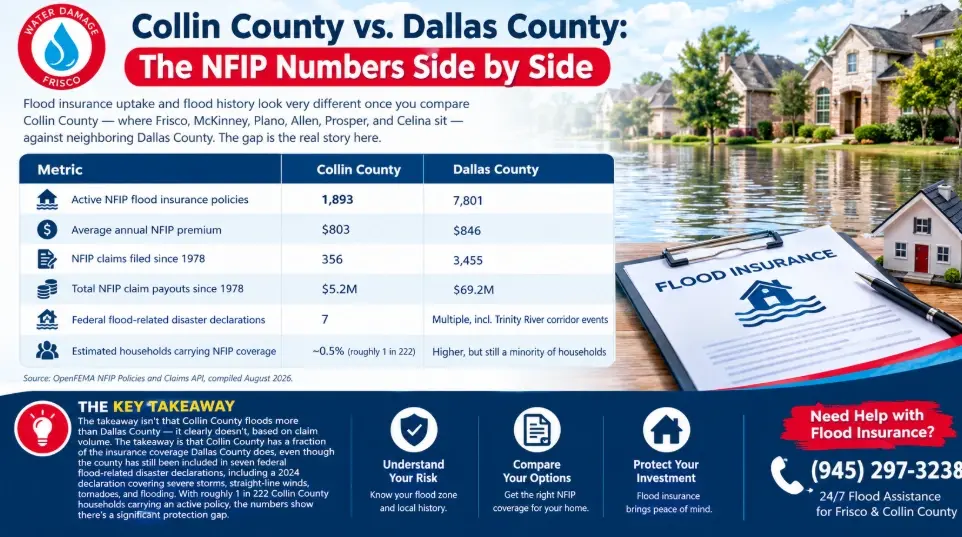
Collin County vs. Dallas County: The NFIP Numbers Side by Side
Flood insurance uptake and flood history look very different once you compare Collin County — where Frisco, McKinney, Plano, Allen, Prosper, and Celina sit — against neighboring Dallas County. The gap is the real story here.
| Metric | Collin County | Dallas County |
|---|---|---|
| Active NFIP flood insurance policies | 1,893 | 7,801 |
| Average annual NFIP premium | $803 | $846 |
| NFIP claims filed since 1978 | 356 | 3,455 |
| Total NFIP claim payouts since 1978 | $5.2M | $69.2M |
| Federal flood-related disaster declarations | 7 | Multiple, incl. Trinity River corridor events |
| Estimated households carrying NFIP coverage | ~0.5% (roughly 1 in 222) | Higher, but still a minority of households |
Source: OpenFEMA NFIP Policies and Claims API, compiled August 2026.
The takeaway isn’t that Collin County floods more than Dallas County — it clearly doesn’t, based on claim volume. The takeaway is that Collin County has a fraction of the insurance coverage Dallas County does, even though the county has still been included in seven federal flood-related disaster declarations, including a 2024 declaration covering severe storms, straight-line winds, tornadoes, and flooding. With roughly 1 in 222 Collin County households carrying an active NFIP policy, the vast majority of local flood losses are almost certainly going uninsured.
Why So Few Collin County Homeowners Carry Flood Insurance
Part of the answer is geography: Collin County sits north of the highest-profile Dallas flood corridors like the Trinity River and White Rock Creek, so it doesn’t generate the same headline coverage. Part of it is also outdated risk perception — Collin County’s FEMA flood maps were updated as recently as November 2024, shifting some properties into newly designated high-risk Special Flood Hazard Areas that weren’t mapped that way before. A homeowner who checked their flood zone status years ago may be working from information that’s no longer accurate.
The Statewide Pattern That Makes This Personal
Zoom out to Texas as a whole, and the same pattern shows up at scale. Only about 1 in 16 Texas households carries NFIP flood insurance — roughly 6% — even though Texas has more flood-prone land than any other state in the country. Nationally, FEMA estimates that around 40% of NFIP claims come from properties in low- or moderate-risk zones, not the high-risk areas where coverage is mandatory. That statistic is the one worth sitting with if your Frisco or Collin County property sits in FEMA’s Zone X: “moderate or low risk” is a real reduction in odds, not a guarantee of zero risk.
What Actually Determines Whether You’re Required to Carry It
- Federally backed mortgage + high-risk zone (A or V): Flood insurance is mandatory under federal law, enforced by your lender.
- Federally backed mortgage + moderate/low-risk zone (X): Not legally required, but strongly worth pricing out given the statewide claims data above.
- No mortgage, or a private/portfolio loan: No federal requirement either way — the decision comes down entirely to your own risk tolerance and the local data.
- Home was recently reclassified after the 2024 Collin County map update: Check your current designation directly — a property that wasn’t high-risk two years ago may be now.
Check your specific address using the FEMA Flood Map Service Center, or see our Frisco TX flood zones guide for a breakdown of local zone designations and Frisco’s specific creek corridors.
NFIP vs. Private Flood Insurance
The National Flood Insurance Program caps building coverage at $250,000 and contents coverage at $100,000 — often not enough for a larger or higher-value Frisco or Collin County home. Private flood insurers have expanded their footprint in Texas in recent years, frequently offering higher coverage limits and, in some cases, more competitive pricing than NFIP for lower-risk properties. Comparing both is worth the extra phone call, especially for homes where the NFIP caps wouldn’t come close to covering a full rebuild.
What This Means If You’re Weighing the Decision
Numbers aside, the practical question is simple: could your household absorb a five- or six-figure flood loss without insurance? FEMA estimates one inch of standing floodwater alone can cause roughly $25,000 in damage — and that’s before accounting for contents, mold remediation, or the weeks a home can be unlivable during restoration. Against an average Texas NFIP premium under $800 a year, that math is straightforward for most Collin County homeowners, whether or not a lender requires it.
Official Resources for Checking Your Flood Insurance Requirements
- Texas Department of Insurance — guidance on flood coverage requirements and shopping for a policy in Texas.
- Texas Water Development Board — National Flood Insurance Program in Texas — how NFIP works and how premiums are calculated under Risk Rating 2.0.
- FEMA Flood Map Service Center — look up your property’s current flood zone designation.
- FEMA FloodSmart — find an NFIP agent and get a policy quote.
- Texas Division of Emergency Management (TDEM) — statewide flood risk and disaster declaration updates.
Flooding Already Happened? We Handle the Insurance Side Too
Water Damage Frisco provides 24/7 emergency water extraction and flood damage restoration across Frisco, McKinney, Prosper, Carrollton, Plano, Allen, Celina, and the rest of Collin County — and we document everything for your insurance claim from the first call.
Get Emergency Help NowFrequently Asked Questions
Do I need flood insurance if I live in Frisco but I’m not in a mapped flood zone?
It’s not legally required outside a high-risk zone, but the data makes a strong case for it anyway. Roughly 40% of NFIP claims nationally come from low- or moderate-risk zones, and only about 6% of Texas households carry flood coverage at all. Being outside a mapped zone reduces your statistical risk, it doesn’t eliminate it.
How many Collin County homes actually have flood insurance?
Based on OpenFEMA policy data, Collin County has roughly 1,893 active NFIP policies, which works out to about 1 in 222 households, or roughly 0.5% coverage. That’s a small fraction of the county’s housing stock, despite Collin County having been included in seven federal flood-related disaster declarations.
Why did my Frisco flood zone status change recently?
FEMA updated Collin County’s flood maps in November 2024, which shifted some properties into newly designated Special Flood Hazard Areas that weren’t classified that way before. If your lender recently notified you of a new flood insurance requirement, this map update is the likely reason. Check your current designation on the FEMA Flood Map Service Center.
What’s the difference between NFIP and private flood insurance?
NFIP policies are federally backed and cap coverage at $250,000 for the building and $100,000 for contents. Private flood insurers, increasingly active in Texas, often offer higher coverage limits and sometimes more competitive pricing, particularly for homes in lower-risk zones. Comparing both is worth doing before choosing a policy.
How much does flood insurance cost in Collin County?
The average active NFIP policy in Collin County carries an annual premium of roughly $803, close to the statewide Texas average of $779. Actual pricing depends on your specific flood zone, elevation relative to the Base Flood Elevation, and coverage amount under FEMA’s Risk Rating 2.0 methodology.
Serving Frisco, McKinney, Plano, Prosper, Celina, Carrollton, and all of Collin County — call (945) 297-3238 for 24/7 emergency flood response.