
Does Homeowners Insurance Cover Burst Pipes in Texas?
Short answer: usually yes, if the burst was sudden and accidental. A standard Texas homeowners policy typically pays for the water damage a burst pipe causes to your home and belongings, but it generally does not pay to replace the pipe itself, it excludes slow leaks, and it can deny frozen-pipe claims when the home was left unheated or you failed to take reasonable care.
If a pipe has just failed in your Frisco home, the first question is simple: does homeowners insurance cover burst pipes in Texas, and what do you need to do to keep your claim intact? The real issue is not only whether insurance applies. It is how to protect the claim while the water is still moving. The Texas Department of Insurance (TDI) states that most home policies cover sudden and accidental water damage, such as a burst pipe, and that gradual leaks and flood damage are not covered. This guide explains how that rule plays out for burst and frozen pipes, why claims get denied, and what to do in the first hours so you do not weaken your own claim.
If water is already spreading through walls or floors, start with our guide to burst pipe water damage in Frisco and call us while you read. Drying should not wait for the claim decision.
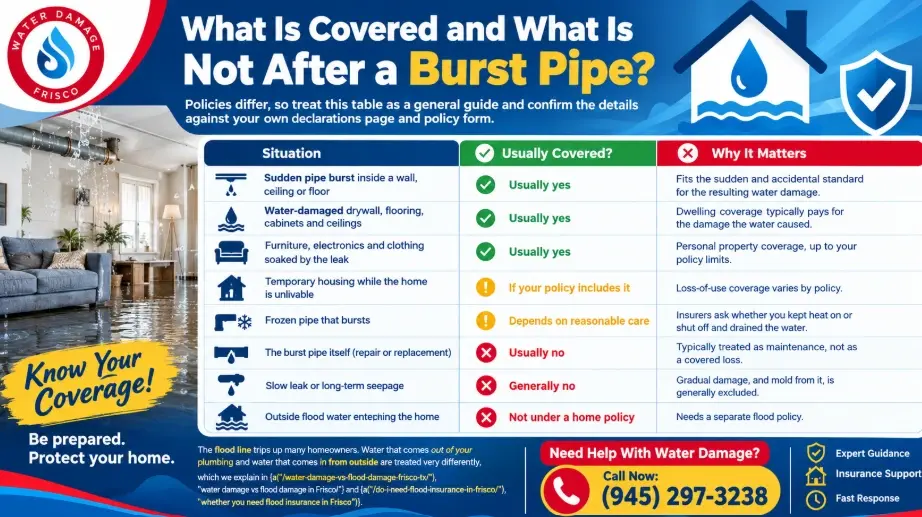
What Is Covered and What Is Not After a Burst Pipe
Policies differ, so treat this table as a general guide and confirm the details against your own declarations page and policy form.
| Situation | Usually covered? | Why it matters |
|---|---|---|
| Sudden pipe burst inside a wall, ceiling or floor | Usually yes | Fits the sudden and accidental standard for the resulting water damage. |
| Water-damaged drywall, flooring, cabinets and ceilings | Usually yes | Dwelling coverage typically pays for the damage the water caused. |
| Furniture, electronics and clothing soaked by the leak | Usually yes | Personal property coverage, up to your policy limits. |
| Temporary housing while the home is unlivable | If your policy includes it | Loss-of-use coverage varies by policy. |
| Frozen pipe that bursts | Depends on reasonable care | Insurers ask whether you kept heat on or shut off and drained the water. |
| The burst pipe itself (repair or replacement) | Usually no | Typically treated as maintenance, not as a covered loss. |
| Slow leak or long-term seepage | Generally no | Gradual damage, and mold from it, is generally excluded. |
| Outside flood water entering the home | Not under a home policy | Needs a separate flood policy. |
The flood line trips up many homeowners. Water that comes out of your plumbing and water that comes in from outside are treated very differently, which we explain in {a(“/water-damage-vs-flood-damage-frisco-tx/”, “water damage vs flood damage in Frisco”)} and {a(“/do-i-need-flood-insurance-in-frisco/”, “whether you need flood insurance in Frisco”)}.
What “Sudden and Accidental” Means for a Burst Pipe
This phrase decides most burst pipe claims. A sudden and accidental event is an abrupt failure you did not expect and could not have prevented in the moment, such as a supply line that splits overnight, a joint that blows apart, or a pipe that cracks when pressure spikes. The damage appears quickly and the cause is identifiable.
A gradual problem is different. A pinhole that has dripped behind a wall for months, a corroded fitting that has seeped for a season, or a leak you noticed and ignored is a maintenance issue in the eyes of most insurers. That is why an adjuster will look at the age of the stains, the condition of the surrounding materials and whether mold or rot is already present.
If you are unsure which category you are in, learn the warning signs in our guide to the signs of a burst pipe in a wall, and read about hidden water damage signs in homes without a basement to see how concealed leaks are usually discovered.
Are Frozen Pipes Covered in Texas?
Frozen pipes are the most disputed part of this topic. After the February 2021 freeze, TDI told insurers in Bulletin B-0010-21 that policies may cover freezing losses if the policyholder took reasonable care to keep the heat on, or to shut off the water and drain the pipes. TDI also said that what counts as reasonable depends on the specific claim, and it listed factors that can limit a homeowner’s options, including long power outages, conflicting guidance and icy conditions that made shutting off water risky.
In practice, an insurer is more likely to pay a frozen-pipe claim when:
- the heat was on, or the power failed through no fault of yours;
- you opened cabinet doors, let faucets drip or insulated exposed pipes before the freeze;
- you shut off and drained the plumbing if you were leaving town.
It is more likely to deny when the house was vacant or unheated, when pipes in an attic, garage or exterior wall were left unprotected, or when you ignored a known weakness. The City of Frisco publishes practical advice in its cold weather tips for residents, including letting faucets drip, insulating pipes in attics, garages and crawlspaces, and keeping the heat on when you leave town.
For step-by-step prevention and thawing advice, see our guides on how to keep pipes from freezing and how to thaw frozen pipes safely. If a pipe has already split above the living space, our article on a burst pipe in the attic or ceiling explains how to handle the wet insulation and ceiling.
Who Pays for the Pipe and Who Pays for the Water Damage?
Homeowners are often surprised to learn that a covered burst pipe claim can still leave them paying for the plumbing. Insurers generally separate two costs:
- The water damage to floors, walls, ceilings, cabinets and belongings, which is usually the covered loss.
- The failed pipe, which is usually treated as wear, age or maintenance and is paid by the homeowner.
Some policies add limited coverage for the cost of getting to a leak, such as opening a wall. Others do not. Ask your agent or adjuster directly, and ask for the answer in writing so there is no confusion after the repair.
Why Insurers Deny Burst Pipe Claims in Texas
Most denials trace back to a short list of reasons. Knowing them lets you avoid the avoidable ones.
- Gradual leak or seepage. TDI notes that gradual leaks, and any mold that results from them, are generally not covered.
- Failure to protect the property. TDI warns that an insurer may deny a claim if you do not protect your property after a loss, which includes shutting off the water and starting to dry the area.
- Neglect or poor maintenance. Ignoring a known leak or failing to maintain plumbing can lead to denial.
- Vacant or unheated home in winter. Freeze losses in a home left without adequate heat are a common denial reason.
- Late reporting. Waiting weeks lets damage grow and makes it harder to show the loss was sudden.
- Wrong peril. Outside flood water is not covered by a home policy even when the result looks like plumbing damage.
Mold is a related trap. TDI states that mold on an item damaged by a covered sudden event is covered, while mold from gradual leaks is not. If a mold claim is disputed, our article on a denied mold insurance claim in Frisco walks through your options, and our page on mold after water damage in Frisco explains how quickly it can start.
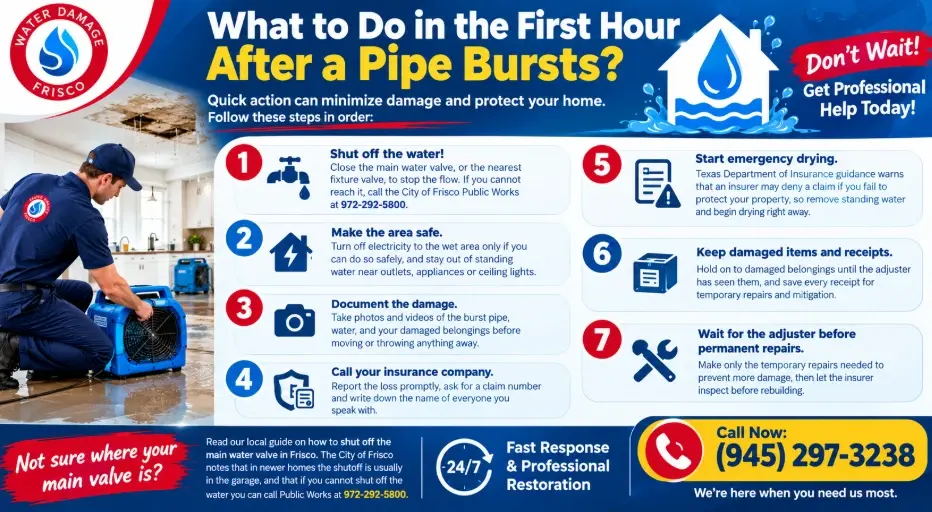
What to Do in the First Hour After a Pipe Bursts
The first hour protects your home and your claim at the same time. Follow these steps in order.
- Shut off the water. Close the main water valve, or the nearest fixture valve, to stop the flow. If you cannot reach it, call the City of Frisco Public Works line at 972-292-5800.
- Make the area safe. Turn off electricity to the wet area only if you can do so safely, and stay out of standing water near outlets, appliances or ceiling light fixtures.
- Photograph and video everything. Record the burst pipe, the water, every wet surface and your damaged belongings before anything is moved or thrown away.
- Call your insurance company. Report the loss promptly, ask for a claim number and write down the name of everyone you speak with.
- Start emergency drying. Texas Department of Insurance guidance warns that an insurer may deny a claim if you fail to protect your property, so remove standing water and begin drying right away.
- Keep damaged items and receipts. Hold on to damaged belongings until the adjuster has seen them, and save every receipt for temporary repairs and mitigation.
- Wait for the adjuster before permanent repairs. Make only the temporary repairs needed to prevent more damage, then let the insurer inspect before rebuilding.
Not sure where your main valve is? Read our local guide on how to shut off the main water valve in Frisco. The City of Frisco notes that in newer homes the shutoff is usually in the garage, and that if you cannot shut off the water you can call Public Works at 972-292-5800, a line available around the clock.
Once the leak is stopped, our checklist of what to do in the first 24 hours after water damage covers the next stage, and our explanation of water damage categories helps you understand which materials can be dried and which must be removed.
How to Document a Burst Pipe Claim
A well documented claim is paid faster and disputed less. Build your file while the evidence is still fresh.
- Date-stamped photos and video of the broken pipe, the source of the water and every affected room.
- A written inventory of damaged belongings with approximate age and value.
- The claim number, adjuster name and a log of every call and email.
- Receipts for plumbers, temporary repairs and water extraction or drying.
- The moisture readings and drying records from your restoration company.
- Photos of what was removed, such as wet carpet padding that cannot be saved, before it is discarded.
Professional drying logs are especially useful because they show an adjuster exactly how far the water traveled. They also support the point that you acted promptly to limit the loss, which is your duty under most policies.
The Texas Claim Timeline: What Your Insurer Must Do
Texas law sets deadlines for how insurers handle first-party property claims under Chapter 542 of the Insurance Code, known as the Prompt Payment of Claims Act. In general terms:
- The insurer must acknowledge your claim, begin investigating and request any needed documents within 15 days of receiving written notice.
- After it has everything it asked for, it must accept or reject the claim within 15 business days, unless it notifies you in writing that it needs more time.
- If it accepts the claim, it must pay within 5 business days.
These deadlines can shift after a declared disaster or for certain weather-related claims, and your policy may add its own requirements. TDI also notes that Insurance Code Section 541.060 prohibits unfair claim settlement practices, including failing to make a good-faith attempt at a prompt, fair settlement once liability is reasonably clear. If you believe your claim is being mishandled, contact your insurer first, then TDI or a licensed Texas attorney or public adjuster for guidance. For how this fits into the wider claim process, see our overview of the water damage insurance claim process in Texas.
Deductible vs. Damage: Should You File a Burst Pipe Claim?
A burst pipe in a wall or ceiling often creates far more damage than the visible stain suggests, because water travels along framing and under flooring. Before deciding whether to file, compare your deductible, listed on your declarations page, with a realistic estimate of the repair. Our water damage cost calculator and our breakdown of water damage restoration cost in Frisco, TX can help you set expectations.
Two cautions apply. First, do not let a small-looking leak talk you out of reporting it, because hidden moisture can become a large loss. Second, ask your agent how a claim may affect your renewal before you decide. You can usually open a claim to preserve your rights while you gather estimates.
Renters, Landlords and Rental Homes
If you rent, the owner’s policy covers the building, not your belongings. TDI explains that renter’s insurance is what covers your furniture, electronics and clothing after a burst pipe. Tenants should report the leak to the landlord in writing right away. Our guide to Texas rental water damage and tenant rights explains what each side is responsible for.
How Professional Water Damage Restoration Fits Into Your Claim
Restoration is not a separate step from the claim. It is the mitigation your policy expects you to carry out. A licensed, trained crew removes standing water, uses moisture meters to find water in hidden cavities, dries the structure and records everything for the adjuster. Our water damage restoration in Frisco team works from the same documentation standards insurers expect, and our emergency water damage restoration service is available when the loss happens at night or on a weekend.
Learn how mitigation differs from rebuilding in our guide to whether insurance covers water mitigation, and see what to expect from the water damage restoration timeline. If the leak affected the HVAC system, read about HVAC problems after water damage, and if the floors were soaked, see how to dry hardwood floors after water damage.
We serve homeowners across Frisco and nearby cities. Browse our Frisco service area page or our Frisco neighborhoods water damage guide to see how we help in your part of town.
How to Prevent the Next Burst Pipe
The cheapest claim is the one you never file. Insurers also look favorably on homeowners who can show they maintained the home.
- Insulate pipes in attics, garages and exterior walls before cold snaps, and keep the heat on when you travel.
- Know where your main shutoff is and test it once a year.
- Replace aging supply lines and hoses before they fail.
- Install smart leak detectors and automatic shut-off valves, which can stop a burst within moments.
- Follow our checklist to prevent water damage while you are away before any long trip.
If a pipe has already failed and needs repair, our overview of Frisco pipe break repair explains what to expect from a plumber, and our page on a slab leak in Frisco covers leaks under the foundation.
Frequently Asked Questions About Burst Pipes and Homeowners Insurance
Does homeowners insurance cover a burst pipe in Texas?
In most cases, yes, when the burst is sudden and accidental. The Texas Department of Insurance says most home policies cover sudden and accidental water damage such as a burst pipe. Coverage usually applies to the resulting damage to your home and belongings, not to the pipe itself, and your exact policy wording controls.
Does insurance cover frozen pipes that burst in Texas?
Often it does, but insurers look at whether you used reasonable care, such as keeping heat on or shutting off the water and draining the pipes when a freeze was coming. A home left unheated or vacant in winter is where most denials happen.
Will my insurer pay to repair the burst pipe itself?
Usually not. Standard policies typically pay for the water damage the burst caused, such as floors, drywall, ceilings and belongings, while the plumbing repair is treated as maintenance. Ask your agent whether your policy pays any tear-out or access costs.
How fast should I report a burst pipe claim?
As soon as the water is shut off and the area is safe. The Texas Department of Insurance advises reporting hidden water damage within a few days of noticing it, and many insurers prefer a report within 24 hours.
Can my claim be denied for a slow leak?
Yes. Gradual leaks and long-term seepage, and any mold that grows from them, are generally excluded. That is why the sudden-versus-gradual question is the one adjusters examine most closely.
Does insurance pay for water damage restoration after a burst pipe?
When the burst is a covered loss, reasonable emergency mitigation such as water extraction and drying is normally part of the claim. Keep every invoice and photograph and share them with your adjuster.
Get Burst Pipe Help in Frisco, TX Today
A burst pipe is stressful enough without wondering whether you are doing the right things for your claim. Our team stops the damage, dries the structure and gives you the documentation your adjuster needs. Call now, or visit our contact page to request help online.
Please note: this article provides general information for Texas homeowners and is not legal or insurance advice. Coverage depends on your policy language, your declarations page and the facts of your loss. Confirm details with your insurer or a licensed professional.
Official sources: Texas Department of Insurance: when are water damage and mold covered, TDI Bulletin B-0010-21 on frozen pipe claims and the City of Frisco cold weather tips.