
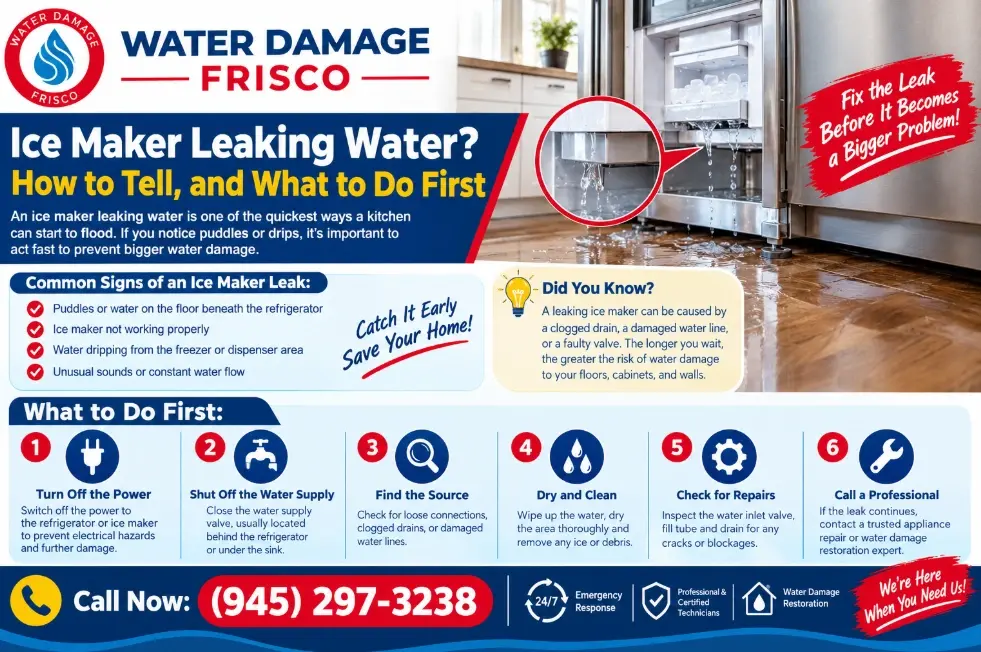
Ice Maker Leaking Water Signs? How to Tell, and What to Do First
An ice maker leaking water is one of the quietest ways a kitchen floods. Unlike a burst pipe, it rarely makes a puddle you notice at once. A loose fitting or a cracked line can drip slowly for weeks behind the refrigerator, soaking the flooring, the subfloor and the wall before a single stain shows up. This guide shows the warning signs, how to pin down where the water is coming from, where it travels and what it damages, so you can act before a small drip becomes a repair bill.
If you already know the leak is coming from somewhere other than the ice maker, such as the defrost drain, the drain pan or the door gasket, our guide to a refrigerator leaking water on the floor covers every common cause. This article focuses on the ice maker, its fill tube, its inlet valve and the water line that feeds it.
Found water around the refrigerator?
Our Frisco team is available 24/7 for water extraction, moisture checks and drying.
Call (945) 297-3238 Request Help OnlineSigns Your Ice Maker Is Leaking Water
Some signs are obvious. Many are not. Check this list, because the subtle ones usually show up first.
| What you notice | What it often means |
|---|---|
| A sheet of ice on the freezer floor or under the ice maker | The fill tube is misaligned or frozen, or the ice maker is overfilling. The extra water freezes, then melts and drips. |
| Hollow, small or fused-together cubes | Low water flow or a failing inlet valve. A weak valve can also seep when the ice maker is idle. |
| Water or dampness behind or beside the refrigerator | A loose fitting, cracked line or leaking valve on the supply line. |
| A damp spot or musty smell in the kitchen | Water has been sitting under the flooring or inside the wall for days or longer. |
| Flooring that lifts, cups, swells or feels soft near the fridge | Moisture has reached the flooring layers or the subfloor. |
| Stained or swollen cabinet sides and baseboards next to the refrigerator | Water is wicking sideways from the leak. |
| Ice maker runs constantly or makes a hissing or dripping sound | The valve is not shutting off fully. |
| A slightly higher water bill with no change in use | A slow, steady leak somewhere in the home’s plumbing. |
If the floor near the refrigerator is wet but the refrigerator and its water line check out dry, the water may be coming from elsewhere. Read about slab leaks in Frisco and the hidden water damage signs in Frisco homes with no basement before you assume it is the appliance.
What to Do Right Now When the Ice Maker Is Leaking
- Turn the ice maker off. Lift the wire shutoff arm or use the on/off switch or the control panel setting. This stops it from calling for more water.
- Close the water supply to the refrigerator. The shutoff valve is usually under the kitchen sink or in the wall behind the refrigerator. Turn it clockwise until it stops. If you cannot find it or it will not close, our guide to how to shut off the main water valve at your Frisco home shows how to stop the water at the source.
- Protect yourself from electricity. The refrigerator plugs into an outlet that is often right where the water collects. If the outlet or cord is wet, do not touch it. Switch off the breaker that feeds the kitchen outlet instead. A closed refrigerator keeps food cold for about four hours without power, so move fast but do not rush into standing water.
- Remove the standing water. Use towels, a mop or a wet/dry vacuum plugged into a dry outlet on a different circuit.
- Photograph everything before you move anything: the floor, the cabinet sides, the wall and the line connection. You will need these for repairs and for any insurance claim.
- Start air movement. Point a fan at the wet floor and turn on the AC or a dehumidifier. Avoid heaters or hair dryers on wet flooring.
Call a professional right away if
- Water has reached an outlet, the breaker panel or the refrigerator’s electrical parts.
- The flooring is soft, bubbling or lifting.
- You smell mustiness, or there are dark spots on the wall or cabinets.
- You cannot tell how long the leak has been going on.
Why Is the Ice Maker Leaking Water? Finding the Source
Ice makers fail in four common ways. Working out which one you have tells you whether it is a simple fix or a plumbing repair.
A misaligned or frozen fill tube
The fill tube delivers water into the ice mold. If it shifts or freezes over, water spills past the mold and freezes on the freezer floor. You may find a block of ice below the ice maker or water dripping into the fresh-food section when the ice melts during a defrost cycle. This type tends to leak around the time ice is made.
A leaking or stuck water inlet valve
The inlet valve opens to let water into the ice maker. If it sticks or does not seal, water can seep through even when no ice is being made. Mineral deposits from North Texas hard water can foul a valve over time. Hollow or fused cubes often appear first, and the leak can continue after the ice maker is switched off.
A cracked, kinked or loose water line
The line that feeds the ice maker is often a thin plastic or copper tube that runs from a valve in the wall or under the sink. Pushing the refrigerator back into place can kink or pinch the line, and age can make it brittle. Fittings can also work loose with the vibration of normal use. A leak here keeps running even when the ice maker is off.
Overfilling or an ice jam
A faulty sensor or a jammed ice mold can make the ice maker keep refilling. The extra water overflows the tray and runs down into the freezer. This often comes with oversized, clumped ice.
A simple way to narrow it down
Turn the ice maker off and leave the water supply open for a few hours, with a dry towel under the line connection. If water keeps appearing, the problem is the water line, a fitting or the inlet valve. If the water stops once the ice maker is off, the problem is more likely the fill tube, the ice mold or overfilling. Close the supply valve again afterward until the repair is done.
A technician should replace the inlet valve, the line or the ice maker assembly if the leak is inside the appliance or in the plumbing connection. A leveling adjustment, thawing a frozen fill tube and clearing an ice jam are the only things a homeowner should normally try on their own.
Where the Water Goes After an Ice Maker Leak
Most Frisco kitchens sit on a concrete slab, not over a basement. Water cannot drain down, so it moves sideways and soaks upward. Here is the usual path of an ice maker leak.
- Inside the freezer and fridge. Water freezes into a sheet, then thaws and drips into the fresh-food area or out the bottom of the appliance.
- Under and behind the refrigerator. This is where most slow leaks collect, out of sight, between the wall and the appliance.
- Along the baseboard and into the drywall. The bottom of the wall behind the fridge wicks water upward.
- Under the flooring. Water slips through seams and edges and spreads under the planks or tile, away from the leak.
- Into neighboring cabinets and the pantry. Cabinet bases made of particleboard soak up water from the floor.
- Into the wall cavity. If the supply valve and line run through the wall, a leak at the box can wet the insulation and framing.
For a wider look at how appliance leaks travel through a house, see appliance water damage in Frisco.
What an Ice Maker Leak Can Damage
| Material | What can happen | More help |
|---|---|---|
| Hardwood and engineered wood | Boards absorb water, cup and may buckle over days or weeks. | How to dry hardwood floors after water damage |
| Laminate | The fiberboard core swells and edges lift, and swelling is often permanent. | Can water-damaged laminate be saved? |
| Vinyl plank and tile | The surface may look fine, but water can sit under the planks or tile and in the grout. | Lift a few pieces near the fridge to check underneath. |
| Carpet and padding | Padding holds water like a sponge and can stay wet long after the top feels dry. | Wet carpet padding drying and discard guide |
| Subfloor and slab layers | Trapped moisture can stay in the layers under the finish flooring for a long time. | The foundation risk of untreated water damage |
| Cabinets, baseboards and drywall | Swelling, staining, crumbling and mold in the lowest few inches. | Mold after water damage in Frisco |
Slow leaks matter because the damage compounds. Mold can begin on damp porous materials in 24 to 48 hours, and a leak that has been dripping for weeks has had far longer than that. The water from an ice maker line is usually clean at first, but standing water that sits in building materials can lose its category over time. The three categories of water damage explain why that changes how the cleanup must be done.
How to Check for Hidden Moisture Behind and Under the Refrigerator
- Turn off the ice maker and the water supply first.
- Pull the refrigerator out slowly and straight. Have a helper if possible. Do not twist it or yank it, because that can crimp the water line or pull it off its fitting. Put cardboard under the feet to protect the flooring.
- Look at the water line from end to end. Check the valve, both fittings and the length of tube for drips, white mineral crust, green corrosion, kinks or cracks.
- Look at the floor and the wall. Press the baseboard and the bottom edge of the wall. Check for soft spots, a raised baseboard, stains or a musty smell.
- Check flooring and cabinets. Look for cupping, gaps at plank edges, swelling at the cabinet sides and a hollow or spongy feel.
- Use a moisture meter if you have one. Compare a reading near the fridge to a dry spot of the same material elsewhere in the home. A consistently higher reading means moisture is still there.
- Repeat after 24 to 48 hours. Surface dryness can hide wet layers underneath.
Not sure how far the water has spread?
We measure moisture in the flooring, cabinets and walls and tell you honestly whether drying equipment is needed.
Call (945) 297-3238 See Ice Maker Leak ServiceDry It Yourself or Call a Restoration Team?
You may be able to handle it if
- You caught the leak within a day and the water covered a small area of tile or vinyl.
- The flooring, baseboards and cabinets read dry on a moisture meter after 24 to 48 hours.
- There is no musty smell and no staining.
Call professionals if
- The leak may have run for days or weeks.
- The flooring is wood, laminate or carpet, or any of it has cupped, swelled or lifted.
- Water got into the wall, the cabinets or the next room.
- You see or smell mold, or the area is not dry after two days of fans.
- You are filing an insurance claim and want documented moisture readings.
Fans and a dehumidifier cannot dry layers of flooring and wall framing the way professional equipment can. Our guide on water extraction versus structural drying explains the difference, and our water extraction service in Frisco covers removing standing water. For the full job, from extraction to drying and repair, see our ice maker leak water damage cleanup service. To plan your budget and timeline, use the water damage cost calculator, the Frisco water damage restoration cost guide and our article on how long water damage restoration takes. If mold has already started, our mold remediation service in Frisco can handle it.
Insurance, Water Bills and Renters: Paperwork After an Ice Maker Leak
Homeowners insurance
Insurers often treat a sudden failure, such as a line that suddenly splits, differently from a leak that has been seeping for a long time. Many policies cover the first and commonly exclude the second, but wording varies, so read your policy or ask your agent. Keep photos, moisture readings and the failed part, and report the damage promptly. Our Texas water damage insurance claim guide walks through the process. This is general information, not insurance or legal advice.
Your water bill and the City of Frisco
A slow leak can show up as a higher water bill. The City of Frisco’s utility billing FAQ on high water bills and leaks explains common checks. The Utility Billing page lists customer service numbers and notes that a partial leak credit may be available, so call to confirm what applies to you.
Repairs and permits
Replacing flooring, cabinets or plumbing may require permits and registered contractors in Frisco. The City’s building permit and plan review page explains the rules, and the Building Inspections Division can confirm what your project needs.
If you rent
Tell your landlord or property manager in writing right away, and keep your photos. Our guide to Texas rental water damage and tenant rights explains what to expect.
How to Fix and Prevent an Ice Maker Leak
- Replace the water line before it fails. A braided stainless steel line is more durable than thin plastic tubing. Aging lines are a common cause of failures; our guide on how often to replace washing machine hoses gives a useful timeline for supply lines in general.
- Use a proper shutoff valve. Many plumbers avoid self-piercing saddle valves as a permanent connection because they are a known weak point. Ask a plumber to install a full shutoff valve.
- Leave a little slack. Do not crush or kink the line when you push the refrigerator back.
- Check behind the refrigerator once a year. Look for drips, mineral crust and damp flooring.
- Keep the refrigerator level and replace the water filter on schedule.
- Add a leak sensor. A small sensor behind the fridge can alert your phone. See our guide to smart leak detectors and shut-off valves.
- Shut off the supply when you travel. See how to prevent water damage while you are away.
Other kitchen appliances can leak in similar hidden ways. If you also run a dishwasher, read why a dishwasher leaks and where the water goes.
Need help today?
If the leak is bigger than the kitchen, see our 24/7 emergency water damage restoration in Frisco, or call now.
Call (945) 297-3238 See Our Emergency ServiceFrequently Asked Questions About an Ice Maker Leaking Water
Why is my ice maker leaking water?
The most common causes are a misaligned or frozen fill tube, a leaking or stuck inlet valve, a cracked or loose water line, and overfilling from a jammed ice mold or faulty sensor. A leak that continues with the ice maker off usually points to the line, a fitting or the inlet valve.
Is a leaking ice maker dangerous?
The water itself is usually harmless at first, but it can reach outlets and electrical parts, soak flooring and cabinets, and lead to mold if it sits. Switch off the ice maker and the water supply, and keep clear of wet outlets.
Can an ice maker leak for weeks without me noticing?
Yes. A slow drip behind or under the refrigerator is easy to miss. Warning signs include a musty smell, lifting or soft flooring, stained cabinet sides and a slightly higher water bill.
How do I know if the leak is the ice maker or the defrost drain?
An ice maker leak usually follows ice production, leaves ice on the freezer floor or continues with the ice maker off if the line or valve is at fault. A defrost drain problem typically causes water inside the fridge or pooling at the bottom after defrost cycles. Our guide to a refrigerator leaking water on the floor covers the drain and pan.
How long before mold grows after an ice maker leak?
Mold can start on damp porous materials in 24 to 48 hours. A long-running slow leak has usually been wet far longer, so dry the area and have it checked quickly.
Does homeowners insurance cover an ice maker leak?
Often it covers sudden and accidental discharge, but many policies exclude long-term seepage and maintenance issues. Check your policy wording, document the damage and ask your agent.
Can I fix the ice maker leak myself?
Leveling the refrigerator, thawing a frozen fill tube and clearing an ice jam are reasonable homeowner tasks. Replacing an inlet valve, the water line or the ice maker assembly is best done by a technician or plumber, and the wet flooring and cabinets still need to be dried.
Ice Maker Leaking Water in Frisco? Get It Checked Before the Damage Spreads
A slow ice maker leak is easy to miss and expensive to ignore. Switch the ice maker off, close the supply, pull the refrigerator out and look for moisture in the line, the floor, the cabinets and the wall. If anything feels wet, soft or musty, our team can measure the damage and tell you what needs drying and what can stay. We serve homeowners across Frisco, TX and its Frisco neighborhoods, and nearby cities through our DFW service locations. For broader needs, see our water damage restoration in Frisco page.
Talk to a Frisco water damage specialist today
Honest guidance on whether your kitchen needs drying equipment, and 24/7 emergency response when it does.
Call (945) 297-3238 Contact Us Online