
Refrigerator Leaking Water on Floor? Start With Where and When It Leaks
A refrigerator leaking water on floor surfaces is rarely a mystery once you notice the pattern. Water that shows up in a steady stream points to a supply line or valve. Water that appears every few hours points to the defrost cycle, and water that shows up after the ice maker runs points to the fill tube or inlet valve. The pattern tells you which part failed, and in many cases the part costs very little.
The expensive part is what you cannot see. A refrigerator sits flush against a wall with a water line running behind it, and most people only move it when they clean or replace it. This guide explains the nine most common causes, where the water goes once it leaves the appliance, and how to check for hidden damage before it turns into rotted subfloor or mold.
The most common causes are a clogged or frozen defrost drain, a cracked or loose water supply line, a failing inlet valve, a leaking filter housing and a refrigerator that is not level. Close the water valve, remove standing water, then check the floor, cabinet base and wall behind the unit for moisture. A repaired leak that is never dried can keep damaging the structure.
Match the symptom to the likely cause
| What you notice | Most likely cause | Hidden damage risk |
|---|---|---|
| Water pooling inside at the bottom, then on the floor | Frozen or clogged defrost drain | Moderate. Water spreads slowly under the unit |
| Puddle under the front, worse after defrost | Cracked or overfull drain pan | Moderate. It sits under the fridge unseen |
| Water behind the unit, constant | Cracked or loose supply line, failing valve | Very high. Pressurized water runs all day |
| Leak after ice is made or the tray refills | Inlet valve, fill tube, cracked ice mold | High. It leaks in short cycles for weeks |
| Drips at the filter or dispenser | Filter housing, cartridge seal, dispenser line | Moderate. Often found early |
| No puddle, but musty smell or soft flooring | Slow pinhole leak or fitting seepage | Very high. Rot and mold form out of sight |
Water already on the kitchen floor?
Our Frisco team is available 24/7. Call (945) 297-3238 for a moisture check before the water reaches the subfloor.
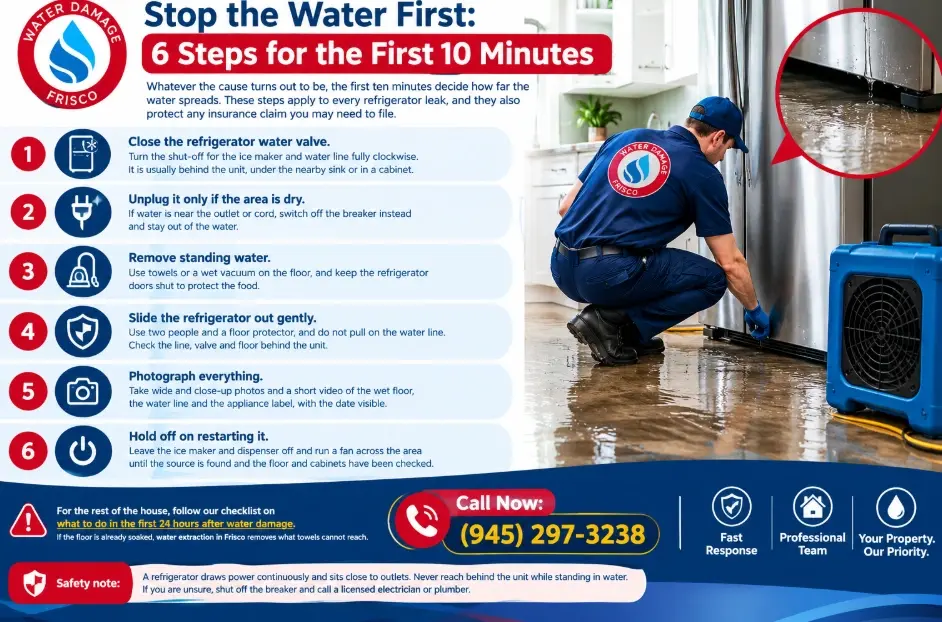
Stop the Water First: 6 Steps for the First 10 Minutes
Whatever the cause turns out to be, the first ten minutes decide how far the water spreads. These steps apply to every refrigerator leak, and they also protect any insurance claim you may need to file.
- Close the refrigerator water valve. Turn the shut-off for the ice maker and water line fully clockwise. It is usually behind the unit, under the nearby sink or in a cabinet.
- Unplug it only if the area is dry. If water is near the outlet or cord, switch off the breaker instead and stay out of the water.
- Remove standing water. Use towels or a wet vacuum on the floor, and keep the refrigerator doors shut to protect the food.
- Slide the refrigerator out gently. Use two people and a floor protector, and do not pull on the water line. Check the line, valve and floor behind the unit.
- Photograph everything. Take wide and close-up photos and a short video of the wet floor, the water line and the appliance label, with the date visible.
- Hold off on restarting it. Leave the ice maker and dispenser off and run a fan across the area until the source is found and the floor and cabinets have been checked.
For the rest of the house, follow our checklist on what to do in the first 24 hours after water damage. If the floor is already soaked, water extraction in Frisco removes what towels cannot reach.
9 Common Reasons a Refrigerator Leaks Water
Appliance technicians see the same handful of failures repeatedly. Use this list to narrow down the source, and keep in mind that two causes can be present at once.
1. A frozen or clogged defrost drain
During each defrost cycle, melted frost runs through a small drain tube to a pan under the unit. Food debris or ice can block that tube, so the water backs up inside the freezer or refrigerator and spills onto the floor. A crowded freezer that blocks the back wall makes this more likely.
2. A cracked, warped or overfull drain pan
The drain pan under the refrigerator catches defrost water so it can evaporate. A cracked or tilted pan, or one that is full of debris, lets that water reach the floor.
3. A cracked or loose water supply line
The thin plastic line that feeds the ice maker and water dispenser can crack, kink or pull loose at a fitting, especially if the refrigerator was pushed back too hard. Because the line is pressurized, it can leak constantly.
4. A failing water inlet valve
This electric valve opens to fill the ice maker and dispenser. If it sticks or fails to seal, water drips even when the ice maker is not asking for any.
5. A leaking water filter or filter housing
A worn cartridge seal, a cartridge that is not fully seated or a cracked housing can drip at the filter. The leak often starts right after a filter change.
6. An ice maker problem
An overfilling ice maker, a frozen fill tube or a cracked ice mold can send water past the tray and into the freezer, where it freezes and later melts onto the floor.
7. A refrigerator that is not level
A unit that tilts forward or to one side can push condensation and defrost water out of the pan or over the door edge. The leveling feet are usually adjustable from the front.
8. A worn door gasket or high humidity
A gasket that no longer seals lets warm, humid air in, which increases condensation and frost. In a humid North Texas summer this can produce more water than the pan was built to handle.
9. A leaking supply valve or fitting at the wall
The shut-off valve and the pipe that feed the refrigerator sit behind the unit, or inside the wall. A loose compression nut or a pinhole in the valve can seep for months. The same hidden-line problem is covered in our guide to appliance water damage in Frisco, where we recommend regular inspection of every appliance connection.
Where the Water Goes After a Refrigerator Leak
A refrigerator is heavy, tightly fitted and rarely moved, so water that escapes underneath or behind it has plenty of places to hide. In most Frisco homes the floor sits on a concrete slab with a thin layer of flooring above it, and the water follows the path of least resistance.
Under the unit
Water spreads sideways under the refrigerator and into the seams of the flooring. It can stay trapped there for weeks, because the appliance blocks airflow and the area never dries naturally.
The cabinet and pantry sides
Refrigerators are often framed by cabinets or a pantry. Particleboard cabinet bases soak up water like a sponge, swell, and rarely return to their original shape.
The wall behind the refrigerator
A leaking line or valve soaks the drywall, baseboard and insulation behind the unit. The surface can look dry while the back side stays damp. Our hidden water damage signs in Frisco homes guide explains why slab-on-grade houses hide moisture differently from homes with basements.
The flooring and subfloor
Once water reaches the underlayment or subfloor, it can keep damaging the structure long after the surface is wiped dry. Hardwood is especially vulnerable, and a long-running leak can reach the slab edge.
The type of water matters
Water from the supply line starts out clean, but clean water that sits for a day or more is no longer clean, and defrost water can carry food residue. Professionals classify this using the categories we explain in our guide to water damage categories, and the category decides which materials can be dried and which must be removed.
How to Check for Hidden Damage After a Refrigerator Leak
Once the source is found and the surface water is gone, spend fifteen minutes on this inspection. It follows the same order a restoration technician uses before taking meter readings.
- Smell first. A musty or sour odor near the refrigerator means water is trapped somewhere.
- Look behind and under the unit. Check the line, the valve and the floor for stains, rust, corrosion or green mineral deposits.
- Check the flooring edge. Look for cupping, lifting seams, gaps opening between planks or tiles that sound hollow.
- Press the cabinet bases. Soft, swollen, stained or crumbling material beside the refrigerator is a clear warning.
- Inspect the baseboards and drywall. Peeling paint, bubbles and discoloration at the bottom of the wall are signs of wicking.
- Look at the water bill. A slow rise with no change in habits can point to a small, constant leak.
- Use a moisture meter. Compare readings beside the refrigerator with a dry area of the same material.
- Re-check after 24 to 48 hours. Mold can begin to grow in damp, enclosed spaces within that window, so a second look matters.
If any of these checks come back positive, read about mold after water damage in Frisco and plan professional drying rather than waiting to see what happens. If mold is already visible, our mold remediation service in Frisco covers the next step. The longer water stays in a structure, the more it can weaken it, as described in our article on the foundation risk of untreated water damage.
How a Refrigerator Leak Affects Different Kitchen Floors
| Floor type | What usually happens | Where to read more |
|---|---|---|
| Solid or engineered hardwood | Edges cup and boards can gap or buckle as moisture moves through | how to dry hardwood floors after water damage |
| Laminate | The fiberboard core swells at the seams and rarely goes back | whether water-damaged laminate can be saved |
| Tile | The tile survives, but water collects below it, in the grout lines and in the cabinet base | Ask for moisture readings under and beside the tile |
| Vinyl plank | Water travels under the planks and stays trapped, so the surface can look perfect | Lift a loose edge to check the underside |
| Carpet in adjoining rooms | Padding holds water long after the surface feels dry | wet carpet padding drying and discard guide |
Repair It Yourself, Call a Plumber, or Call a Restoration Team?
These are three different jobs, and most refrigerator leaks need more than one of them.
- Fix the source. Leveling the unit, cleaning the drain pan, clearing a frozen defrost drain and reseating a filter are reasonable DIY jobs. Supply lines, valves and anything involving the electrical system are better handled by a plumber or appliance technician.
- Remove and dry the water. Fixing the refrigerator does nothing for the water already in the floor, cabinets and wall. This is the job for a restoration crew, who use moisture mapping, extraction and controlled drying equipment. Our refrigerator ice maker leak water damage service covers exactly this step, and our water damage repair in Frisco team handles the rebuild when materials cannot be saved.
- Rebuild what could not be saved. Swollen cabinet bases, damaged baseboards and subfloor sections are repaired or replaced once the area is dry.
If you want an idea of the budget before you call, our water damage restoration cost guide for Frisco and the water damage cost calculator explain what drives the price, and how long water damage restoration takes covers a typical timeline.
Not sure how far the water traveled?
Call (945) 297-3238 and we will tell you what to check, what to dry and what to leave alone.
Insurance and Your City Water Bill: What Frisco Homeowners Should Know
Homeowners insurance
Policies in Texas generally respond to sudden and accidental water discharge, such as a supply line that bursts. They often exclude damage from a leak that went on slowly for a long time, which is how many refrigerator leaks behave. Your own policy wording decides, so read it or ask your agent. Photos from the first ten minutes, the repair invoice for the failed part and a dated moisture report all help. Our Texas water damage insurance claim guide walks through the process.
The City of Frisco
Unlike a dishwasher, a refrigerator water line can leak continuously, so a rising water bill is a real warning sign. Frisco’s Utility Billing department offers a one-time partial credit for leaks on the customer side of the meter, provided the repair is finished within 90 days of detecting the leak and the request is filed within 90 days of the repair. Credits are limited to once every 12 consecutive months. These City of Frisco pages are worth bookmarking:
How to Keep a Refrigerator From Leaking Again
- Replace a plastic water line with braided stainless steel tubing, and leave a little slack so the unit can be moved without stress on the fittings.
- Do not push the unit back hard. Pinched or kinked lines are a common cause of leaks.
- Change the water filter on schedule and make sure it is fully seated.
- Clean the drain pan and keep the area behind the grille free of dust and debris.
- Do not overstock the freezer in a way that blocks the back wall and the defrost drain.
- Level the refrigerator after any floor repair or move.
- Pull the unit out once a year to check the line, the valve and the floor.
- Add a leak sensor behind or beside the refrigerator. Our guide to smart leak detectors and shut-off valves explains which types are worth buying.
The refrigerator is only one of several appliances that fail quietly. If you are checking the rest of the kitchen and laundry area, read why your dishwasher is leaking and how our dishwasher leak water damage service helps, what to do when a washing machine has overflowed, and why a water heater is leaking in a Frisco home.
Frequently Asked Questions About a Leaking Refrigerator
Should I unplug the refrigerator if it is leaking?
Only if the floor around the outlet and the cord is completely dry. If water is near the plug, switch off the breaker instead and do not stand in water. Close the refrigerator water valve first, and keep the doors shut to protect the food.
Why is my refrigerator leaking water inside and under the fridge?
Water pooling inside at the bottom, or under the unit, usually points to a frozen or clogged defrost drain. Melted frost has nowhere to go, so it overflows into the compartment and then onto the floor.
Why does my refrigerator only leak sometimes?
Leaks that appear in a pattern usually follow the defrost cycle, ice maker refills or filter changes. A constant leak points to a supply line or valve, and a leak after making ice points to the fill tube or inlet valve.
Can a refrigerator leak cause mold?
Yes. Water trapped under flooring, in the cabinet base or inside the wall behind the unit can support mold growth within 24 to 48 hours. A slow leak that nobody notices is the most likely to cause it.
Does homeowners insurance cover a refrigerator leak?
Many policies cover sudden and accidental water damage, such as a supply line that bursts, and exclude long-term seepage or lack of maintenance. Your policy wording, the cause and your photos and invoices decide the outcome, so file promptly.
Who should I call first in Frisco for a leaking refrigerator?
Close the water valve and call an appliance technician or plumber for the repair. Call a restoration company as soon as flooring, cabinets or the wall behind the unit are wet, because drying should begin quickly. Many homeowners make both calls on the same day.
Refrigerator Leak in Frisco? Get It Checked Before the Damage Spreads
A leaking refrigerator is usually a small repair, but the water it leaves behind can grow into a large one if it is not dried properly. We serve homes across Frisco, TX, including Frisco neighborhoods from Starwood to The Trails, and our Frisco neighborhoods water damage guide explains the local risks. We also respond in Plano, Allen, McKinney and Prosper.
Talk to a Frisco water damage specialist now
24/7 response. Call (945) 297-3238 or send us the details online and we will call you back.