
Bathroom Sink Leaking Underneath: The Quick Answer
A bathroom sink leaking underneath almost always traces back to one of five places: the P-trap slip nuts, the drain flange or tailpiece, a worn supply line or shutoff valve, the faucet body, or a hairline crack in the basin. The fastest way to tell them apart is to notice when the water appears. Water that shows up while the sink drains points to the drain side. Water that shows up while the faucet runs, or all the time, points to the supply side.
Most of these leaks are small, and a small leak is exactly why they do damage. A slow drip behind a closed vanity door can soak particle board, swell the cabinet floor and feed mold for weeks before anyone smells it. This guide shows how to find the source in about ten minutes, what to tighten or replace, when to hand the job to a plumber, and how to check the cabinet and subfloor for hidden water damage in your Frisco home.
Water already on the floor or inside the vanity? Our Frisco crew can extract it and dry the structure today.
Call (945) 297-3238What to Do in the First 10 Minutes
Before you look for the cause, stop the water and protect the room. Work through these steps in order:
- Close the angle stops. Reach under the sink and turn the small oval handles on the hot and cold supply lines clockwise until they stop. If a handle will not turn or the valve keeps dripping, close the main valve instead. Our guide on how to shut off the main water valve in Frisco shows where to find it.
- Empty the cabinet. Lift out cleaning supplies, toilet paper and storage bins so you can see every pipe and the cabinet floor.
- Soak up standing water. Use towels or a wet vacuum. Do not leave a wet towel sitting in the cabinet, because it holds moisture against the wood.
- Take photos. Capture the pipes, the wet areas and any stained wood. You will want them if you ever file a claim.
- Mind the electricity. If the leak is near an outlet, a vanity light or a hair dryer plug, switch off that breaker before you put your hands in the wet area.
How to Find Which Part Is Leaking
Guessing leads to replacing the wrong part. A dry paper towel test removes the guesswork, because paper shows even a single bead of water that your eyes will miss.
- Dry every pipe, nut and valve with a rag, then dry the cabinet floor.
- Wrap a strip of dry toilet paper around each joint, or lay a paper towel under each connection.
- Open the angle stops again. Look at the supply side first: the two valves, the two braided lines and the connections that go up into the faucet.
- Turn the faucet on for one minute and check the paper at each supply connection.
- Now plug the drain, fill the basin halfway and release it. Watch the drain side: the tailpiece below the sink, the P-trap and the wall pipe.
- Mark the first spot where the paper turns wet. That joint, or the one directly above it, is your source, because water always runs downhill from the real leak.
Match the Symptom to the Cause
This table pairs what you see with the most likely culprit. Use it together with the paper test above.
| When the water appears | Likely source | Typical fix | DIY level |
|---|---|---|---|
| Only while the sink drains | P-trap slip nut, washer or tailpiece | Hand-tighten, then reseat or replace the washer | Easy |
| Only when the basin is full | Overflow channel, pop-up assembly or basin crack | Reseal the pop-up, or replace the basin if cracked | Moderate |
| Under the sink drain opening, always when draining | Drain flange seal (plumber’s putty or gasket) | Remove the drain body and reseal it | Moderate |
| Only while the faucet runs | Supply line connection or faucet inlet | Replace the braided supply line | Easy |
| Constantly, even when nobody uses the sink | Angle stop or supply line under pressure | Replace the valve or line | Moderate |
| Drips from the faucet base or handle, then runs down | Worn O-ring or cartridge | Replace the O-ring or cartridge | Moderate |
| Wet wall or ceiling below, no visible drip | Concealed pipe or drain inside the wall | Professional leak detection | Plumber |
The Most Common Causes in Detail
1. A Loose or Worn P-Trap
The P-trap is the curved pipe under the sink that holds a little water to block sewer gas. Vibration and the constant weight of draining water loosen the slip nuts over the years, and the rubber or plastic washers inside harden and flatten. If the paper towel under the trap is wet only after the sink drains, tighten each slip nut by hand, then add a quarter turn. Overtightening cracks the plastic threads, which turns a drip into a bigger problem. If tightening does not stop it, unscrew the nut, check that the washer sits flat and the bevel faces the right way, and replace it if it looks stiff or flattened.
2. A Worn Supply Line or Shutoff Valve
Braided supply lines last roughly ten years, though the real figure depends on water conditions and how often they are disturbed. A line that sweats, shows rust-colored stains on the braid or drips at the nut should be replaced, not tightened again and again. Bring the old line to the hardware store so the size and thread type match. If the angle stop itself leaks around its stem, or will not close fully, replace the valve. Our post on smart leak detectors and shutoff valves explains how a small sensor under the vanity can warn you the moment one of these parts lets go.
3. A Faucet Leak That Runs Down the Pipes
When the faucet body leaks, the water can follow the supply lines and appear to come from lower down. Look for moisture at the base of the faucet, around the handles and at the points where the lines screw into the faucet. A worn O-ring or cartridge is the usual cause and a common DIY repair. Rust rings on the sink deck or loose, wobbling handles are further clues.
4. A Failed Drain Flange or Pop-Up Assembly
The drain flange is the metal ring in the bottom of the basin. It is sealed with plumber’s putty or a gasket, and that seal dries out. The leak shows up around the tailpiece right below the sink, but only when water is going down. The pop-up stopper linkage in a bathroom sink adds another set of seals, which is a detail many kitchen-sink guides skip. For the kitchen version of this troubleshooting, see our guide to water leaking under the kitchen sink.
5. High Water Pressure and Aging Plumbing
Fittings that keep loosening or supply lines that fail early can mean the home’s water pressure runs high. A plumber can test it with a simple gauge and fit a pressure-reducing valve if needed, which protects every fixture in the house, not only the bathroom.
Do not ignore a “minor” drip. Even a slow leak can keep the cabinet floor damp around the clock. Wood that stays wet can start growing mold within 24 to 48 hours, according to common restoration guidance, and a vanity made of pressed wood absorbs water like a sponge.
DIY Repair or Call a Plumber?
You can usually handle a loose slip nut, a worn washer or a replacement braided supply line with basic hand tools. Call a licensed plumber when:
- The angle stop will not turn, or it breaks when you try.
- Pipes are corroded, cracked or made of an old material you do not recognize.
- The basin is cracked, or the sink top has separated from the vanity.
- The leak returns after you have already replaced the part.
- You find water in the wall, a stained ceiling below an upstairs bathroom or a damp smell you cannot trace.
A plumber repairs the pipe. A restoration company deals with what the water already soaked. If the cabinet, drywall or flooring got wet, you usually need both, and ideally in that order: stop the leak first, then dry the structure.
Check the Vanity and Subfloor for Hidden Water Damage
This is the step most repair guides leave out. After the leak is fixed, inspect these areas, even if the repair looked simple:
- The cabinet floor. Press a screwdriver tip into the wood. If it sinks in, or the surface is swollen, bubbled or peeling, the material has absorbed water.
- The back wall of the vanity. Dark stains or a white powdery residue often mean repeated wetting.
- The bathroom floor beside the vanity. Look for lifting vinyl, cupped laminate or tiles that sound hollow.
- Smell. A musty, earthy odor after you close the cabinet door suggests moisture is still trapped.
- The ceiling below. In a two-story home, a brown ring on the ceiling underneath the bathroom is a warning sign. Read our guide to ceiling leak repair in Frisco for what to do next.
Many Frisco homes are built on slab foundations with the plumbing in interior walls, so a leak can travel before it shows. Our article on hidden water damage signs in Frisco homes lists the early warnings, and the overview of the most common home water damage spots in Frisco shows where else to look.
How Water Gets Dried and When Materials Must Go
Surface drying with a towel or a fan rarely reaches wet insulation, baseboards or subfloor. Professionals measure moisture with meters and use air movers and dehumidifiers to dry the structure to a documented target. Learn the difference in water extraction versus structural drying, and see why soaked padding is often discarded in wet carpet padding: dry it or discard it. If you are not sure how far the water traveled, the first 24 hours after water damage checklist is a good next read.
If Mold Has Already Started
Small spots on a cabinet surface can sometimes be cleaned, but a musty smell, dark growth on the back wall or a spreading stain needs a proper assessment. Review the top warning signs of mold and our explanation of mold after water damage in Frisco. When growth is confirmed, our mold remediation service in Frisco contains and removes it safely.
Not sure how far the water spread? Ask for a moisture check before you rebuild the vanity.
Call (945) 297-3238Does Insurance Cover a Leaking Bathroom Sink?
Coverage depends on the policy and on how the leak happened. Many standard homeowners policies cover sudden and accidental water discharge, such as a supply line that bursts, but exclude damage from a leak that went on for a long time unnoticed. That is why a dated photo record and a quick repair matter. Document the source, the repair receipt and the damage before anything is thrown out. Our Texas water damage insurance claim guide walks through the process, and your adjuster has the final word on what your specific policy covers.
Frisco Water Bill Spike? Ask About the City’s Leak Credit
A hidden leak can raise your water bill before you ever see a puddle. The City of Frisco offers a one-time courtesy credit on billed water usage for leaks on the customer’s side of the meter. According to the City’s Partial Leak Credit program, the repair generally needs to be completed within 90 days of finding the leak, and the request is submitted afterward with a plumber’s receipt or a receipt for the parts. Keep your receipts and check the program page for current terms. For watering rules, conservation tips and leak reporting, see the City’s Frisco Water Resources page.
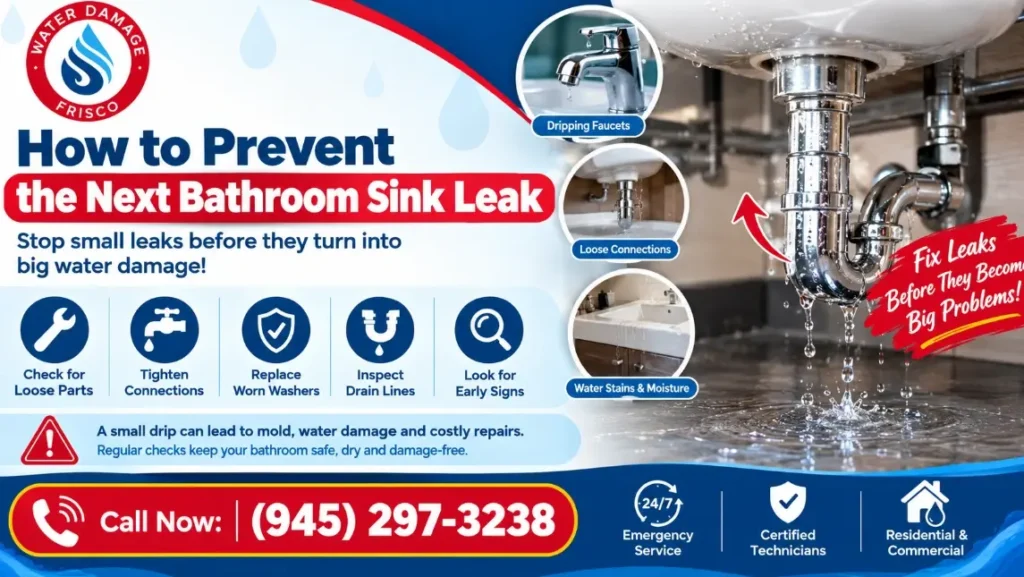
How to Prevent the Next Bathroom Sink Leak
- Once a quarter, run your fingers along each supply line, valve and slip nut. Any dampness or mineral crust means attention is due.
- Replace braided supply lines every five to ten years, before they fail.
- Keep the cabinet floor clear so a drip is easy to spot, and avoid storing items directly on the wood.
- Place a small leak sensor on the cabinet floor. See our guide to smart leak detectors and shutoff valves for options.
- Traveling? Follow our checklist to prevent water damage while you are away.
Leaks from fixtures and appliances follow similar patterns throughout the home. Our overview of appliance water damage in Frisco and the post on an overflowing sink and tub cover related situations.
When Your Sink Leak Becomes a Water Damage Problem
Once water has soaked the cabinet, the wall or the floor, the job shifts from plumbing to restoration. Our sink leak water damage service in Frisco extracts the water, dries the vanity area and subfloor, and checks for hidden moisture. For larger or spreading losses, we also provide water damage restoration in Frisco, TX, and the same crew responds to emergency water damage restoration calls in Frisco at any hour. Want a rough idea of the scale first? Try the water damage cost calculator, read how long water damage restoration takes or learn about water damage categories. We serve homes across Frisco, Texas, including every neighborhood in our Frisco neighborhoods water damage guide. You can also contact our team online.
Bathroom Sink Leaking Underneath: Frequently Asked Questions
Why is my bathroom sink leaking underneath only when I use it?
A leak that appears only during use usually comes from a connection that is not tight under flow. If it happens as the sink drains, check the P-trap slip nuts, the tailpiece and the drain flange. If it happens as the faucet runs, check the supply lines and the faucet inlets.
How do I know if the P-trap, supply line or faucet is leaking?
Dry everything, wrap dry toilet paper around each joint, then run the faucet and drain the basin separately. Wet paper on the supply side means a supply line, valve or faucet. Wet paper on the drain side means the P-trap, tailpiece or drain flange.
Can I use the sink while it is leaking underneath?
It is best not to. Close the angle stops and place a bucket under the leak until it is repaired. Continued use sends more water into the cabinet, which raises the risk of swelling and mold.
How long does it take for mold to grow under a bathroom sink?
Mold can begin to grow on damp organic material within 24 to 48 hours. A small, slow leak that keeps the cabinet floor wet can lead to visible growth within days to weeks, depending on ventilation and materials.
Should I call a plumber or a water damage company?
Call a plumber to repair the leaking part, and a water damage company when the cabinet, wall or floor got wet. In Frisco, you can call Water Damage Frisco at (945) 297-3238 for a moisture check and drying plan.
Will my homeowners insurance pay for a bathroom sink leak?
It can, if the damage was sudden and accidental, but many policies exclude damage from long-term seepage. Document the leak, keep the repair receipt and read your policy or ask your adjuster.
Leak fixed, but the vanity still smells damp? Do not wait for mold. We answer calls day and night in Frisco and the surrounding DFW area.
Call (945) 297-3238