
Water Leaking Under Kitchen Sink: How to Find the Source and Check for Damage
A wet cabinet floor is easy to ignore until the wood swells and the smell starts. Here is how to find where the water is coming from, what to do right away, and how to tell when the damage goes beyond a wet towel.
- Close the two small shutoff valves under the sink, empty the cabinet, and dry everything so you can see where the water starts.
- Most under-sink leaks come from the drain connections, a supply line, the faucet base, or the disposal.
- If the cabinet floor is soft, stained, or smells musty, the damage is already past the pipe and needs to be dried and checked.
Water Leaking Under Kitchen Sink are among the most common household water problems, and also among the most underestimated. The cabinet hides the pipes, a leak can drip slowly for weeks, and the damage spreads to the cabinet floor, the wall behind it, and sometimes the subfloor. This guide helps you find the source quickly and decide what to do next.
What to Do First
- Close the shutoff valves. Turn the small oval handles under the sink clockwise, one for hot and one for cold. If they will not turn, close the main water valve.
- Put a bucket under the drain pipe and stop using the sink, dishwasher and disposal until you know the source.
- Empty the cabinet. Remove cleaning supplies and trash bins and set them on a towel, not on the floor, so you can see what is wet.
- Mop up and dry the cabinet floor with towels, then run a fan toward it.
- Photograph the leak and the damage before you start repairs, in case you need to file a claim.
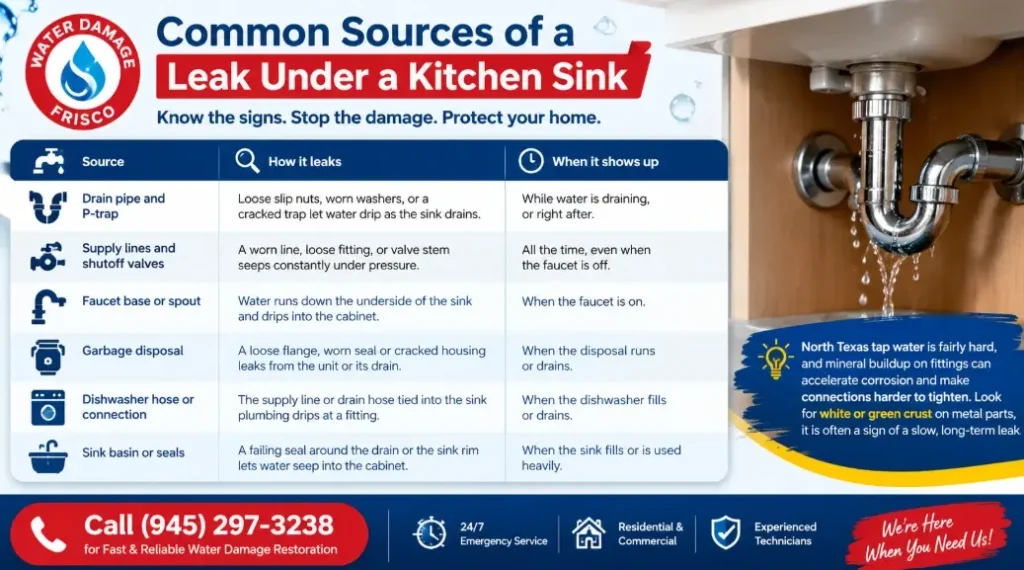
Common Sources of a Leak Under a Kitchen Sink
| Source | How it leaks | When it shows up |
|---|---|---|
| Drain pipe and P-trap | Loose slip nuts, worn washers, or a cracked trap let water drip as the sink drains | While water is draining, or right after |
| Supply lines and shutoff valves | A worn line, loose fitting, or valve stem seeps constantly under pressure | All the time, even when the faucet is off |
| Faucet base or spout | Water runs down the underside of the sink and drips into the cabinet | When the faucet is on |
| Garbage disposal | A loose flange, worn seal or cracked housing leaks from the unit or its drain | When the disposal runs or drains |
| Dishwasher hose or connection | The supply line or drain hose tied into the sink plumbing drips at a fitting | When the dishwasher fills or drains |
| Sink basin or seals | A failing seal around the drain or the sink rim lets water seep into the cabinet | When the sink fills or is used heavily |
North Texas tap water is fairly hard, and mineral buildup on fittings can accelerate corrosion and make connections harder to tighten. Look for white or green crust on metal parts, it is often a sign of a slow, long-term leak.
The Paper Towel Test: Find the Exact Spot
- Dry every pipe, fitting and the cabinet floor completely.
- Wrap a small piece of dry paper towel around each connection, or lay one under it.
- Run the cold water for a minute, then the hot. Check the towels.
- Fill the sink basin, then release the water so it drains through the trap. Check the towels again.
- Run the dishwasher or disposal briefly if they connect under the sink, and check once more.
The first towel that gets wet points to the source. A leak that only appears while draining is a drain-side problem. A leak that never stops is almost always a supply line or shutoff valve.
Is It Just a Drip, or Is There Hidden Damage?
| What you see | What it likely means |
|---|---|
| Cabinet floor is dry after wiping | A minor or recent leak, likely fine after the repair |
| Cabinet floor is soft, swollen or stained | The leak has been going on for some time and the particleboard is absorbing water |
| Musty smell or dark spots | Mold or mildew is starting. The material needs to be dried and checked, not just wiped |
| Wet wall or baseboard behind the cabinet | The water has spread beyond the cabinet and may be inside the wall |
| Damp flooring next to the sink | Water has run out of the cabinet or soaked into the subfloor |
Water that escapes sideways can show up as damp flooring or a wet baseboard, see hidden water damage signs in Frisco homes. If the cabinet has been wet for more than a day or two, read mold after water damage in Frisco.
Fix It Yourself or Call a Plumber?
- DIY is reasonable for tightening a slip nut, replacing a worn washer, or swapping a flexible supply line when the shutoff valves close fully.
- Call a plumber if a shutoff valve will not close, a pipe is corroded or cracked, the leak is inside the wall, or you are not comfortable working with plumbing.
- Do not use chemical drain cleaners on a leaking drain. They can sit in the trap and damage fittings.
If the sink overflows instead of leaking, see overflowing sink and tub water damage. For households that want automatic protection, smart leak detectors and shutoff valves can alert you or close the water before a drip becomes a flood.
Cabinet Wet or Smells Musty?
If the damage goes beyond the pipe, we dry the cabinet and the area behind it before it becomes a larger repair.
When the Leak Becomes a Water Damage Job
A single wiped-up drip is a plumbing fix. Water that has soaked the cabinet floor, run into the wall, or reached the subfloor is a drying job, because wet materials hold moisture long after the surface looks dry. That is where professional extraction and drying make the difference. Our sink leak water damage service in Frisco covers moisture mapping, drying and repair, so the cabinet, wall and floor are all dry before anything is closed up.
Insurance and Under-Sink Leaks
Coverage often depends on whether the leak was sudden and accidental or slow and long-term. Take photos of the leak and the damage, keep plumber and cleanup receipts, and report the claim promptly. Our Texas water damage insurance claim guide explains the process. Your policy and adjuster decide coverage.
Frisco City Resources
For water service, utility billing or city questions, start with the City of Frisco:
Frequently Asked Questions
Why is water leaking under my kitchen sink?
The most common sources are loose or worn drain connections (the P-trap and slip nuts), a cracked or loose supply line, a faucet that leaks at its base and runs down underneath, a leaking garbage disposal, and a dishwasher drain or supply line that connects under the sink.
How can I tell which pipe is leaking under the sink?
Dry everything with a towel, put a piece of dry paper towel under each connection, run the faucet, then run the drain with the stopper in and out. The spot where the paper towel gets wet first shows the source.
Is a small leak under the sink an emergency?
A slow drip is not an emergency, but it should be fixed quickly. Constant moisture rots the cabinet floor and starts mold, and a supply line that is failing can turn into a steady flow without warning.
How long before mold grows under a leaking sink?
Mold can start on damp wood and drywall within about 24 to 48 hours in warm, humid conditions. A cabinet that stays damp for several days should be dried and checked.
Can I still use the sink if it is leaking?
If the leak is at a drain connection, use the sink as little as possible and keep a bucket under it. If a supply line is leaking, close the shutoff valve under the sink and stop using that faucet until it is fixed.
Water Under Your Sink Spreading?
Close the shutoff valves, then call us. We handle the drying and repair so the damage does not hide.
This guide is general information for Frisco, TX homeowners and does not replace a licensed plumber or your insurance policy. Turn off electricity before working near water.
The same checks apply in the bathroom. See bathroom sink leaking underneath for the vanity-specific causes.