Water Heater Drain Pan: What It Does and Why Frisco Homes Need One
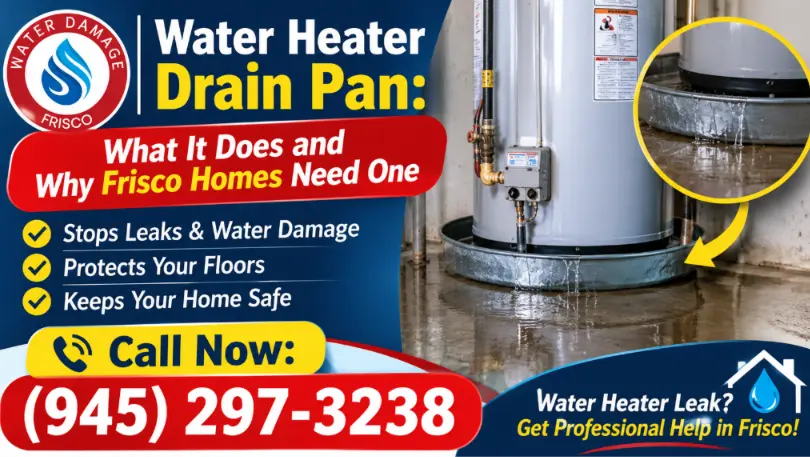
A water heater drain pan is a shallow tray that sits under the tank and catches water before it soaks the floor, drywall or ceiling below. In North Texas, where most homes are built on slabs and many heaters sit in garages, attics or upstairs closets, that tray is often the only thing between a small drip and a large repair bill. This guide explains when a pan is expected, how the pan drain line should work, and where a shutoff valve fits in.
Quick answer: Yes, install a drain pan wherever a leak could damage finished space, which includes attics, upper floors and closets. Frisco follows the 2024 International Plumbing Code with local amendments. A pan only catches water, so pair it with a shutoff valve or leak sensor if the heater sits above living areas.
Water heater leaking right now?
Shut off the water and power, then call. Our crew can start extraction and drying fast.
Is a Water Heater Drain Pan Required in Texas?
There is no single rule that settles it for every Texas home, because cities adopt and amend their building codes locally. The model International Plumbing Code (IPC) calls for a pan under a tank wherever leakage would cause damage, and local officials decide how that applies. In Frisco, the city lists the 2024 IPC and 2024 International Residential Code, both with local amendments, on its official adopted codes page.
Neighboring cities spell out their expectations in plain language. The City of Anna, for example, states that a pan about 1½ inches deep is required for any replaced water heater and that the pan should drain to the outside of the building, as shown in its water heater requirements sheet. That is one city’s rule, not Frisco’s, but it shows the direction most North Texas inspectors lean.
Whether you need a permit for a particular job is a separate question. The city advises asking directly, and you can reach the Frisco Building Inspections division or start in the Plans and Permits portal. Inspection expectations for new homes are summarized in the city’s residential inspection checklist. For the pan, drain and valve work itself, hire a licensed plumber.
Where a Drain Pan Matters Most in Frisco Homes
Location decides how costly a leak becomes. A heater on a garage slab leaks onto concrete. A heater in an attic or upstairs closet leaks through insulation, drywall and light fixtures.
- Attic installations: Water spreads across the ceiling below before anyone notices. Our guide to a water heater leaking in an attic or garage in Frisco covers what to do when it happens.
- Second-floor closets and utility rooms: A pinhole leak can saturate carpet and run into the ceiling below. See how this looks in our post on ceiling leak repair in Frisco.
- Interior closets on a slab: With no basement to catch the water, it travels under flooring and into wall bottoms. Read about the hidden water damage signs in homes with no basement.
- Garages with finished walls: Drywall and stored belongings wick water quickly. This is one of the most common home water damage spots in Frisco.
How a Water Heater Drain Pan and Pan Drain Line Work
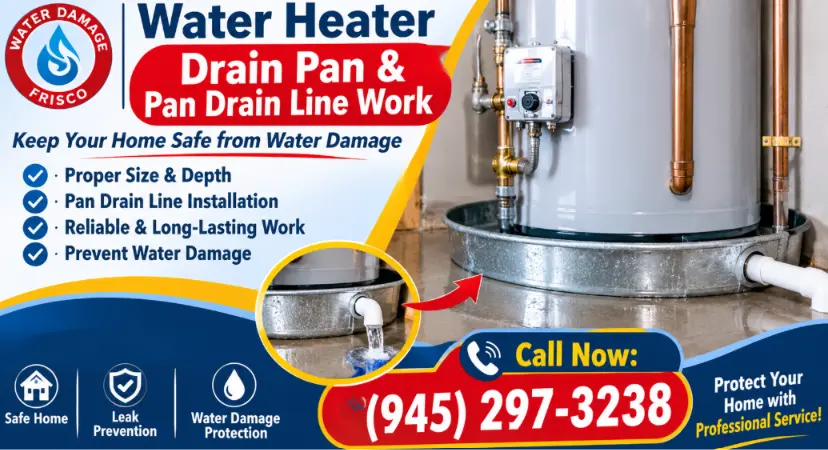
The pan has one job: hold escaping water and send it somewhere harmless. Three details decide whether it succeeds.
Size and depth
Choose a pan roughly two inches wider than the heater base and about 1½ inches deep, then confirm the sizing against the manufacturer’s instructions and your installer’s code. A pan that is too small lets water spill over the rim, and one that is too shallow overflows quickly.
The pan drain line
A fitting in the pan connects to a pipe, commonly ¾ inch, that must slope continuously downhill. It typically ends at a floor drain, a laundry sink or the exterior of the house. Any sag, level run or blockage turns the line into a dead end, and the pan fills.
Material
| Pan material | Strength | Watch for |
|---|---|---|
| Plastic (ABS or HDPE) | Rust-proof and inexpensive | Can crack or warp with years of heat |
| Galvanized steel | Rigid and long established | Corrodes if water sits in it |
| Aluminum | Light and easy to cut to size | Pitting where moisture lingers |
Remember that the pan is separate from the T&P (temperature and pressure) relief valve. That valve needs its own discharge pipe routed to a safe termination point, and a plumber should confirm the routing. If water appears under the tank, our article on a water heater leaking from the bottom helps you tell a failed tank from a loose fitting.
Water Heater Shutoff Valve: Manual vs. Automatic
A pan collects water, but the cold supply line keeps refilling the tank. Closing that supply is what actually ends a leak, so the valve matters as much as the pan.
Manual shutoff valve
Every heater should have an accessible valve on the cold water inlet pipe. Test it once a year. A valve that has never moved can seize, and you do not want to discover that during an emergency. If you cannot reach it, our walkthrough on how to shut off the main water valve in Frisco shows the fallback.
Automatic shutoff with a pan sensor
An automatic system places a moisture sensor in the pan and links it to a motorized valve on the cold supply. When water touches the sensor, the valve closes, limiting the release to what is already in the tank and pan. This is especially useful for attics and upstairs closets, and for homes left empty during travel. For a wider view, see our guide to smart leak detectors and shut-off valves and our tips for how to prevent water damage while you are away.
Found water in the pan or on the floor?
Do not wait for it to spread into the walls. Call now for an assessment and fast water removal.
Drain Pan vs. Shutoff Valve vs. Leak Sensor: What Each One Does
| Protection | What it does | What it does not do |
|---|---|---|
| Drain pan with drain line | Catches drips and small leaks and carries them to a safe spot | Stop the water or handle a full tank failure |
| Manual shutoff valve | Lets you end the flow by hand | Act while you are asleep or away |
| Pan sensor with automatic valve | Closes the supply the moment moisture appears | Remove water already released |
| Standalone leak alarm | Sounds or sends an alert | Close the valve for you |
For a garage heater on a slab, a pan and a working manual valve are a sensible baseline. For anything above living space, add the automatic valve. Do not confuse this pan with the condensate tray under your air handler, which is a different system. That one is covered in our post on an AC drain pan overflowing and the float switch.
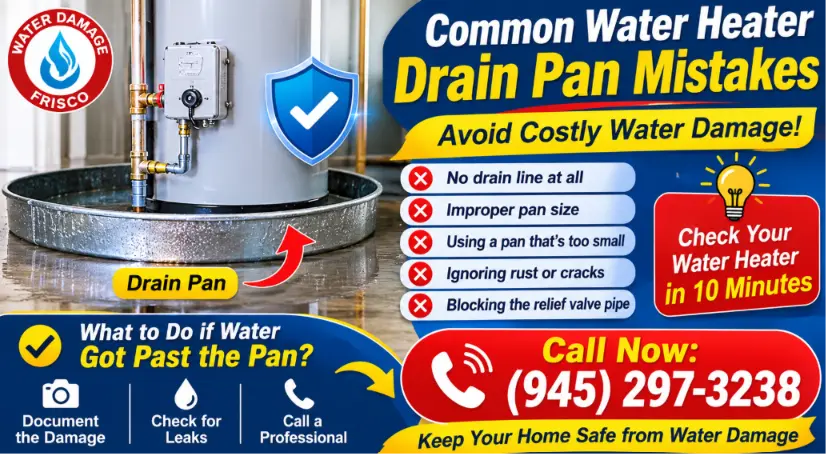
Common Water Heater Drain Pan Mistakes
- No drain line at all. A pan without a drain simply becomes a small basin that overflows.
- A drain line that runs level or sags. Water sits in the low spot and the pan stays wet.
- Using a pan that is too small. A pan that barely clears the tank misses water running down the side.
- Ignoring rust or cracks. A damaged pan fails exactly when you need it.
- Blocking the relief valve pipe. Capping or plugging it creates a safety hazard.
- Never inspecting the pan. Slow leaks go unseen for months. Age is a factor too, as explained in our guide on how long a water heater lasts in Texas.
Safety first: Never work on a gas heater’s gas line or flue yourself. Turn off power or gas, close the cold supply and call a licensed plumber for pan, drain or valve changes.
How to Check Your Water Heater Drain Pan in 10 Minutes
- Turn off power or gas. For an electric heater, switch off its breaker. For a gas heater, set the gas control to the off or pilot position. Never reach into the pan while power is live.
- Look at the pan. Check for cracks, rust, warping, stains or standing water. Water that returns after you dry the pan points to an active leak.
- Follow the drain line. Confirm the pipe is connected to the pan, slopes downhill the whole way and ends in an approved location with no kinks or blockages.
- Check the relief valve pipe. Make sure the T&P discharge pipe is present, points downward and is not capped or plugged.
- Locate the shutoff valve. Find the cold water supply valve above the heater and confirm it turns freely so you can close it in an emergency.
If you are unsure why the tank is wet, read our explanation of why a water heater leaks in Frisco before you decide on a repair or a replacement.
Does a Drain Pan Affect Your Insurance Claim?
Policies differ, and a pan is not a guarantee of coverage. Insurers generally look at whether the loss was sudden or the result of long-term seepage, and well-kept equipment with documented maintenance supports a stronger claim. Keep photos of your pan, drain line and shutoff valve, along with the installation receipt. Our article on whether homeowners insurance covers a water heater leak explains what adjusters usually review.
If you rent, your obligations and your landlord’s are different. See Texas rental water damage and tenant rights.
What to Do If Water Got Past the Pan
- Close the cold water valve and turn off power or gas to the heater.
- Photograph the water, the pan and any wet materials before moving anything.
- Remove standing water and open doors and windows for airflow where it is safe.
- Call a restoration team within the first day. Our checklist for the first 24 hours after water damage in Frisco lists what to save and what to leave alone.
Water from a supply line or heater tank usually starts as clean water, but it can become contaminated as it sits. Learn the difference in our guide to water damage categories. Wet padding often cannot be saved, as covered in drying or discarding wet carpet padding, and attic or closet moisture invites growth. Our post on mold prevention in Frisco attics, garages and closets explains how to stop it.
For professional help, our team handles water heater leak cleanup in Frisco, backed by full emergency water damage restoration in Frisco. Planning ahead? Try the water damage cost calculator, or browse our Frisco service area. Other leak sources are covered under appliance water damage in Frisco.
Water Heater Drain Pan FAQ
Do I need a drain pan under my water heater in Texas?
It depends on where the heater is installed and which code your city enforces. Texas cities adopt and amend building codes locally, and the model plumbing code calls for a pan wherever a leak would damage the structure. That covers attics, upstairs closets and finished spaces. Frisco enforces the 2024 International Plumbing Code with local amendments, so confirm your specific installation with the city or a licensed plumber.
Does a water heater drain pan stop a leak?
No. A pan only catches and redirects the water that escapes. It does not stop the flow. Because a standard pan holds just a few gallons, a steady leak can overflow it quickly, which is why a shutoff valve or leak sensor adds real protection.
Where should a water heater drain pan drain to?
The pan drain line should slope continuously downhill and end at an approved location, typically a floor drain, a laundry sink or the exterior of the home. It should not dead-end, sag or run level, because standing water defeats the purpose of the pan.
What size drain pan does my water heater need?
As a rule of thumb, choose a pan at least two inches wider than the base of the heater, with a depth of about one and a half inches. Check the manufacturer's instructions and the code your installer follows, because the exact requirement can vary.
Should the temperature and pressure relief pipe drain into the pan?
No. The temperature and pressure (T&P) relief valve needs its own discharge pipe that runs to a safe, approved termination point. Do not cap it, plug it or tie it into the pan in a way that restricts flow. A licensed plumber can confirm the correct routing for your home.
How often should I inspect or replace a drain pan?
Look at the pan twice a year and after any storm-related plumbing event. Replace it when it is cracked, rusted through, warped or stained from repeated leaks. Many homeowners replace the pan when the water heater itself is replaced.
Is an automatic water heater shutoff valve worth it?
For heaters in attics, upstairs closets or above finished ceilings, usually yes. A sensor in the pan can close the water supply when it detects moisture, which limits a leak to a small fraction of what an unattended tank and supply line could release.
Protect your home before a leak becomes a claim
Talk to a local Frisco restoration team today. We respond to water heater leaks day and night.
Official Resources
- City of Frisco: Adopted Codes
- City of Frisco: Building Inspections
- City of Frisco: Plans and Permits
- City of Frisco: Residential Inspection Checklist (PDF)
This article is general information, not a code interpretation. Confirm requirements for your specific installation with the City of Frisco or a licensed plumber.