PEX vs Copper Pipes Burst Risk North Texas: The Short Answer for Frisco Homeowners
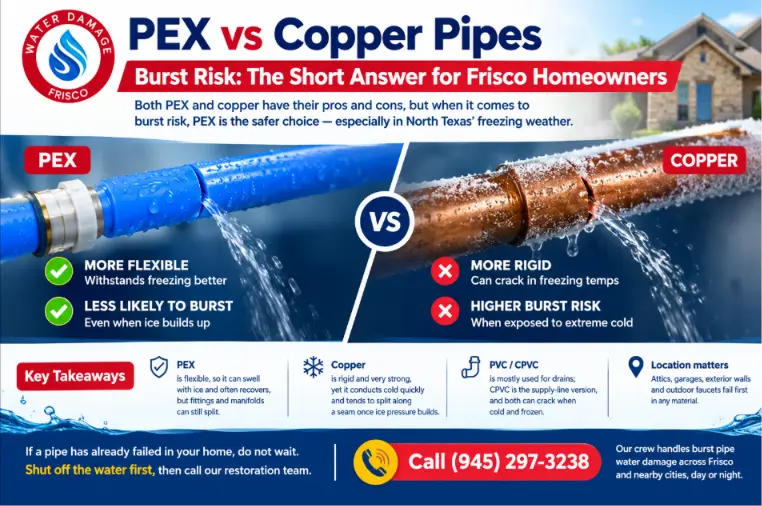
When homeowners compare PEX vs copper pipes burst risk North Texas, they usually want one answer: which material is safest when a North Texas freeze hits? The honest answer is that PEX is the most forgiving of the common options, copper is the least forgiving once ice builds up, and rigid PVC or CPVC sits in between but turns brittle in the cold. None of them is freeze-proof. Where a pipe is installed, and whether it is protected, often matters more than what it is made of.
- PEX: flexible, so it can swell with ice and often recovers, but fittings and manifolds can still split.
- Copper: rigid and very strong, yet it conducts cold quickly and tends to split along a seam once ice pressure builds.
- PVC / CPVC: PVC is mostly used for drains; CPVC is the supply-line version, and both can crack when cold and frozen.
- Location beats material: attics, garages, exterior walls and outdoor faucets fail first in any material.
If a pipe has already failed in your home, do not wait. Shut off the water first, then call a restoration team. Our crew handles burst pipe water damage across Frisco and nearby cities, day or night.
Burst pipe or active leak right now?
Our Frisco team is available 24/7 for emergency water extraction.
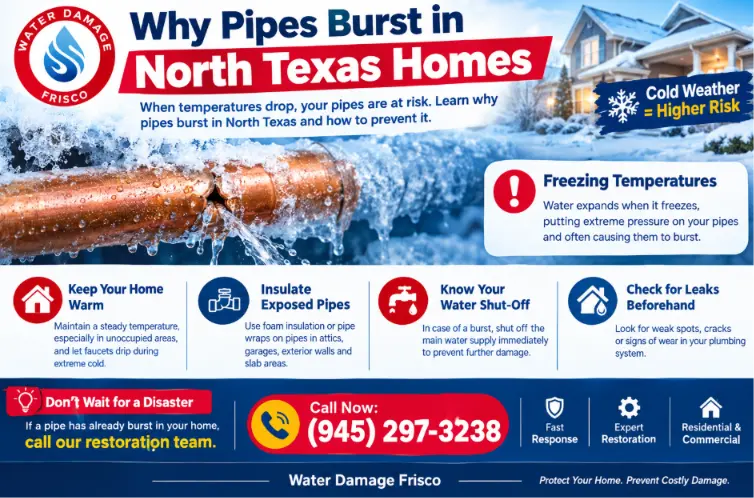
Why Pipes Burst in North Texas Homes
A pipe does not burst at one magic temperature. It bursts when water freezes, forms an ice plug, and the water trapped between that plug and a closed faucet has nowhere to go. The pressure builds in the section of pipe beside the ice, and the weakest point gives way. That is why a pipe often looks fine while frozen and only floods your home when it thaws.
North Texas makes this worse in a specific way. Our winters are mild for most of the season, so homes are often built with plumbing in attics, garages, exterior walls and slab-adjacent chases that would be unusual in colder states. Then a hard cold snap arrives, sometimes with power outages, and those unprotected runs freeze within hours. After Winter Storm Uri in 2021, a Frisco city official told CBS News Texas that crews had responded to more than 3,500 frozen or burst pipe shutoffs in the city.
Material choice changes how a pipe fails, not whether the plumbing system as a whole is at risk. Keep that in mind as we compare each type below.
How PEX Pipes Handle a Freeze
PEX (cross-linked polyethylene) is the flexible plastic tubing found in many newer North Texas homes. Its main advantage in a freeze is that it can stretch as ice forms and often returns close to its original size after thawing. That is why plumbers describe PEX as freeze-resistant, not freeze-proof.
Where PEX still fails
- Fittings and manifolds. The tubing may survive while a brass fitting, crimp ring or manifold connection cracks or loosens. Those rigid components do not stretch.
- Repeated or prolonged freezes. A long power outage can keep a PEX line frozen for days, and that sustained stress can still split the tubing.
- Sunlight and exposure. PEX is not meant to sit in direct sun, so exposed runs in garages or near windows need protection.
PEX also has a practical benefit: it needs fewer joints than rigid pipe, so there are fewer places for a leak to start. If you are unsure whether your plumbing is PEX, the section on identifying your pipes below will help.
Will Copper Pipes Burst in a Freeze?
Copper has a long track record and a very high pressure rating, so it can take a lot of abuse in normal use. In a freeze it behaves differently. Copper conducts heat quickly, which means cold air reaches the water inside faster than it does with plastic. And because copper is rigid, it cannot absorb the expansion. It tends to stretch slightly, weaken, and then split, often as a lengthwise crack.
Copper has a second, separate weakness that homeowners often confuse with freeze damage: pinhole leaks. These small leaks develop over time from corrosion, water chemistry and age, and they can soak a wall or ceiling quietly for weeks. Learning the signs of a burst pipe in a wall helps you catch both problems early.
Can PVC and CPVC Pipes Freeze and Burst?
This is where many comparison articles blur two different products. Standard white PVC is mostly used for drain, waste and vent lines, which are not under constant pressure. The plastic used for hot and cold supply lines in some homes is CPVC, usually cream or light yellow.
- PVC (drains): a frozen drain line is less likely to burst because it is not pressurized, but ice can still crack fittings, and a cracked drain leaks every time you use it.
- CPVC (supply): it insulates a little better than copper, so water may freeze more slowly, but it becomes brittle in the cold and can crack or shatter when stressed.
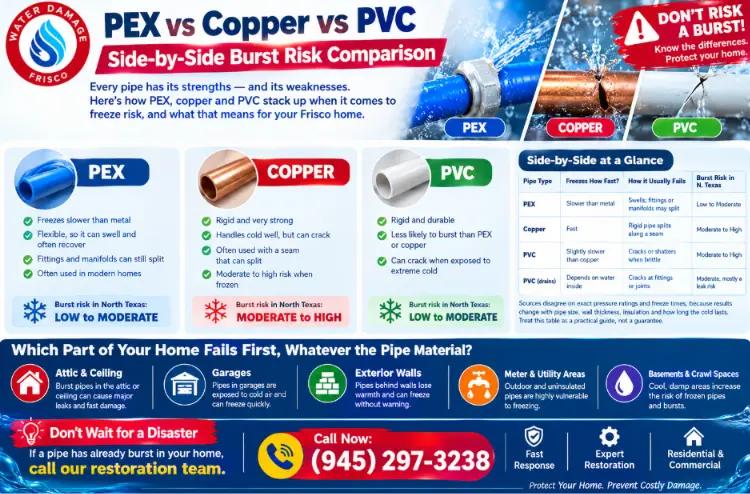
PEX vs Copper vs PVC: Side-by-Side Burst Risk Comparison
| Pipe type | Freezes how fast? | How it usually fails | Burst risk in a North Texas freeze |
|---|---|---|---|
| PEX | Slower than metal | Swells; fittings or manifolds may split | Lower, but not zero |
| Copper | Fast (conducts cold) | Rigid pipe splits along a seam | Higher once ice forms |
| CPVC | Slightly slower than copper | Cracks or shatters when brittle | Moderate to high |
| PVC (drains) | Depends on water inside | Cracks at fittings or joints | Moderate, mostly a leak risk |
Sources disagree on exact pressure ratings and freeze times, because results change with pipe size, wall thickness, insulation and how long the cold lasts. Treat the table as a practical guide, not a guarantee.
Which Part of Your Home Fails First, Whatever the Pipe Material?
In real North Texas freezes, the pipe that bursts is rarely the one in the heated middle of the house. Check these spots first:
- Attic runs and ceiling spaces. Plumbing above the insulation is exposed to the coldest air. See what a burst pipe in the attic or ceiling looks like and how fast the damage spreads.
- Garages. Supply lines, laundry connections and a water heater in an attic or garage are all vulnerable.
- Exterior walls. Pipes behind sinks on outside walls lose the warmth of the room.
- Outdoor faucets and irrigation lines. Hose bibs and sprinkler plumbing freeze first, and the break can be inside the wall.
- Tankless water heaters on exterior walls. The City of Frisco specifically flags these for extra care during extended freezes.
Newer homes are not exempt. Water damage in new construction homes often traces back to plumbing that was never exposed to a real cold snap before.
How to Tell What Pipes Your Frisco Home Has
You can often identify your plumbing in a few minutes with a flashlight:
- PEX: flexible tubing, commonly red (hot), blue (cold) or white, with metal crimp rings at the fittings. Look near the water heater and under sinks.
- Copper: rigid metal tubing in a copper or green-tinted color, joined by soldered fittings.
- CPVC: rigid cream or light-yellow plastic, often with glued joints.
- PVC: rigid white or gray plastic, usually larger and used for drains.
Many homes have a mix, for example PEX supply lines with copper at the water heater and PVC drains. If you cannot tell, a licensed plumber can identify it during a quick inspection.
Not sure how bad the damage is?
Get a free estimate and a moisture check from our Frisco restoration crew.
What to Do When a Pipe Bursts in Your Frisco Home
Speed matters more than material. Follow these steps in order:
- Shut off the water. Know how to shut off your main water valve before you need it. In newer Frisco homes it is often in the garage, and in older homes it may be in a flowerbed near the street.
- Call the city if you cannot reach the valve. The City of Frisco cold weather tips list the Public Works emergency line at 972-292-5800, with assistance available around the clock.
- Stay clear of electrical hazards. If water is near outlets, light fixtures or the panel, do not touch them. Have a professional shut off power safely.
- Open faucets. This relieves pressure and drains water from the lines while you wait for help.
- Document everything. Take photos and video of the source, the standing water and every damaged item before cleanup.
- Start drying fast. Review what to do in the first 24 hours after water damage, because mold can start soon after materials stay wet.
Never use an open flame to thaw a frozen pipe. If a line is frozen but not yet burst, our guide to thaw frozen pipes safely explains safer methods.
Burst Pipes and Homeowners Insurance in Texas
Coverage depends on your policy, but insurers generally distinguish between sudden and accidental water damage and gradual leaks or neglected maintenance. Whether your pipes are PEX or copper does not usually decide a claim, but proof of the cause and quick mitigation do. Our breakdown of whether homeowners insurance covers burst pipes explains the common rules, and our overview of a Texas water damage insurance claim shows how to document it. We are not insurance advisors, so confirm details with your carrier.
How to Protect Any Pipe Type Before the Next Freeze
The City of Frisco recommends practical steps that work for every material. Pair them with the tips in our guide on how to keep pipes from freezing:
- Turn off your sprinkler system at the controller and do not water during a freeze.
- Disconnect and drain hoses, and cover outdoor faucets with insulated covers.
- Open cabinet doors under sinks on exterior walls.
- Let indoor faucets drip slowly during extended cold.
- Insulate pipes in attics, garages and crawlspaces.
- Keep the thermostat on if you travel. Frozen pipes can burst even when no water is running.
For an extra layer of protection, consider smart leak detectors and automatic shut-off valves, which can limit a burst to minutes instead of hours.
Should You Repipe With PEX?
Repiping with PEX can make sense for a home with repeated copper pinhole leaks or old CPVC, and it is generally less expensive and faster than repiping with copper. It is not required to be safe, though. A well-insulated copper system with a known shutoff valve is far safer than an unprotected PEX run in a cold garage. If you are weighing a repipe, get a written scope from a licensed plumber, and ask where the manifold and shutoff valves will sit.
Professional Water Damage Restoration After a Burst Pipe
A burst pipe is a plumbing problem first and a water damage problem a few minutes later. Plumbers fix the pipe, but only restoration crews extract the water, dry the structure and check for moisture hiding behind walls. Our team provides water damage restoration in Frisco, TX, including emergency water damage restoration and the water mitigation process that stops secondary damage.
Dirty or contaminated water changes the work required, so it helps to understand the water damage categories. If drying is delayed, you may also face mold after water damage. For planning, our water damage restoration cost in Frisco guide and water damage cost calculator give a realistic starting range, and how long water damage restoration takes explains the timeline.
We serve homeowners throughout Frisco. See our Frisco neighborhoods water damage guide or browse the Frisco neighborhoods we serve. If you need plumbing repair coordination, read about Frisco pipe break repair, and if the ceiling is already stained, see ceiling leak repair. For city resources, visit City of Frisco Public Works.
PEX vs Copper Pipes Burst Risk: Frequently Asked Questions
Do PEX pipes burst when frozen?
They can, but it is less likely than with copper. PEX can expand as water freezes and often returns to shape after thawing. A long freeze, a power outage, or a weak fitting can still cause a split, so insulation and a known shutoff valve are still important.
Will copper pipes burst in a freeze?
Copper is more likely to split once ice builds pressure, because it cannot flex. It also loses heat fast. Many copper systems get through mild freezes, but a sustained hard freeze in an uninsulated attic or garage is a common cause of bursts.
Can PVC pipes freeze and burst?
Yes. PVC and CPVC become brittle in cold weather and can crack when ice forms. PVC is mostly used for drains, so the usual result is a crack or leaking joint rather than a pressure burst. CPVC supply lines are more at risk of splitting.
At what temperature do pipes burst?
There is no single temperature. Pipes burst when water freezes and pressure builds, which depends on insulation, wind, pipe location and how long the cold lasts. Unprotected pipes in attics, garages and exterior walls can freeze within hours once temperatures drop into the teens or low twenties.
Which pipe is best for freezing weather?
PEX is generally the most forgiving, but the best protection is insulation, keeping plumbing inside the conditioned space, and knowing where your main shutoff is. No material is freeze-proof.
What should I do first if a pipe bursts?
Shut off the main water valve, stay away from electrical hazards, open faucets to relieve pressure, and take photos. If you cannot reach the valve, call Frisco Public Works at 972-292-5800. Then call a restoration company to start drying the structure.
Water already inside your walls, floors or ceiling?
Fast extraction and drying prevent mold and bigger repair bills.