
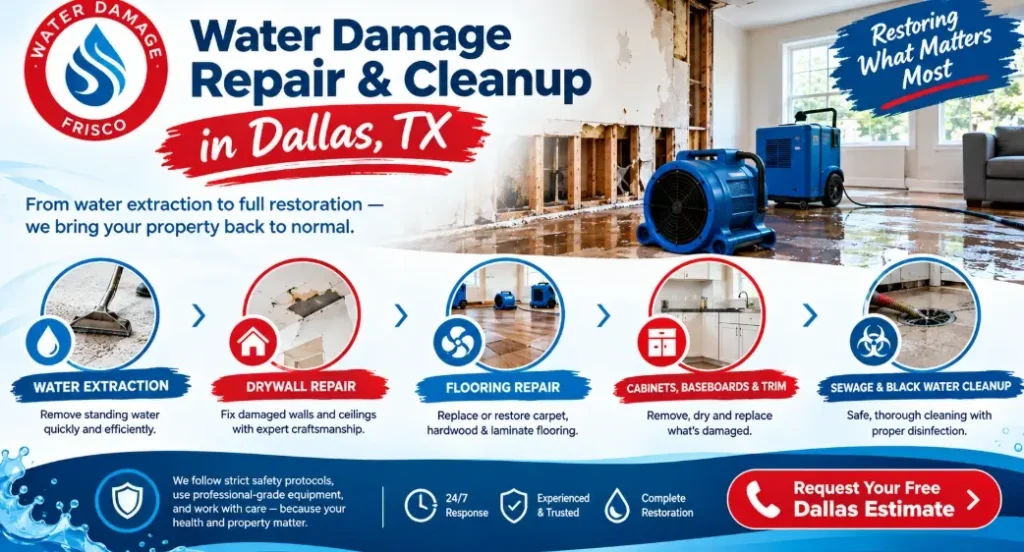
Once the water is gone, the real work often begins: figuring out what’s safe to clean yourself, what needs professional repair, and what has to be thrown out. This guide covers the practical Water Damage Repair Cleanup Dallas TX — material by material, plus the safety steps that matter most in the first 24 hours.
Looking for the bigger picture first — local risks, the full restoration process, typical cost, and insurance? Start with our complete guide to Water Damage Repair Cleanup Dallas TX, or see our water restoration service guide for how extraction, drying, and content restoration fit together.
What Water Damage Repair Cleanup Dallas TX Actually Involves in Dallas, TX
Water damage repair and cleanup in Dallas covers two related but different jobs: cleanup deals with removing contaminated materials, debris, and moisture-related mess; repair deals with fixing or replacing whatever was damaged beyond saving. Which category your property falls into depends heavily on the water category involved — see our breakdown of water damage categories for how clean, gray, and black water are classified differently.
Safe Cleanup in the First 24 Hours
What you do in the first 24 hours after water damage affects how much can actually be saved. Before anything else: shut off electricity to affected areas if it’s safe to reach the breaker, avoid walking through standing water near outlets, and remove valuables and electronics from wet areas immediately. Our full walkthrough of what to do in the first 24 hours after water damage covers the complete safety checklist.
Call (945) 297-3238 — 24/7 Dallas Response
Repairing Drywall & Ceilings After Water Damage
Drywall acts like a sponge — once it’s saturated, it typically has to be cut out and replaced rather than dried in place, especially in the bottom 12-24 inches of a wall where water wicks upward. Ceilings are trickier: a water stain doesn’t always mean structural damage, but sagging or bubbling drywall does, and that section needs to come down before mold has a chance to start behind it.
Flooring Repair: Carpet, Hardwood & Laminate
Flooring is where “can it be saved?” comes up most often. Carpet padding almost never survives water damage and should be discarded even if the carpet itself can be dried and reused — our guide on wet carpet padding: drying vs. discarding explains why. Laminate flooring is even less forgiving, since water gets trapped beneath the surface layer; see whether water-damaged laminate flooring can be saved before assuming it can be dried out.
Cabinets, Baseboards & Trim
Particleboard cabinets (common in kitchens and bathrooms) swell permanently when wet and generally need replacing, while solid wood cabinets often survive with proper drying. Baseboards are usually removed during the drying process anyway, since they trap moisture against the wall — expect them to be reinstalled or replaced as one of the final repair steps.
Sewage & Black Water Cleanup: Special Safety Protocols
Sewage backups and flood water require a different cleanup standard entirely — porous materials that contact black water (carpet, drywall, insulation) generally can’t be sanitized and must be removed and discarded, not cleaned. Our detailed guide on sewage backup health risks covers why this category needs professional handling rather than DIY cleanup.
Request Your Free Dallas Estimate
Debris Removal & Disposal: What Can (and Can’t) Be Saved
Deciding what to keep is often the hardest part of cleanup — our guide on what can be saved after flood damage walks through material-by-material guidance. For debris that has to go, Dallas residents can use the city’s own disposal system: the City of Dallas Sanitation Services Brush and Bulky Item Collection allows up to 10 cubic yards of bulky waste to be set out monthly, or self-hauled to a city landfill or transfer station at no charge for Dallas residents — worth knowing before a full room’s worth of ruined flooring and drywall piles up in your driveway.
Deodorizing & Final Sanitization
A property can look completely repaired and still smell like the water damage that caused it — that lingering odor usually means moisture is still trapped somewhere, even if it isn’t visible. See our guide on lingering odor after water or fire damage for what causes it and when it signals a problem worth investigating further, rather than something an air freshener will fix.
DIY vs. Calling a Professional for Water Damage Cleanup in Dallas
Small, clean-water spills you catch immediately are often manageable yourself — mop up, run fans, and monitor for a few days. Anything involving gray or black water, water that’s been sitting more than 24 hours, or damage to drywall, subflooring, or electrical systems is worth a professional assessment before you start cleanup, even if you end up doing some of the work yourself. Our guide on DIY vs. professional water mitigation breaks down exactly where that line sits.
Frequently Asked Questions
Should I try to clean up water damage myself before calling a professional?
For small, clean-water spills caught immediately, yes. For anything involving contaminated water, standing water over 24 hours old, or structural materials, get a professional assessment first.
How do I know if drywall needs to be replaced or can just be dried?
If it’s sagging, bubbling, or was in contact with gray or black water, it needs to be removed. Clean water contact that’s addressed within 24-48 hours can sometimes be dried in place.
Can I put water-damaged debris out with my regular trash in Dallas?
Large volumes typically need to go through the city’s Brush and Bulky Item Collection or be self-hauled to a landfill — check current limits before setting materials at the curb.
Why does my property still smell after water damage cleanup?
Lingering odor almost always means moisture is still trapped somewhere that wasn’t fully dried or sanitized — it’s worth having that checked rather than masking it.
Get Help Now — Call (945) 297-3238