If your home sits near a creek, in a mapped FEMA flood zone, or has already taken on water once before, gutters and grading alone won’t cut it. Here’s how to protect your home in a flood-prone area using the same floodproofing methods FEMA engineers recommend — plus the Texas grant program that can help pay for it.
What “Protecting” a Flood-Prone Home Actually Means
Most flood-prep advice stops at gutters, grading, and a sump pump — good basics, but they’re built for occasional heavy rain, not a property that sits inside or near a mapped flood zone. If you already know your home carries real flood exposure, protecting it means going a step further into structural floodproofing: the same categories of measures FEMA engineers document in their Homeowner’s Guide to Retrofitting. These fall into two broad approaches — keeping water out entirely, or letting it pass through safely instead of trapping it against your walls.
For the everyday storm-season basics — clearing drains, grading, insurance timing — see our storm season flood prep checklist for Frisco TX. If you’re not yet sure whether your address carries flood-zone risk in the first place, start with our Frisco TX flood zones guide. This page picks up from there — for homes that are confirmed flood-prone and need real structural protection.
Know Your Base Flood Elevation Before You Do Anything Else
Every floodproofing decision starts with one number: your home’s Base Flood Elevation, or BFE — the height floodwater is expected to reach during a flood with a 1% annual chance of occurring, the same “100-year flood” standard used on FEMA maps. Your BFE determines how high utilities need to sit, how many flood vents a foundation wall needs, and whether dry floodproofing is even a viable option for your specific home. You can look up your property’s flood zone and BFE data directly through the FEMA Flood Map Service Center, and our Frisco flood zones guide explains what each zone designation means for a Collin County property.
Two Ways to Floodproof a Home: Wet vs. Dry
FEMA’s retrofitting guidance groups nearly every structural flood-protection method into two categories. Which one applies to your home depends on your BFE, your foundation type, and whether your home has a basement.
Dry Floodproofing Keep water out
Sealing the exterior of the home against water intrusion — waterproof coatings or membranes on exterior walls, watertight shields over doors and windows, and backflow valves to stop sewage from being pushed back up through drains during a flood. Dry floodproofing works below the BFE only up to a limited depth, and FEMA does not recommend it for homes with basements, since basement walls aren’t built to resist that much water pressure from outside.
Wet Floodproofing Let water pass through
Instead of fighting the water, wet floodproofing allows it to enter and exit an enclosed low area — a crawlspace, garage, or walkout basement — through engineered flood vents, equalizing the pressure on both sides of the wall so the structure isn’t pushed off its foundation. This is typically required for the enclosed space beneath an elevated home, and it’s paired with flood-resistant materials so the space can be cleaned out and dried rather than rebuilt after every event.
Install Flood Vents in Foundation Walls and Garages
Flood vents are one of the most cost-effective floodproofing upgrades available, and they’re often required by code for any enclosed space below the BFE. Properly sized vents let floodwater flow through a crawlspace or garage instead of pooling against the walls, which is what causes structural failure and even homes floating off their foundation in extreme events. Sizing isn’t guesswork — NFIP regulations typically require at least one square inch of vent opening for every square foot of enclosed area, positioned low on the wall so water can enter and drain freely. Older foundation grilles usually don’t meet this standard; purpose-built flood vents are engineered specifically to hold that opening size while resisting debris and pest intrusion.
Elevate Utilities Above the BFE
Your HVAC system, electrical panel, water heater, and any fuel tanks are some of the most expensive components in your home to replace — and among the easiest to protect. Elevating or relocating these units above your BFE, or encasing them in waterproof housings when they can’t be moved, keeps a flood from taking out your entire mechanical system in a single event. Fuel tanks should be anchored to prevent floating, with vents and fill lines kept above the BFE as well. This single category of protection is one insurers and FEMA both weigh heavily, since mechanical system replacement is frequently the largest line item in a flood damage claim.
Use Flood-Resistant Materials Below the BFE
Anything below your Base Flood Elevation should be able to get wet and dry out without being destroyed. That means replacing carpet with tile in lower-level rooms, using flood-resistant insulation and gypsum wallboard instead of standard drywall, and choosing furniture and cabinetry that can be cleaned rather than discarded after water exposure. This won’t stop a flood from entering a wet-floodproofed space — it changes what happens afterward, cutting the rebuild cost dramatically compared to a room finished in standard materials.
Elevating the Whole Structure
For homes with a documented history of repeat flooding, full elevation — raising the structure on piers, stilts, or an extended foundation above the BFE — is the most complete protection available, and it can also reduce flood insurance premiums significantly. It’s a major undertaking, but it doesn’t have to come entirely out of pocket.
FEMA Flood Mitigation Assistance Grant
Administered in Texas by the Texas Water Development Board, this program can fund 75% to 100% of the cost of elevating an eligible home, with the homeowner covering any remaining share.
Active NFIP Policy Required
Your home generally needs an active National Flood Insurance Program policy in place before the grant application period opens, and that coverage must continue for the life of the elevated structure.
Repetitive-Loss Properties
The program prioritizes structures with a documented history of repeat flood claims, which is exactly the situation it’s designed to break the cycle on.
Start the process through the Texas Water Development Board’s Flood Mitigation Assistance program page, or ask your city’s floodplain manager whether your property qualifies for the current funding cycle.
Landscaping and Site-Level Protection
Not every protective measure requires a permit or a contractor. Grading the yard so it slopes away from the foundation, installing a French drain or dry creek bed to redirect runoff, and building a small berm or swale between your home and a nearby creek corridor can meaningfully reduce how much water reaches your walls in the first place — buying time before it ever reaches the point where vents, seals, or elevation are tested. These site-level steps work best combined with the structural measures above, not instead of them.
What to Do Before the Next Storm Hits
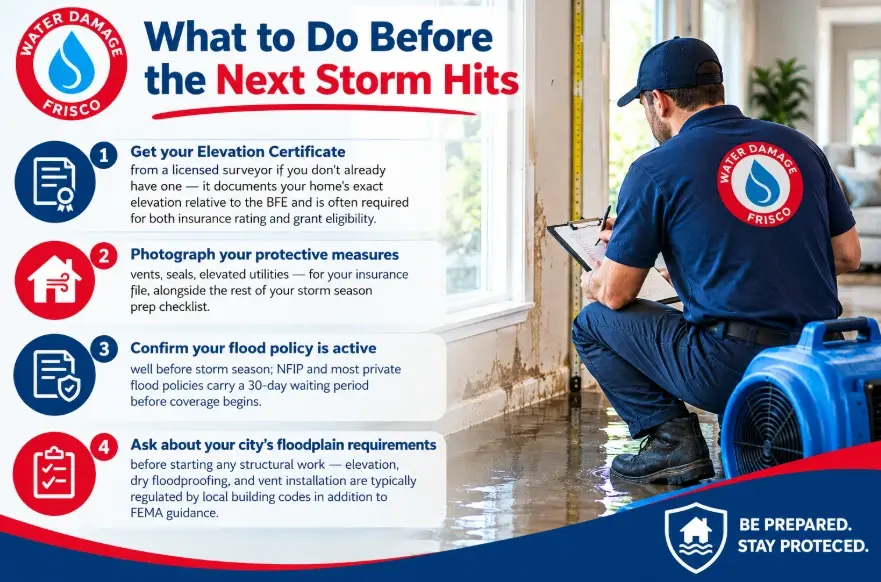
- Get your Elevation Certificate from a licensed surveyor if you don’t already have one — it documents your home’s exact elevation relative to the BFE and is often required for both insurance rating and grant eligibility.
- Photograph your protective measures — vents, seals, elevated utilities — for your insurance file, alongside the rest of your storm season prep checklist.
- Confirm your flood policy is active well before storm season; NFIP and most private flood policies carry a 30-day waiting period before coverage begins.
- Ask about your city’s floodplain requirements before starting any structural work — elevation, dry floodproofing, and vent installation are typically regulated by local building codes in addition to FEMA guidance.
If Water Still Gets In
No floodproofing method is 100% failure-proof in an extreme event, and that’s exactly what a restoration plan is for. Our DFW storm flooding response guide covers the first hour after water enters a home, and our team provides 24/7 water extraction and structural drying across Frisco and the surrounding DFW cities the moment floodwater does get through.
Official Resources for Flood-Prone Homeowners
- Texas Water Development Board — Flood Mitigation Assistance Grant Program — funding for home elevation and other mitigation projects.
- Texas Department of Insurance — guidance on flood coverage requirements for Texas homeowners.
- FEMA — National Flood Insurance Program — coverage details and policy information.
- FEMA Flood Map Service Center — look up your property’s flood zone and Base Flood Elevation.
- Texas Division of Emergency Management (TDEM) — statewide flood mitigation and preparedness resources.
Already Flooded? We Respond in 60 Minutes
Water Damage Frisco provides 24/7 emergency water extraction, structural drying, and flood damage restoration across Frisco, McKinney, Prosper, Carrollton, Plano, Allen, Celina, and the rest of North Texas.
Get Emergency Help NowFrequently Asked Questions
What’s the difference between dry floodproofing and wet floodproofing?
Dry floodproofing seals a home’s exterior to keep water out entirely and works only up to a limited depth below the Base Flood Elevation. Wet floodproofing does the opposite — it lets floodwater enter and exit an enclosed low area like a crawlspace or garage through flood vents, equalizing pressure so the structure isn’t damaged. Homes with basements generally need wet floodproofing rather than dry, since basement walls aren’t designed to resist floodwater pressure from outside.
How do I know if my home needs flood vents?
If any part of your home — a crawlspace, garage, or enclosed area — sits below your Base Flood Elevation, it likely needs engineered flood vents sized to at least one square inch of opening per square foot of enclosed space. Check your property’s flood zone through the FEMA Flood Map Service Center, or ask a licensed floodplain contractor to assess your specific foundation.
Is there financial help for elevating a flood-prone home in Texas?
Yes. The FEMA Flood Mitigation Assistance grant program, administered in Texas by the Texas Water Development Board, can cover 75% to 100% of eligible elevation costs, particularly for repetitive-loss properties with an active NFIP flood insurance policy. Availability depends on the current funding cycle and your property’s benefit-cost eligibility.
Does floodproofing my home mean I don’t need flood insurance?
No. Structural floodproofing reduces damage and can lower your premium, but it doesn’t replace the need for an active NFIP or private flood insurance policy. Standard Texas homeowners insurance excludes rising floodwater regardless of what protective measures are in place.
What should I do if floodwater gets into my home despite these protections?
Get everyone out of the affected area safely, shut off power at the breaker only if you can reach it dry, and document all damage before cleanup begins. Then call a certified restoration team — our DFW storm flooding response guide covers the full first-hour sequence.
Serving Frisco, McKinney, Plano, Prosper, Celina, Carrollton, and all of North Texas — call (945) 297-3238 for 24/7 emergency flood response.