
A storm season flood prep checklist Frisco TX homeowners can actually use — built around local drainage rules, HOA responsibilities, and NFIP flood zones, not generic storm advice.
Call (945) 297-3238Frisco Homes Don’t Flood Like Everywhere Else — Here’s What Actually Matters
Most flood-prep checklists read the same no matter where you live: clean the gutters, test the sump pump, buy some sandbags. That advice isn’t wrong, but it skips the part that actually decides whether a North Texas storm reaches your slab — the clay soil under your yard, the watershed your neighborhood drains into, and whether your HOA’s detention pond is doing its job.
This storm season flood prep checklist for Frisco TX covers the standard preparation steps, but built around what’s specific to Frisco: the city’s floodplain rules, the drainage responsibilities that fall on homeowners and HOAs rather than the city, and the two Collin and Denton County watersheds that decide where storm runoff actually goes. If your home has already flooded and you need immediate steps, our storm flooding response guide covers the first hour. This page is for the weeks before that call ever needs to happen.
Why North Texas Storms Flood Homes That Aren’t Even in a Flood Zone
Frisco sits across two counties and drains into the Elm Fork of the Trinity River, along with a smaller share flowing toward other Trinity tributaries. The city’s clay-heavy soil doesn’t absorb water quickly, so during a fast summer thunderstorm, runoff moves overland toward creeks and drainage easements faster than it can soak in. That’s a big reason flash flooding here can hit neighborhoods that were never mapped as high-risk.
That distinction matters for insurance too. Frisco participates in FEMA’s National Flood Insurance Program, and the city’s building standards require new homes to sit above the 100-year floodplain elevation. But “outside the mapped floodplain” doesn’t mean “can’t flood” — it means the statistical risk is lower, not zero. Check your property’s flood zone status and drainage easements directly through the City of Frisco’s Stormwater Management program, and see our breakdown of Frisco’s local flood zones for ZIP-code-level detail.
Whose Job Is Drainage: Yours, the City’s, or Your HOA’s?
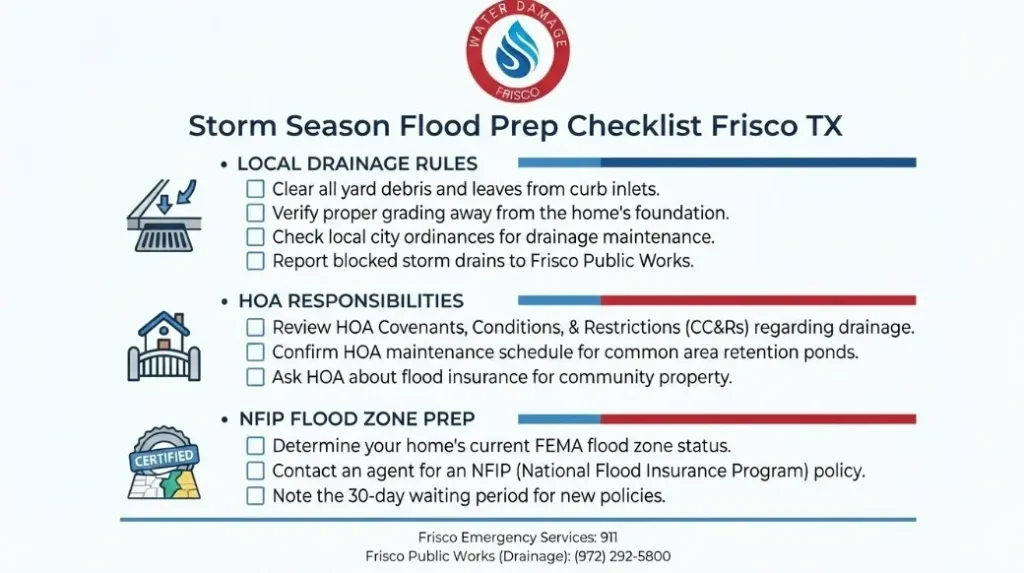
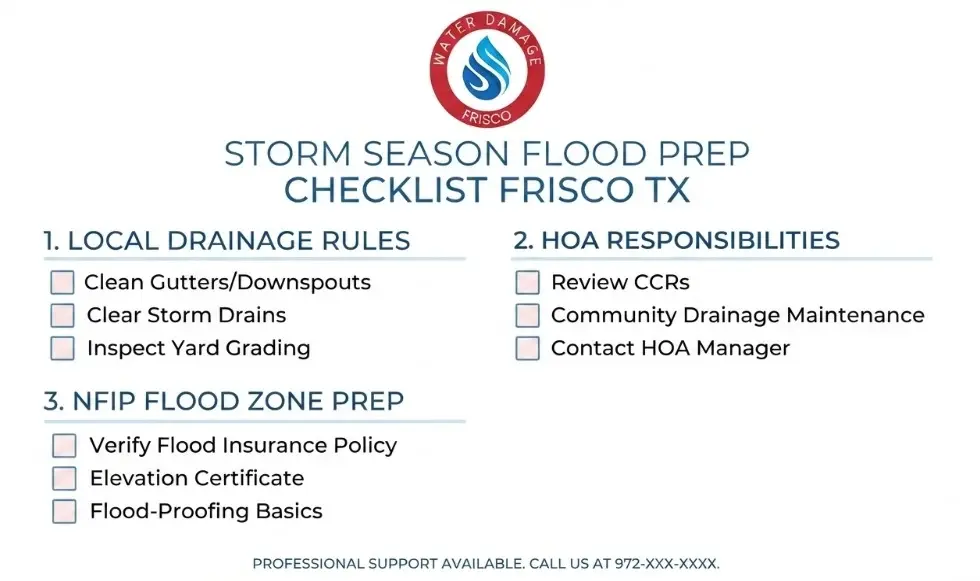
This is the step almost every generic checklist skips, and it’s often the difference between a dry yard and a flooded garage.
City of Frisco
Public streets and city storm drains. Report clogged culverts or blocked storm drains to Public Works.
You, the Homeowner
Grading, gutters, French drains — anything on your own lot that moves water away from your foundation.
Your HOA
Neighborhood detention and retention ponds. A silted-in pond loses storage capacity exactly when you need it most.
Ask your HOA board when the pond was last cleared of sediment. Frisco’s own HOA Stormwater Management guidance is worth forwarding to the board before storm season. We’ve also written a longer explainer on HOA drainage responsibilities if you want to push this at your next meeting.
Knowing which of these three applies to your problem saves days when water is already collecting where it shouldn’t.
Before Storm Season: The Property Checklist
Walk Your Property Like an Inspector
Check where water pools after a normal rain, not just a big one. Standing water near the foundation, low spots in the yard, or a driveway that slopes toward the garage are all early warnings. Basement or crawl space window wells, utility openings, and door thresholds are the usual entry points.
Clear Gutters, Downspouts, and Yard Drainage
Direct downspouts at least several feet away from the foundation. Clogged gutters send water straight down the side of the house instead of away from it — a common cause of foundation and basement seepage that has nothing to do with a “flood” in the dramatic sense.
Test Sump Pumps and Battery Backups Now, Not During a Warning
If your home has a sump pump, run it manually before the season starts. Power outages are common during severe DFW thunderstorms, so a battery backup isn’t optional if you’re relying on the pump to keep a basement or low-lying slab dry.
Confirm What Your Insurance Actually Covers
Standard homeowners insurance in Texas typically excludes flood damage from rising water — that requires a separate NFIP or private flood policy. Review your policy now, not after water is already in the house. The Texas Water Development Board’s flood insurance guidance is a straightforward starting point, and our flood insurance breakdown for DFW homeowners covers what’s typically excluded and what a separate policy adds back.
Photograph the House Before There’s Anything to Document
Walk through every room and record video of flooring, walls, furniture, and major appliances. Store a copy off-site or in the cloud. This single step does more for a smooth insurance claim than almost anything else on this list, because it gives you a clear “before” to compare against if damage happens.
Emergency Supplies Worth Having on Hand
Ready.gov’s build-a-kit guidance is a solid baseline: several days of water and non-perishable food per person, a battery-powered or hand-crank radio, flashlights, a first aid kit, and backup batteries. For North Texas households specifically, add a portable phone charger and copies of insurance and identification documents in a waterproof bag. If anyone in the household depends on refrigerated medication or powered medical equipment, plan for that separately — a cooler with ice packs or a backup battery isn’t something you want to be sourcing after the power’s already out.
If Water Starts Coming In: Safety First, Always
- Never walk or drive through moving water. The National Weather Service’s Turn Around, Don’t Drown campaign exists because six inches of moving water can knock an adult off their feet, and about a foot can float a vehicle.
- Shut off electricity at the breaker only if you can reach it safely and dry. If reaching the panel means wading through water, leave it alone and call a professional instead.
- Treat all storm floodwater as contaminated. The CDC’s floodwater safety guidance classifies floodwater as a health risk that can carry bacteria and chemical contaminants — keep pets and kids away from it entirely. Standing water that lingers even after a storm passes carries its own risks; see our guide on stagnant water health dangers for what to watch for.
After the Water Recedes: The Mold Clock Is Already Running
Document everything before you start moving or discarding anything — photos and video first, cleanup second. Then move fast: the EPA’s mold prevention guidance puts the window at 24 to 48 hours before trapped moisture turns into mold growth, and that window is tighter in a humid Texas summer than almost anywhere else in the country. Open windows, run fans, and pull out anything visibly soaked. Watch for musty odors, warped flooring, or bubbling paint over the following days. If you’re already seeing them, our guide on mold after water damage covers what to check next.
When It’s Time to Call a Professional
Sandbags and a shop light handle small stuff. They don’t handle water that’s soaked into drywall, insulation, or subfloor, or water contaminated enough to be a health hazard on its own. If more than an inch or two of water got into a living space, or the water came from outside rather than a controllable indoor source, professional drying equipment is usually the difference between a full recovery and materials that have to be torn out later.
Our team handles storm damage restoration, flood damage restoration, and water mitigation across Frisco and the surrounding DFW cities. For active flooding, our water extraction team pulls standing water out fast, and every job is built on the same core water damage restoration process — with documentation handled as part of the job so your insurance claim conversation is easier, not harder. If you’re not sure whether what you’re looking at needs a professional, contact us and we’ll tell you honestly — not every wet carpet needs a restoration crew, but every one of them is worth a phone call to find out.
Frequently Asked Questions
Possibly. Frisco’s floodplain maps are based on FEMA’s 100-year floodplain data, but the city has grown significantly since those maps were last fully updated, and clay soil runoff can flood low-lying properties that sit outside the mapped zones. Check your address through the City of Frisco’s stormwater program or see our local flood zone breakdown.
Usually not for rising floodwater specifically. Most standard policies cover wind and roof-driven water intrusion but exclude flood damage, which requires a separate NFIP or private flood policy. Review coverage before storm season, not during it.
Typically the HOA, not the City of Frisco — city responsibility generally stops at public streets and municipal storm drains. Ask your HOA board directly, or reference the city’s HOA stormwater guidance.
Within 24 to 48 hours per EPA guidance, and often faster in Texas summer humidity. Fast extraction and structural drying are the only real way to beat that window.
Get people and pets out of the affected area first, and only touch the breaker panel if you can reach it safely and dry. Our storm flooding emergency guide walks through the full first-hour sequence.
Get Ahead of the Next Storm
Preparation doesn’t prevent every storm, but it changes how much damage one does to your home — and it changes how smooth your insurance claim is if water does get in.
Call (945) 297-3238 — Same-Day Response- FEMA — National Flood Insurance Program
- Ready.gov — Build a Kit
- Ready.gov — Flood Preparedness
- National Weather Service — Turn Around, Don’t Drown
- CDC — Floodwater Safety Guidance
- EPA — A Brief Guide to Mold, Moisture and Your Home
- Texas Water Development Board — Flood Insurance in Texas
- City of Frisco — Stormwater Management
- City of Frisco — HOA Stormwater Management
Need help right now? See our full guide to water damage restoration in Frisco, TX for emergency response, services, and coverage across the city.