IICRC Certified Water Damage Restoration Allen TX: What the Badge Really Means
When a pipe bursts in Twin Creeks or a storm pushes water under the door near Bethany Lakes, almost every company you call will say it is certified. Choosing IICRC certified water damage restoration Allen TX only protects you if the certification is real, current, and held by the people who will actually be in your house. This guide explains what IICRC certification covers, how to check it in about five minutes, and which questions separate a trained crew from a company that just uses the word.
Water in your Allen home right now?
Don’t wait on paperwork. Call first, verify credentials while the crew is on the way.
What Does “IICRC Certified” Actually Mean?
IICRC is the standards body for the cleaning and restoration industry. It publishes the ANSI/IICRC S500 Standard for Professional Water Damage Restoration, which describes the procedures and precautions for restoring residential, commercial, and institutional buildings. The standard is also the reference point adjusters and contractors use when they argue about whether a job was done properly.
Two different things are called “certified,” and companies often blur them together:
- Certified technician: an individual who passed an IICRC-approved course and exam, such as WRT, ASD, FSRT (fire and smoke), or AMRT (microbial remediation).
- Certified firm: a company that meets IICRC firm requirements, which include employing certified technicians, carrying required insurance, following the code of ethics, and taking part in the consumer complaint process.
A firm badge on a website does not guarantee that the person standing in your kitchen holds a WRT. That is why the best homeowners ask about both. If you want the broader overview first, our IICRC certified restoration guide covers the basics, and our sister article on IICRC-certified restoration in McKinney shows how the same rules apply one city over.
The credentials you will hear most often
| Credential | What it covers | Why it matters in Allen |
|---|---|---|
| WRT | Water categories, drying science, equipment, S500 basics | Minimum for anyone leading a water loss |
| ASD | Advanced drying, psychrometrics, equipment placement, monitoring | Matters on slab homes, multi-room losses, and wet wall cavities |
| AMRT | Microbial (mold) remediation | Useful when water sat for more than a day or two |
| FSRT | Fire and smoke restoration | Relevant when a loss involves both fire and water |
Why Certification Matters More Than You Think in Allen Homes
Allen is a Collin County city of newer, tightly built homes, many on concrete slabs and many with finished walls and engineered flooring. Water that gets behind drywall, under laminate, or into insulation will not dry on its own, and it does not stay where you can see it. Mold can begin forming within 24 to 48 hours in warm, damp conditions, and North Texas summers supply plenty of both.
Trained technicians classify the water before they touch anything. S500 recognizes three categories: clean water from a supply line, grey water from appliances, and black water from sewage or floodwater. Each calls for a different protocol, from what gets removed to what protective gear is required. Our breakdown of water damage categories explains how those categories change the job and the price.
Skipping this step is how a “quick dry-out” turns into a musty wall six weeks later. If you are still weighing when to call, read what to do in the first 24 hours after water damage.
How to Verify IICRC Certified Water Damage Restoration in Allen, TX
Verification takes less time than a phone hold. Do it while the crew is on the way, not after the invoice arrives.
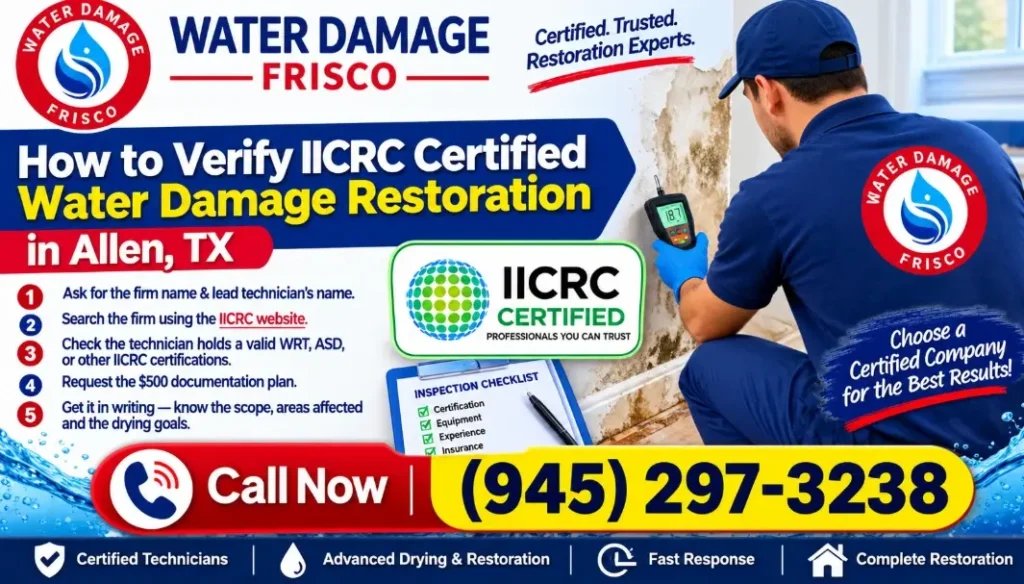
- Ask for the firm name and the lead technician’s name. A reputable company gives both without hesitation.
- Search the firm using the certified firm lookup on the IICRC website. Confirm the legal name, not just a similar brand name.
- Check the technician. Ask which certifications they hold (WRT, ASD) and whether they are current. Certifications must be renewed, so an expired card is not a credential.
- Request the S500 documentation plan. A certified crew can tell you how they will record moisture readings, equipment, and daily progress.
- Get it in writing. The scope of work should name the water category, the areas affected, and the drying goals.
Tip: if a company will not name its technicians or points you to a generic badge image, treat that as a warning sign and keep calling. For a wider checklist, see how to choose a water restoration company and our local ranking of the best water damage restoration companies in Allen, TX.
10 Questions to Ask Before You Sign Anything
- Is your firm IICRC certified, and can you show me the listing?
- Who is my lead technician, and do they hold WRT or ASD?
- What category and class of water damage do you think this is, and why?
- How will you measure moisture, and how often will you record it?
- How many air movers and dehumidifiers will you place, and how did you calculate that?
- What is your target dry standard for my materials?
- Will you check wall cavities, insulation, and subfloor, or only the visible surface?
- What happens if a material cannot be saved?
- Will you send the drying logs to my insurance adjuster?
- Is your estimate itemized, and what could change it?
Get a certified answer, not a sales pitch
Tell us what happened and we will explain the category, the likely drying time, and what to do next.
What an S500-Based Water Restoration Job Looks Like
A properly run job follows a sequence, and each step leaves a paper trail. Here is what Allen homeowners should expect from a certified crew:
1. Inspection and moisture mapping
Technicians locate the source, stop the water if it is still flowing, and map where moisture has traveled using meters and thermal imaging. Water wicks up drywall and travels well beyond the stain you can see.
2. Water extraction
Standing water comes out first, because it is the fastest way to reduce drying time. Our guide to emergency water extraction in Allen covers this stage in detail.
3. Structural drying and dehumidification
This is where certification shows. Extraction and drying are not the same thing, and many cheap jobs stop after the first. Learn the difference in water extraction vs. structural drying, and see how long water damage restoration takes so your expectations match the science.
4. Monitoring and documentation
Readings are taken daily until materials reach their dry standard. Equipment is not pulled on a guess. Those logs are what your insurer will ask for.
5. Repairs and mold checks
Once everything is dry, damaged materials are repaired or replaced. If water sat too long, a separate mold assessment may be needed. Our Allen mold remediation page explains that process, and mold after water damage shows what to watch for.
If you are unsure whether you need mitigation or full restoration, water mitigation vs. water restoration clears it up, and our water mitigation services page lists what is included.
Certification, Insurance, and Your Claim
Insurance carriers and adjusters know the S500. A contractor who documents moisture readings, equipment logs, and photos makes your claim easier to approve and harder to dispute. Most policies cover sudden losses such as a burst pipe but not gradual leaks or floodwater, so coverage language matters before you spend money.
Start with our Allen water damage insurance claim guide and the statewide Texas water damage insurance claim overview. For consumer rights and complaint options, the Texas Department of Insurance is the official source.
Permits and Local Rules in Allen
Minor drying and cleanup usually needs no permit, but structural repairs, plumbing, and electrical work can. The City of Allen handles building permits and inspections through its Community Development department, and a licensed contractor should know when a permit applies. If the leak came from a city-side line or you are unsure who owns a pipe, the city also publishes utility and emergency information, including its water conservation and emergency management plan.
For cause-specific help in town, see burst pipe repair in Allen, flood damage restoration in Allen, and storm damage repair in Allen.
Red Flags That Suggest “Certified” Is Just Marketing
- No technician names, or a refusal to show a certification number.
- A quote that skips moisture readings and goes straight to “we’ll run fans.”
- Pressure to sign a work authorization before anyone has inspected.
- No mention of water category, even when the source was a toilet or sewer line.
- Equipment removed after one day with no dry standard recorded.
- A price far below every other estimate, with no itemization.
What Does Certified Restoration Cost in Allen?
Certification does not automatically mean a higher bill. It means the price is tied to measured conditions, not guesswork. Cost depends on the water category, the square footage affected, how long water sat, and what materials were wet. Use our water damage cost calculator for a quick range, then read the Allen water damage restoration cost guide to see what moves the number. Fire and smoke involved? Our Allen fire damage restoration page covers that side.
Frequently Asked Questions
Is IICRC certification required by law in Texas?
No. IICRC certification is an industry credential, not a state license for water damage work. That is exactly why you should verify it yourself rather than assume it.
What is the difference between WRT and ASD?
WRT is the foundational water restoration certification. ASD is advanced training in drying science and equipment placement, and it is especially valuable on complicated or multi-room losses.
Does an IICRC certified firm guarantee better results?
It improves your odds, because the firm is held to a standard and a complaint process. It is not a guarantee, so still ask about the lead technician, the drying plan, and the documentation.
How fast should a certified company respond in Allen?
As fast as possible. Water can damage drywall and flooring within hours, and mold may start in 24 to 48 hours, so same-day response is the realistic goal.
Will my insurance company require an IICRC certified contractor?
Many carriers and preferred-vendor programs prefer or require certified firms. Check with your adjuster before you choose, since you generally have the right to select your own contractor.
Where can I learn about Allen-specific restoration services?
Start with our Allen, TX restoration hub, which links to our water, fire, and mold pages for the city.
Ready to hire certified help in Allen?
Call now for a fast response, a clear explanation, and documentation your insurer will accept.