Frisco Has a Documented Lightning Fire Pattern — Here’s Why It Matters
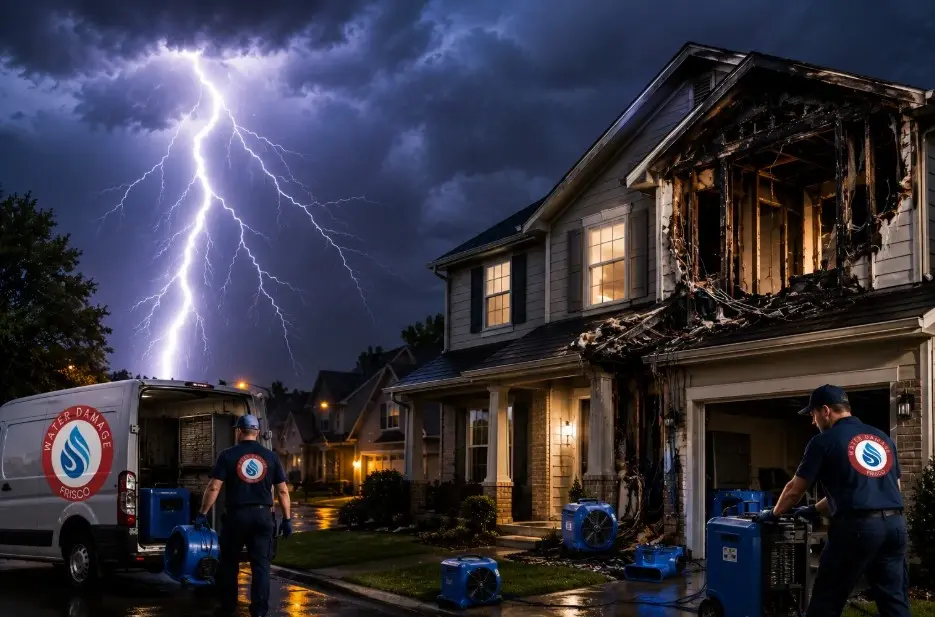
This isn’t a generic weather warning. In September 2020, lightning strikes on Frisco’s west side started house fires at two separate homes during the same storm — one on Possum Kingdom Drive, another on Chestnut, with a third home on Rainbow Falls Drive hit separately that same season. Frisco’s own fire marshal noted the city had studied the pattern and couldn’t pin down why that part of the city saw such a concentration of lightning-related fires. Whatever the exact cause, the pattern is real, documented, and worth understanding if you live in North Texas, where summer thunderstorms are a near-weekly occurrence — and where storm activity across the DFW metroplex regularly brings both flooding and lightning risk in the same system.
Our other guide on common electrical fire causes covers wiring, outlets, and appliance-related fires — the causes that don’t need a storm to happen. This one is specifically about lightning, which behaves differently and catches a lot of homeowners off guard because the strike itself is often nowhere near where the fire actually starts.
Not sure if a recent strike caused hidden damage? Our team can check.
Call (945) 297-3238 NowYour House Doesn’t Have to Be Hit Directly
This is the part that surprises people: a direct strike on your roof isn’t the only way lightning starts a house fire. According to the U.S. Fire Administration’s lightning fire data, an estimated 17,400 fires are attributed to lightning every year nationwide, and 41% of those occur inside structures rather than outdoors. Indirect strikes — lightning that hits a nearby tree, a power line, or the ground some distance away — are far more likely to cause property damage than a direct hit, because the resulting electrical surge travels back to your home through power lines, phone lines, plumbing, or even grounded metal components like gutters and window frames.
Once that surge enters your home’s wiring, it generates intense heat as it races through, which can melt wire insulation and ignite the materials around it — inside a wall cavity or attic space where nobody sees it happening until it’s already spread. This is part of why lightning-caused fires often aren’t obvious right away: the ignition point can be entirely hidden inside a wall or attic, not at any point you’d associate with “getting struck.”
Why the Fire Sometimes Shows Up Somewhere Unexpected
Metal building components — gutters, plumbing, structural elements — conduct both electricity and heat efficiently. That means a surge entering at one point in a home’s electrical or metal infrastructure can produce heat and ignition risk somewhere else entirely, not just at the point of contact. This is why a lightning-related fire can start in an attic even when nothing outside shows visible strike damage, and it’s part of why fire investigators don’t always find an obvious point of origin right at the roofline.
What to Do If Lightning Strikes Near Your Home
The National Weather Service’s guidance is built around a simple rule during the storm itself: when thunder roars, go indoors, and stay away from corded electronics, plumbing, and anything connected to your home’s electrical or water systems until 30 minutes after the last thunder. The CDC’s lightning safety guidance adds that this includes avoiding showers, dishwashing, and any contact with plumbing during a storm, since lightning can travel through a building’s pipes as easily as its wiring. That’s not just personal safety — it’s also a reasonable precaution against a surge reaching you through wiring or plumbing during the strike itself.
After a nearby strike, whether or not you saw or heard anything unusual:
- Call the fire department even without visible flames or smoke. Lightning-caused fires can smolder inside a wall or attic for a while before becoming visible, and a quick check costs you nothing.
- Schedule an electrical inspection, even if nothing looks wrong. A qualified electrician can check for wiring damage that a surge may have caused without an obvious visible sign.
- Watch for a burning smell, warm spots on walls or ceilings, or flickering power in the hours and days after a nearby strike — these are signs of hidden damage that didn’t immediately show itself.
- Consider a whole-house surge protector if you don’t already have one. FEMA’s Ready.gov specifically recommends surge protectors and lightning protection systems as a way to reduce home and appliance damage from strikes — it won’t stop a direct strike, but it meaningfully reduces damage from the far more common indirect surge.
Why Restoration After a Lightning Fire Is Different
A lightning-ignited fire often starts inside a wall cavity or attic space rather than in an open room, which changes what the restoration process actually needs to address. Structural materials can be damaged well beyond the visible burn area, since the fire may have been spreading inside a cavity before it became visible from either side. Electrical systems need a full inspection — not just repair of the obviously damaged section — since a surge that caused one visible failure point may have stressed wiring elsewhere in the same circuit. And because these fires are frequently caught later than a fire that starts in an open, visible space, smoke and soot often have more time to spread through the property before anyone notices, which is where our guide on smoke and soot damage cleanup becomes relevant even in homes with no visible burn damage.
Our fire damage restoration team treats attic and wall-cavity fires as their own category for exactly this reason — the visible damage is rarely the full extent of it. For commercial properties, the stakes are higher still since a hidden attic or roof-cavity fire can shut down operations before anyone smells smoke; our commercial fire damage restoration team handles that inspection-first approach for businesses. If soot or smoke odor is lingering after cleanup, our guide on lingering odors after fire or water damage covers why that can happen even once surfaces look clean. And if you’re working through the claims side, our fire damage insurance claim guide walks through documentation and the claims process step by step.
Frequently Asked Questions
Even without visible fire, a nearby strike is worth a follow-up check — hidden wiring damage doesn’t always announce itself right away. If you’re noticing warning signs or already dealing with fire damage, our IICRC-certified team responds across Frisco and the DFW metroplex in as little as 60 minutes.
Call (945) 297-3238
Need help right now? See our full guide to water damage restoration in Frisco, TX for emergency response, services, and coverage across the city.