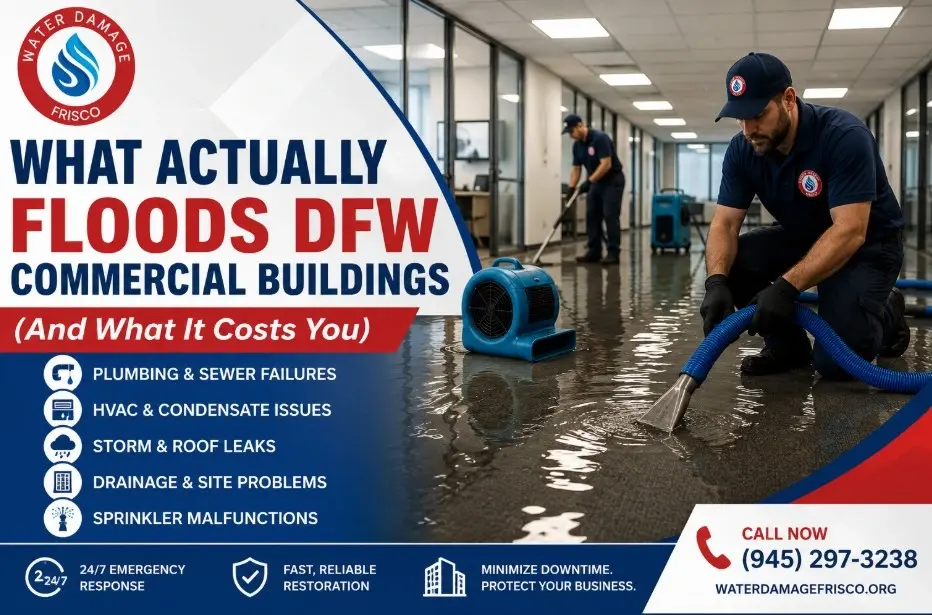
Plumbing, HVAC, drainage, and roofing — the real causes of commercial flood damage in Frisco and DFW, plus what downtime actually costs a business.
Call (945) 297-3238The Real Cost of Commercial Flooding Isn’t the Water — It’s the Downtime
Most articles about commercial flood damage causes in DFW list the same causes: broken pipes, storms, bad drainage. That’s accurate, but it skips the number that actually matters to a business owner: what a day of closure costs versus what an hour of prevention costs. According to FEMA’s Ready Business program, roughly 40% of small businesses never reopen after a disaster, and another 25% close within a year even if they do reopen — and businesses without a continuity plan fail at a rate of 75% after a major disruption. Flooding rarely closes a business permanently on its own. Not being prepared for it does.
This guide covers where commercial flooding actually starts in DFW office buildings, retail centers, restaurants, and warehouses, and — more importantly — what each cause typically costs in downtime, not just in repairs.
Where Commercial Flooding Actually Starts
Plumbing and Sewer Line Failures
Commercial buildings run more plumbing per square foot than a house — restrooms on every floor, break rooms, kitchen lines in restaurant and medical spaces. More lines means more failure points. A burst supply line on an upper floor can drain into every unit below it before anyone notices, and in multi-tenant buildings, that often means damage spreads to businesses that had nothing to do with the failure.
Sewer backups carry an added layer of risk: contaminated water. Aging municipal lines, grease buildup from food-service tenants, and root intrusion are common contributors in older commercial corridors around DFW. Category 3 water — the classification for sewage-contaminated backups — usually means affected materials get removed rather than dried, which extends closure time significantly compared to a clean-water leak.
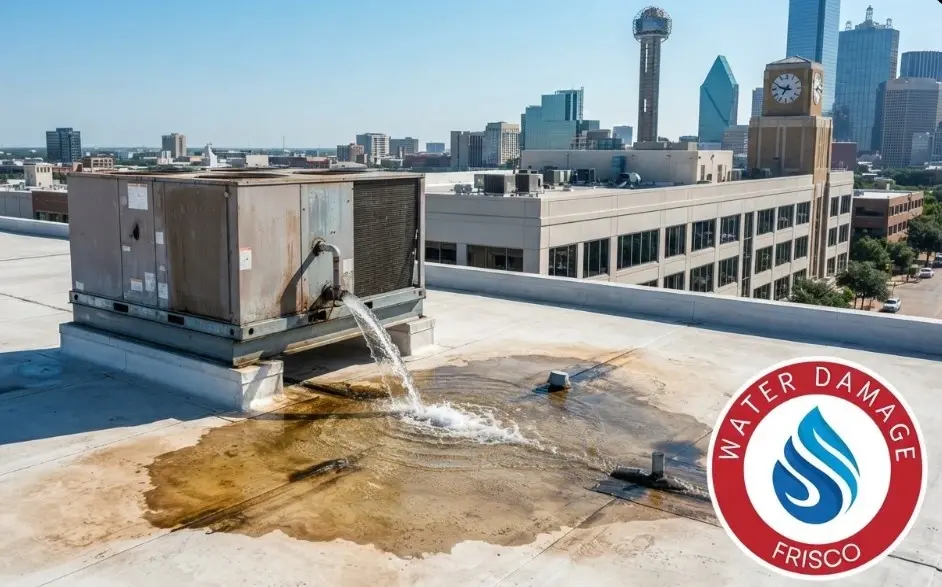
HVAC Condensate Lines and Water Heaters
This is the cause that catches the most businesses off guard, because it doesn’t look like flooding — it looks like a stain on a ceiling tile. Texas summers run commercial HVAC systems near-constantly, and a clogged condensate line backs up slowly, often above a drop ceiling where no one’s looking. By the time it’s visible, insulation and ceiling grid are already saturated. Commercial water heaters and boiler systems fail the same way in reverse: little warning, then a sudden release of a large volume of hot water.
Severe Weather and Roof Intrusion
North Texas storms move fast and drop a lot of rain in a short window. On commercial buildings, the more common failure point isn’t the walls — it’s the roof. Flat and low-slope commercial roofs, common on retail centers and warehouses, pool water during heavy rain, and any membrane weakness turns into a slow leak that can travel a long way from the actual breach before showing up on a ceiling tile below. Our storm damage restoration team sees this pattern often after fast-moving DFW thunderstorms.
Drainage and Site Grading Problems
Parking lots, loading docks, and large paved footprints shed water fast, and if site drainage wasn’t designed (or maintained) for that volume, water pools against the building instead of moving away from it. Clogged storm drains, undersized culverts, and grading that’s shifted over years of settling are common, quiet contributors — the kind of thing that doesn’t cause a problem until one storm exceeds the threshold.
Fire Sprinkler Malfunctions
Sprinkler systems are a safety requirement, not a flood risk — but a corroded head, a frozen pipe in an unheated storage area, or a maintenance error can trigger accidental discharge. When it happens, it’s typically fast and covers a wide area, since sprinkler systems are designed to move a large volume of water quickly by design.
Deferred Maintenance
The quiet cause behind most of the above: a leak that got noticed and not fixed, a roof inspection that got postponed a season, a drain that’s been “a little slow” for months. None of these show up as a line item until they become an emergency repair instead of a maintenance one — which is usually a five-to-ten times cost difference by the time it’s a flood instead of a work order.
What Downtime Actually Costs
Repair cost is only part of the number that matters. The bigger figure is revenue and rent obligations during closure — a retail space or restaurant not open, a medical office rescheduling patients, a warehouse that can’t ship. FEMA’s data on commercial flood claims puts the average commercial claim north of $85,000, and that figure doesn’t include lost income during the closure itself. This is the exact gap that business interruption coverage is meant to close, and it’s worth confirming with your insurance provider whether your policy includes it — standard commercial property coverage often doesn’t include it automatically. Our breakdown of water damage insurance claims in Texas covers what’s typically included and what isn’t.
Reducing the Risk Before It’s an Emergency
HVAC Condensate Lines
Schedule clearing as part of routine seasonal service, not as a response to a stain appearing.
Roof Inspections
Put them on a calendar, especially before and after severe weather season, particularly for flat or low-slope roofs.
Parking Lot & Loading Dock
Walk it after heavy rain to see where water actually pools — more reliable than a drainage plan on paper.
Sprinkler Service Records
Confirm they’re current, particularly in any unheated or seasonal storage areas.
Written Response Plan
So staff know who to call and what to shut off before an emergency, not during one. FEMA’s Ready Business toolkits are built for this and include a flooding-specific version.
If Flooding Has Already Started
Employee and tenant safety comes first — treat any standing water as a hazard until it’s been assessed, since electrical and contamination risks aren’t always visible. OSHA’s flood cleanup safety guidance is written for exactly this: general precautions for anyone assessing or beginning cleanup after a flood, and a reminder that specialized situations like utility restoration should be left to trained professionals.
Once people are safe, documentation is next. Photograph everything before anything is moved or discarded — that record is what makes an insurance and business-interruption claim move quickly instead of getting disputed.
Why Response Speed Changes the Outcome
A leak that’s dried within a day is a repair. The same leak left three days is a mold remediation project, a flooring replacement, and a longer closure — commercial buildings in North Texas summer humidity move through that timeline faster than almost anywhere else in the country. Fast water extraction and structural water mitigation are what keep a plumbing failure or storm leak from becoming a multi-week closure — see our breakdown of how long water mitigation actually takes for a realistic timeline.
Our team handles commercial disaster restoration, commercial water damage restoration, commercial mold remediation, and commercial fire damage restoration across Frisco and the DFW metroplex — including flood damage restoration for businesses in McKinney and Celina, with documentation that supports your insurance and business-interruption claim from day one. If ceiling tiles are already showing stains or a storm just came through, don’t wait for it to get worse — contact us and we’ll tell you honestly whether it’s a maintenance fix or something that needs a crew today.
Frequently Asked Questions
HVAC condensate line clogs. They build slowly above drop ceilings and often aren’t visible until insulation and ceiling grid are already saturated — by contrast, a burst pipe or storm leak is at least obvious right away.
It depends on the policy and the water source. Standard commercial property coverage often covers sudden internal failures like burst pipes but may exclude flood damage from external sources, and business interruption coverage — which pays for lost income during closure — is frequently a separate add-on rather than automatic. Review this with your insurance provider before it’s tested by an actual claim.
Within 24 to 48 hours to avoid mold risk, per EPA guidance — and faster than that in Texas summer humidity. The bigger driver of cost, though, is usually how long the business stays closed, which is a separate clock from the mold one.
The water itself is usually clean, but the volume and spread are typically larger and faster since sprinkler systems are designed to move water quickly across a wide area. Response speed still matters just as much to limit material damage.
Get Ahead of the Next Failure
Most commercial flooding traces back to something that was maintainable weeks or months earlier. A working prevention plan is far cheaper than a closure.
Call (945) 297-3238 — Fast Response & Documentation SupportRelated Reading